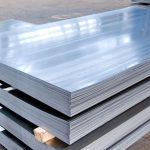
Steel plate dimensions are one of the first technical factors engineers, fabricators, procurement teams and project owners must define before ordering steel plate for construction, shipbuilding, pressure equipment, heavy machinery, storage tanks, bridges, ports, energy projects and industrial fabrication. A steel plate is not selected only by grade; it must also match the required thickness, width, length, flatness, cutting allowance, tolerance class, weight limit, handling capacity and applicable international standard. When dimensions are specified incorrectly, the result can be higher scrap loss, rework, welding distortion, installation delays, non-compliance with design drawings and unnecessary logistics cost.
In industrial steel supply, the term steel plate dimensions generally refers to three basic measurements: thickness, width and length. However, for real projects, dimensional control goes further. It includes thickness tolerance, width tolerance, length tolerance, edge condition, flatness, squareness, camber, surface condition and mass calculation. A 20 mm plate measuring 2,000 mm x 6,000 mm may look simple on paper, but its actual delivered weight is about 1,884 kg based on a steel density of 7,850 kg/m³. If a project uses hundreds or thousands of plates, even small dimensional differences can affect total tonnage, freight planning, lifting equipment and fabrication yield.
Steel plate dimensions describe the physical size of a steel plate, usually written in the order of thickness x width x length. In metric markets, the common unit is millimeter, for example 10 mm x 1,500 mm x 6,000 mm. In imperial markets, dimensions may be shown in inches and feet, such as 3/8 inch x 48 inch x 240 inch. Thickness is the most important value because it directly influences strength, stiffness, load-bearing capacity, weld design, bending behavior, cutting speed, heat input and total plate weight. Width and length determine cutting layout, nesting efficiency and whether the plate can be transported and handled safely.
For hot-rolled steel plate, common commercial thicknesses typically start from 3 mm and can exceed 100 mm for heavy plate applications. Many structural and fabrication projects use plate thicknesses from 6 mm to 50 mm because this range balances strength, availability, weldability and processing cost. Heavy engineering sectors such as offshore structures, pressure vessels, mining equipment and bridge fabrication may require plates from 60 mm to 200 mm or above, depending on grade, mill capability and testing requirements. Standard widths often range from 1,000 mm to 3,000 mm, while plate lengths commonly range from 2,000 mm to 12,000 mm. Wider and longer plates are possible, but they normally require mill planning, special handling and project-based procurement.
The most practical format is: steel grade, standard, thickness, width, length, quantity, edge condition and testing requirement. A complete example is: ASTM A36 steel plate, 12 mm x 1,500 mm x 6,000 mm, mill edge, shot-blasted and primed, ultrasonic testing if required. This format reduces ambiguity between buyer, supplier, mill, warehouse and fabricator. If only “12 mm plate” is stated, the order is incomplete because a supplier cannot determine width, length, allowable tolerance, total tonnage or whether standard stock sizes can be used.
For engineered projects, the plate dimension should also match the cutting plan. For instance, when fabricating rectangular parts of 750 mm x 1,200 mm, a 1,500 mm x 6,000 mm parent plate may provide efficient nesting with limited scrap. For long girder webs, tank shells or ship panels, longer plates such as 2,000 mm x 12,000 mm can reduce butt welds and improve production efficiency. Therefore, steel plate dimensions should be selected not only from available stock but also from the final fabrication geometry.
Commercial steel plate sizes vary by country, mill route and product category, but several dimensions are widely used in global trade. For general structural steel plate, common stock sizes include 1,220 mm x 2,440 mm, 1,500 mm x 3,000 mm, 1,500 mm x 6,000 mm, 2,000 mm x 6,000 mm, 2,000 mm x 12,000 mm and 2,500 mm x 12,000 mm. The 1,500 mm x 6,000 mm format is especially common because it is easy to transport, store, cut and handle in standard fabrication workshops. For heavy industry, 2,000 mm and 2,500 mm widths are often preferred because they reduce welding joints and improve material utilization.
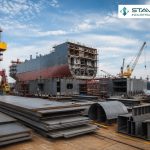
In shipbuilding, offshore fabrication and bridge construction, larger plates are often preferred when workshop equipment allows. Plates such as 2,000 mm x 12,000 mm, 2,500 mm x 12,000 mm and 3,000 mm x 12,000 mm can reduce splice welds, shorten assembly time and improve structural continuity. However, larger dimensions also increase single-piece weight. A 25 mm plate measuring 2,500 mm x 12,000 mm weighs approximately 5,887.5 kg. This means procurement teams must check crane capacity, forklift rating, storage rack load, truck payload, container limitation and unloading method before confirming the order.
| Common Plate Size | Typical Use | Estimated Weight at 10 mm Thickness |
|---|---|---|
| 1,220 mm x 2,440 mm | Small fabrication, base plates, machine guards | About 234 kg |
| 1,500 mm x 3,000 mm | General workshop cutting and medium components | About 353 kg |
| 1,500 mm x 6,000 mm | Structural fabrication, tanks, platforms | About 707 kg |
| 2,000 mm x 6,000 mm | Industrial structures, equipment frames | About 942 kg |
| 2,000 mm x 12,000 mm | Shipbuilding, bridges, large panels | About 1,884 kg |
| 2,500 mm x 12,000 mm | Heavy fabrication, offshore, large shells | About 2,355 kg |
Steel plate thickness is normally selected according to structural design, loading condition, corrosion allowance, fabrication process and applicable code. Common hot-rolled plate thicknesses include 3 mm, 4 mm, 5 mm, 6 mm, 8 mm, 10 mm, 12 mm, 15 mm, 16 mm, 18 mm, 20 mm, 22 mm, 25 mm, 30 mm, 32 mm, 36 mm, 40 mm, 45 mm and 50 mm. Heavy plate thicknesses may continue to 60 mm, 70 mm, 80 mm, 100 mm, 120 mm, 150 mm, 200 mm and above, subject to mill capability and grade availability.
Thin plates from 3 mm to 6 mm are common for light fabrication, ducting, covers, tanks and secondary structures. Medium plates from 8 mm to 25 mm are widely used in construction, machinery frames, ship components, platforms, stiffeners and welded structures. Heavy plates from 30 mm to 100 mm are used for bridge girders, pressure parts, heavy equipment, offshore nodes, base plates and load-bearing members. Ultra-heavy plates above 100 mm require closer attention to through-thickness properties, internal soundness, ultrasonic testing, weld procedure qualification and heat treatment.
Weight calculation is essential when working with steel plate dimensions because every plate size directly affects cost, logistics and fabrication planning. The standard formula for carbon steel plate weight is: thickness in mm x width in mm x length in mm x 7.85 ÷ 1,000,000,000 = weight in metric tons. The same formula can be expressed in kilograms as: thickness in mm x width in mm x length in mm x 7.85 ÷ 1,000,000 = weight in kg. The value 7.85 represents the approximate density of carbon steel in g/cm³, equivalent to 7,850 kg/m³.
For example, a 20 mm x 2,000 mm x 6,000 mm plate weighs 20 x 2,000 x 6,000 x 7.85 ÷ 1,000,000 = 1,884 kg. A 12 mm x 1,500 mm x 6,000 mm plate weighs 12 x 1,500 x 6,000 x 7.85 ÷ 1,000,000 = 847.8 kg. A 50 mm x 2,500 mm x 12,000 mm plate weighs 50 x 2,500 x 12,000 x 7.85 ÷ 1,000,000 = 11,775 kg. These calculations are theoretical weights. Actual delivered weight may vary slightly due to rolling tolerance, surface scale, edge trimming and mill weighing method.
For procurement and estimation, it is useful to remember that one square meter of steel plate weighs about 7.85 kg per millimeter of thickness. This means a 6 mm plate weighs about 47.1 kg/m², a 10 mm plate weighs about 78.5 kg/m², a 20 mm plate weighs about 157 kg/m², and a 50 mm plate weighs about 392.5 kg/m². This quick reference helps engineers estimate total tonnage before final cutting lists are completed.
Industrial steel plate dimensions are controlled by recognized standards so that buyers and suppliers can agree on measurable requirements. The most common references include ASTM A6/A6M for rolled structural steel plates, shapes, sheet piling and bars; EN 10029 for hot-rolled steel plates 3 mm thick and above; JIS G 3193 for hot-rolled steel plates, sheets and strips; and relevant product standards such as ASTM A36, ASTM A572, ASTM A516, EN 10025, EN 10028, JIS G3101, JIS G3106 and shipbuilding classification standards. These standards do not only define mechanical properties; they also affect dimensional tolerances, testing, marking and delivery conditions.
EN 10029 is widely used for hot-rolled plate with nominal thickness from 3 mm to 400 mm and nominal width of 600 mm or greater. ASTM A6/A6M is widely referenced in structural steel supply and includes general requirements for rolled structural plates. JIS G 3193 is commonly used in Asian supply chains for hot-rolled plate, sheet and strip. In practice, the dimensional standard must be aligned with the material grade. For example, ordering S355JR plate under EN 10025 normally involves EN dimensional practices, while ordering ASTM A36 or A572 plate normally involves ASTM dimensional references.
ASTM practice is frequently used in North America, the Middle East, Southeast Asia and international projects using American specifications. ASTM A6/A6M provides general requirements including permissible variations for dimensions, mass, flatness and other delivery conditions for structural plates. EN practice is common in European-designed projects and is widely used in infrastructure, offshore, machinery and construction. EN 10029 classifies tolerances by thickness, width, length and flatness, with different tolerance classes depending on project requirements.
JIS practice is common in Japan, Korea, Vietnam, Thailand and many Asian industrial supply chains. JIS G 3193 includes standard dimensional values and permissible variations for hot-rolled plate, sheet and strip. When a project involves multiple design codes, it is important not to mix standards casually. A plate ordered by ASTM grade with EN tolerance requirements may be possible, but it must be clearly agreed before production or purchase. Otherwise, disputes may occur during receiving inspection because each standard uses different tolerance logic and measurement positions.
Nominal thickness is the ordered thickness, but the actual measured thickness may vary within the tolerance permitted by the applicable standard. This is normal in hot rolling because plate thickness is influenced by rolling force, temperature, plate width, mill control, cooling behavior and leveling process. For many steel plate standards, the plate must not fall below the minimum permitted value, while over-thickness may be allowed within a defined range. In some ASTM plate orders, the permissible under-tolerance for plates ordered to thickness is commonly 0.01 inch, equivalent to approximately 0.25 mm, while over-tolerance depends on thickness and width range.
Thickness tolerance has direct cost and engineering implications. If a plate is slightly thicker than nominal, the buyer receives more steel weight, but cutting, bending and welding may require more energy. If a plate is too thin, structural capacity, corrosion allowance and code compliance may be affected. This is especially critical in pressure vessels, bridge structures, lifting equipment and marine structures. For this reason, inspection teams usually measure plate thickness away from sheared or flame-cut edges, following the measurement positions defined by the relevant standard.
When purchasing by theoretical weight, dimensional tolerance can influence the actual tonnage received versus the tonnage calculated from nominal dimensions. When purchasing by actual weight, the invoice usually reflects the weighed mass. For high-volume projects, even a 1% weight difference can be financially significant. For example, on a 2,000-ton steel plate package, 1% equals 20 tons. At industrial steel prices, this can represent a meaningful procurement variance. Therefore, the purchase contract should state whether payment is based on theoretical weight, actual weight, mill scale weight or final processed weight.
Fabricators should also consider tolerance when designing slots, bolt holes, machined surfaces and formed components. A 10 mm nominal plate may not behave exactly the same as a perfectly machined 10.00 mm plate. For most structural fabrication, standard tolerance is acceptable. For precision machine bases, press components, molds or equipment requiring tight fit-up, additional machining allowance or closer tolerance plate may be necessary. The key is to define the required tolerance before ordering, not after receiving material.
Width and length tolerances are important because they influence cutting yield, fit-up and fabrication sequence. A plate may be delivered with mill edges, sheared edges, gas-cut edges or trimmed edges. Mill edge plates are produced directly from rolling and may have less precise edge geometry. Trimmed or cut-edge plates provide better dimensional control and are preferred when the plate will be used as a near-net-size component. For laser cutting, CNC plasma cutting and robotic welding lines, consistent width and length improve nesting and reduce setup variation.
Flatness is another critical factor in steel plate dimensions. A plate can meet thickness, width and length requirements but still be difficult to fabricate if it has excessive waviness or bowing. Poor flatness can reduce cutting accuracy, create uneven gaps during welding and cause distortion during assembly. Heavy plates may require leveling after rolling, while thin plates may show more visible wave due to residual stress. Flatness requirements should be selected based on the final use: standard structural work may accept normal flatness, while precision fabrication, automated cutting and large welded panels may require tighter flatness control.
Mill edge plate is generally suitable when the plate will be further cut during fabrication and edge precision is not critical at the purchase stage. It can be more economical because it avoids additional trimming. However, the buyer should allow sufficient edge scrap in the cutting plan. Cut edge plate is more suitable when the ordered width and length are close to the final component size or when the edge will become part of a welded joint, exposed surface or machined assembly.
For industrial projects, edge selection should be based on fabrication sequence. If the plate will be CNC cut into multiple parts, mill edge may be acceptable. If the plate will be used directly as a base plate, cover plate, diaphragm or structural panel, cut edge may reduce preparation time. For thick plates, flame-cut edges may require grinding or machining depending on hardness, heat-affected zone and welding requirement.
Different industries require different plate dimensions because each application has its own loading condition, fabrication method and regulatory requirement. Construction projects often use carbon structural steel plate in thicknesses from 6 mm to 40 mm for base plates, gusset plates, stiffeners, splice plates, connection plates and built-up sections. Shipbuilding projects commonly use large-format plates to reduce weld seams in hull panels, decks and bulkheads. Pressure vessel projects may require medium to heavy plate with strict control of thickness, chemical composition, impact toughness and ultrasonic soundness.
Heavy machinery manufacturers often prefer plate dimensions that match cutting tables and component geometry. Mining buckets, crushers, excavator parts, trailers, cranes and agricultural machinery may use abrasion-resistant or high-strength plates from 8 mm to 80 mm. Storage tanks often use plate lengths that match shell course development, reducing vertical welds and improving erection efficiency. Bridge and offshore projects may require wide and long plates with tight flatness and high toughness, especially for fatigue-sensitive welded structures.
In construction, plate dimensions are often selected for connection design and ease of fabrication. Common sizes include 6 mm to 25 mm thickness for secondary components and 30 mm to 80 mm for base plates, bearing plates and heavy connection zones. Widths of 1,500 mm and 2,000 mm are practical for most fabrication shops. Lengths of 6,000 mm and 12,000 mm are widely used depending on cutting layout and transport method.
For large structural steel packages, plate standardization can reduce procurement complexity. Instead of using many different plate thicknesses, designers may rationalize thickness groups where possible. For example, using 10 mm, 12 mm, 16 mm, 20 mm and 25 mm across multiple connection types can improve availability and reduce leftover inventory. However, rationalization must not compromise structural safety or code compliance.
Shipbuilding steel plate is usually ordered in larger dimensions to improve panel production efficiency. Plates such as 2,000 mm x 6,000 mm, 2,000 mm x 12,000 mm, 2,500 mm x 12,000 mm and 3,000 mm x 12,000 mm are common in marine fabrication when available. Thickness can range from 5 mm to more than 50 mm depending on vessel type, hull area, deck loading and classification requirement.
Marine plate selection must consider not only size but also grade and certification. Grades such as A, B, D, E and higher-strength variants may be required under classification society rules. Low-temperature toughness, weldability and traceability are especially important. Dimensional accuracy supports automated panel lines, while good flatness helps reduce rework during block assembly.
Pressure vessel plate dimensions are strongly influenced by vessel diameter, shell course width, forming capacity and design code. Thicknesses may range from 6 mm to more than 100 mm depending on pressure, temperature, corrosion allowance and material grade. Plates are often selected to minimize weld seams while staying within rolling, forming and heat-treatment limits.
For pressure applications, dimensional selection must work together with material standards such as ASTM A516, ASTM A537, EN 10028 or equivalent specifications. The buyer may also require normalized delivery, impact testing, ultrasonic testing and through-thickness properties. In this sector, a plate dimension is not just a commercial size; it is part of pressure integrity and code compliance.
Stavian Industrial Metal is an industrial metal materials trading company established on June 18, 2021, with the orientation of building a transparent, sustainable and globally connected industrial metal market. Stavian Industrial Metal operates within the Stavian Group ecosystem and leverages a broad domestic distribution network, international partnerships across more than 100 countries and territories, and office and warehouse systems in major Vietnamese industrial centers such as Hanoi, Hai Phong and Ho Chi Minh City. For buyers looking for dependable steel plate supply, Stavian Industrial Metal focuses on comprehensive trading solutions, quality commitment and material supply for major domestic and international industries.
For the topic of steel plate dimensions, suitable products from Stavian Industrial Metal include hot-rolled steel plate, construction steel plate and shipbuilding steel plate. Hot-rolled steel plate is appropriate for general fabrication, machinery, tanks, platforms and welded structures. Construction steel plate is suitable for base plates, connection plates, stiffeners, bridge components and industrial buildings. Shipbuilding steel plate is suitable for marine structures, hull fabrication, decks and offshore-related applications where dimensional consistency, grade traceability and certification are important. Stavian Industrial Metal can support customers in matching steel plate size with grade, standard, quantity, logistics and project schedule.
Industrial buyers often know the required steel grade but may need technical support to optimize plate dimensions. For example, selecting 2,000 mm x 12,000 mm instead of 1,500 mm x 6,000 mm may reduce weld joints, but it also increases plate weight and handling requirements. Selecting 10 mm instead of 8 mm may improve stiffness but increase total mass by 25%. Selecting cut edge instead of mill edge may improve dimensional control but affect cost and lead time. These decisions require both material knowledge and supply chain experience.
Stavian Industrial Metal is positioned to support this decision-making process by aligning product availability with industrial requirements. For project-based orders, Stavian Industrial Metal can help evaluate steel plate dimensions based on standard stock, mill production, processing plan, international specification and delivery condition. This is valuable for contractors, EPC companies, fabricators, shipyards and manufacturers that need both reliable steel supply and practical dimensional guidance.
Dimension calculations help convert engineering requirements into procurement quantities. Suppose a fabricator needs 100 plates of 12 mm x 1,500 mm x 6,000 mm. The weight of one plate is 847.8 kg, so the total theoretical weight is 84,780 kg, or 84.78 metric tons. If the project requires 20 mm x 2,000 mm x 12,000 mm plate, each plate weighs about 3,768 kg. A package of 50 plates would weigh about 188.4 metric tons. These figures are essential for budgeting, warehouse planning, truck allocation and project cash flow.
For cutting optimization, assume the final component is 500 mm x 1,000 mm. A 1,500 mm x 6,000 mm plate can theoretically fit 18 pieces before considering kerf, edge trimming and nesting clearance. If the cutting process requires a 5 mm kerf and edge allowance, the actual yield may be lower. Therefore, procurement teams should not calculate only by gross area. They should include cutting loss, edge scrap, test coupons, repair allowance and possible re-cutting requirements. In heavy fabrication, a practical scrap allowance of 3% to 8% is often used depending on complexity, although the final value must be based on the actual nesting plan.
| Calculation | Formula | Example |
|---|---|---|
| Plate area | Width x Length | 2,000 mm x 6,000 mm = 12 m² |
| Weight per square meter | Thickness x 7.85 | 20 mm x 7.85 = 157 kg/m² |
| Single plate weight | Thickness x Width x Length x 7.85 ÷ 1,000,000 | 20 x 2,000 x 6,000 x 7.85 ÷ 1,000,000 = 1,884 kg |
| Total order weight | Single plate weight x Quantity | 1,884 kg x 20 plates = 37,680 kg |
For general fabrication, use commonly available plate dimensions whenever possible because standard sizes usually provide better lead time and more competitive cost. Sizes such as 1,500 mm x 6,000 mm and 2,000 mm x 6,000 mm are practical for many workshops. For large welded structures, evaluate 2,000 mm x 12,000 mm or 2,500 mm x 12,000 mm to reduce weld seams. For precision or project-specific work, define dimensional tolerance, flatness and edge condition clearly. Do not rely on verbal descriptions such as “standard plate” or “normal size” because these terms can vary by market.
For heavy plate, always check the single-piece weight before confirming the order. A plate may be available from the mill, but the workshop may not be able to unload, lift, turn or process it safely. For export projects, confirm container loading, breakbulk requirement, lashing method, port handling and inland transport restrictions. A technically correct plate dimension can still create logistical problems if it exceeds practical handling limits. The most efficient steel plate purchase is one that satisfies design, standard compliance, fabrication yield and delivery feasibility.
A strong purchase specification should read clearly: “Hot-rolled carbon steel plate, ASTM A36 or equivalent, 20 mm x 2,000 mm x 6,000 mm, cut edge, supplied with mill test certificate, tolerance according to applicable standard, surface free from harmful defects, quantity 100 plates, theoretical weight approximately 188.4 metric tons.” This level of detail allows the supplier to quote accurately and helps the buyer compare offers on the same basis.
For more demanding applications, the specification may add ultrasonic testing, impact testing, normalized condition, shot blasting and primer, special flatness tolerance or classification society approval. These requirements must be stated from the beginning because they can affect price, availability and lead time. In industrial steel procurement, dimensional clarity is not paperwork; it is a risk-control measure.
Steel plate dimensions are fundamental to steel selection, cost estimation, fabrication efficiency and project quality. The basic values are thickness, width and length, but real industrial procurement must also consider tolerance, flatness, edge condition, theoretical weight, handling capacity, cutting yield and applicable standards. Common plate sizes such as 1,500 mm x 6,000 mm, 2,000 mm x 6,000 mm and 2,000 mm x 12,000 mm remain widely used because they balance availability, processing efficiency and logistics practicality. Thickness selection should be based on engineering design, while width and length should be optimized for fabrication layout and transport feasibility.
For buyers, the most important rule is to specify plate dimensions completely and technically. A good steel plate order should include grade, standard, thickness, width, length, quantity, edge condition, tolerance, testing and certification. Stavian Industrial Metal can support industrial customers with suitable products such as hot-rolled steel plate, construction steel plate and shipbuilding steel plate, helping align steel plate dimensions with project specifications, supply conditions and practical fabrication requirements. When dimensions are selected correctly, steel plate procurement becomes more predictable, fabrication becomes more efficient and the final structure performs as designed.
Read more
Address
Website: https://stavianmetal.com
Email: info@stavianmetal.com