10mm steel plate is one of the most widely used medium-thickness steel plate products in construction, machinery manufacturing, shipbuilding, tank fabrication, structural components, and general industrial engineering. With a practical balance between strength, weldability, formability, availability, and cost efficiency, this plate thickness is frequently selected when buyers need a material that is stronger than thin sheet steel but still easier to cut, bend, drill, and weld than heavy plate.
For importers and project buyers, choosing the right 10mm Steel Plate is not only about thickness. It also involves steel grade, production standard, dimensional tolerance, surface condition, mill origin, inspection documents, packing method, delivery schedule, and export compliance. In international steel trading, small differences in grade or tolerance can affect fabrication performance, project safety, and total landed cost. Stavian Industrial Metal approaches steel plate supply with this practical export mindset, helping buyers source suitable plate materials for demanding industrial applications.
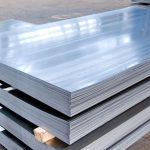
10mm Steel Plate refers to a flat steel product with a nominal thickness of 10 millimeters. It is commonly produced by hot rolling and supplied in standard or customized sizes depending on the mill, grade, and project requirements. In many markets, 10mm is considered a medium plate thickness, suitable for load-bearing structures, equipment parts, base plates, brackets, frames, platforms, tanks, containers, and fabricated assemblies.
The plate may be made from carbon steel, mild steel, low-alloy steel, high-strength structural steel, shipbuilding steel, boiler and pressure vessel steel, or wear-resistant steel. Among these, carbon and mild steel grades are the most common for general fabrication because they offer good weldability, machinability, and price competitiveness. For more demanding applications, buyers may specify higher yield strength, impact toughness, corrosion resistance, or certification to international standards.
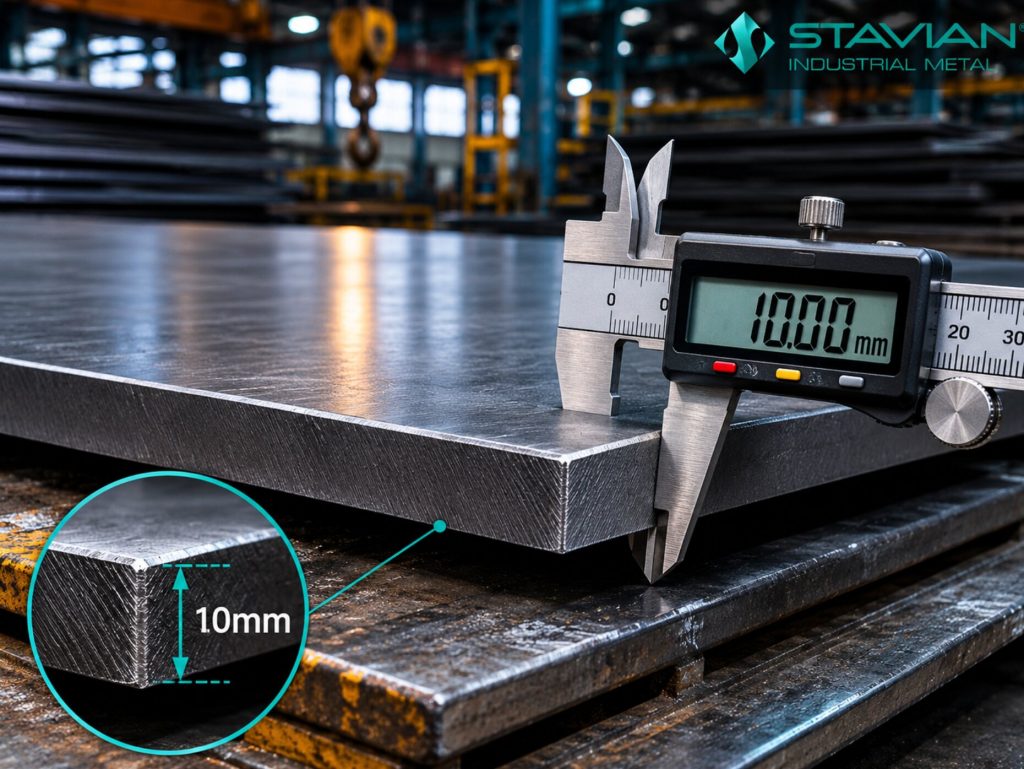
The popularity of 10mm Steel Plate comes from its balanced performance. It is thick enough to provide meaningful structural strength but not so thick that fabrication becomes slow or expensive. For many workshops, 10mm plate can be processed using common plasma cutting, laser cutting, oxy-fuel cutting, drilling, rolling, and welding systems. This makes it highly flexible for both mass production and project-based fabrication.
In export trade, 10mm plate is also attractive because it is commonly available across major steel-producing regions. Buyers can source it in standard commercial grades as well as certified project grades. This availability helps reduce procurement risk, especially when projects require stable supply, repeated shipments, or mixed thickness orders.
The right grade of 10mm steel plate depends on the end-use application. General structural fabrication often uses grades such as ASTM A36, SS400, S235JR, S275JR, S355JR, Q235, or Q345. These grades are commonly used for frames, platforms, machinery bases, support brackets, and construction components. They provide practical strength and weldability for everyday industrial use.
For higher-performance applications, buyers may require grades such as ASTM A572, S355J2, S420, S460, AH36 shipbuilding plate, pressure vessel grades, or wear-resistant grades. These options may offer improved yield strength, low-temperature impact toughness, or better resistance to abrasion. Export buyers should always match the grade to the project drawing, design code, and operating environment rather than selecting based only on price.
10mm steel plate is available in a wide range of dimensions. Common sizes include 1500mm x 6000mm, 2000mm x 6000mm, 2000mm x 12000mm, 2400mm x 12000mm, and other mill-standard formats. Some mills can also provide customized cutting sizes depending on minimum order quantity, production schedule, and tolerance requirements.
For export shipments, size selection affects container loading, freight cost, handling safety, and warehouse efficiency. Plates longer than standard container length may require breakbulk shipment or special logistics planning. Buyers should confirm plate width, length, bundle weight, loading method, and discharge equipment before finalizing the order.
The theoretical weight of carbon steel is normally calculated using a density of 7,850 kg/m³. For 10mm steel plate, the theoretical weight is approximately 78.5 kg per square meter. This figure is essential for estimating order weight, freight cost, lifting requirements, cutting yield, and project budgeting.
| Plate Size | Thickness | Approximate Weight |
|---|---|---|
| 1000mm x 2000mm | 10mm | 157 kg per plate |
| 1500mm x 6000mm | 10mm | 706.5 kg per plate |
| 2000mm x 6000mm | 10mm | 942 kg per plate |
| 2000mm x 12000mm | 10mm | 1,884 kg per plate |
Actual weight may vary slightly because of rolling tolerance. For commercial transactions, buyers should confirm whether the order is sold by theoretical weight or actual weight. This point is important because tolerance differences can affect final invoice weight and landed cost.
10mm steel plate is widely used in construction-related fabrication, especially for base plates, connection plates, gusset plates, embedded plates, stair components, platforms, and support structures. Its thickness offers enough rigidity for many medium-duty structural elements while remaining workable for cutting and drilling.
In infrastructure and building projects, 10mm plate is often selected when engineers need a durable flat component that can transfer load, reinforce joints, or provide a stable mounting surface. Because many structural grades are weldable, the plate can be integrated into beams, columns, frames, and fabricated steel assemblies with predictable performance.
Machinery manufacturers frequently use 10mm steel plate for machine frames, guards, covers, brackets, housings, mounting panels, conveyor parts, agricultural equipment, mining equipment, and industrial support systems. The plate can be machined and welded into customized parts without excessive material waste.
For equipment manufacturers, flatness and dimensional consistency are important. Poor-quality plate may cause alignment problems, welding distortion, or additional machining costs. Therefore, buyers should specify tolerance, surface quality, and testing requirements clearly when ordering 10mm plate for precision equipment fabrication.
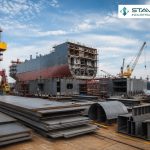
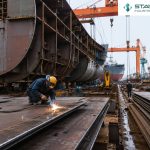
In shipbuilding and marine fabrication, 10mm steel plate may be used for decks, bulkheads, internal structures, small vessel components, workboats, barges, pontoons, and offshore support structures. Marine applications usually require certified grades and classification society approval, depending on the vessel type and project specification.
Marine environments expose steel to moisture, salt, impact, and vibration. As a result, buyers should pay close attention to grade selection, impact testing, surface preparation, coating compatibility, and traceability. For export projects, mill test certificates and third-party inspection documents can be critical for acceptance by shipyards and project owners.
10mm steel plate is also used in tanks, bins, silos, containers, ducts, hoppers, and process equipment. It provides a strong wall or base material for structures that must hold solids, liquids, or mechanical loads. In non-pressure applications, mild steel plate is often sufficient. In pressure or temperature-sensitive applications, specific boiler or pressure vessel grades may be required.
Fabricators working with tanks and containers often evaluate weldability, rolling performance, and surface condition. A consistent plate thickness helps maintain welding quality and structural integrity. For coated or painted tanks, buyers should also consider surface cleanliness and compatibility with blasting, priming, and painting systems.
One of the main advantages of 10mm steel plate is its strong cost-performance ratio. Compared with thinner plates, it offers better rigidity and load-bearing capacity. Compared with heavier plates, it is usually easier to process, transport, and install. This makes it a practical material for projects that require strength but must still control fabrication cost.
In global steel procurement, cost efficiency is not measured only by the price per metric ton. Buyers should also calculate cutting yield, rejection rate, welding productivity, coating performance, delivery reliability, and inspection cost. A lower-priced plate that causes fabrication delays may become more expensive than a better-controlled material from a reliable supplier.
Many grades of 10mm steel plate, especially mild steel and structural carbon steel, offer good weldability using common welding methods such as SMAW, GMAW, FCAW, and SAW. For standard grades, preheating may not be required in many normal conditions, although welding procedures should always follow the project code and material specification.
Weldability depends on chemical composition, carbon equivalent, plate thickness, joint design, filler metal, heat input, and cooling rate. When ordering steel plate for welded structures, buyers should review the mill test certificate and confirm that the chemical and mechanical properties match the fabrication requirements.
10mm steel plate can be processed by laser cutting, plasma cutting, oxy-fuel cutting, waterjet cutting, shearing, drilling, punching, bending, rolling, milling, and welding. This processing flexibility makes it suitable for both simple and complex industrial components.
For high-volume production, laser or plasma cutting can improve accuracy and reduce secondary finishing. For heavy-duty fabrication, oxy-fuel cutting remains common due to its practicality and lower equipment cost. The best processing method depends on edge quality requirements, production speed, heat-affected zone control, and downstream welding or machining needs.
The most important step in choosing 10mm steel plate is understanding the final application. A plate used for a simple bracket does not require the same specification as a plate used in a bridge, ship, pressure equipment, or mining machine. Buyers should clarify load conditions, environmental exposure, welding requirements, coating system, and inspection criteria before requesting a quotation.
When the application is structural, yield strength and impact toughness may be key factors. When the plate is used for machinery, flatness and machinability may be more important. When it is used outdoors or near the sea, corrosion protection and coating preparation become critical. A clear technical requirement helps prevent under-specification and over-specification.
Export buyers often source 10mm steel plate according to international standards such as ASTM, EN, JIS, GB, ABS, LR, DNV, or other project-specific specifications. These standards define chemical composition, mechanical properties, testing methods, tolerance, delivery condition, and inspection documentation.
Using recognized standards makes communication easier between buyers, suppliers, fabricators, inspectors, and end users. However, equivalent grades are not always identical. For example, a commercial structural grade from one standard may have different chemical limits or impact test requirements compared with another. Buyers should confirm acceptable equivalents before purchase.
A mill test certificate is a key document for any serious 10mm steel plate purchase. It usually includes heat number, plate size, grade, standard, chemical composition, mechanical properties, delivery condition, and test results. For export projects, this document supports traceability and helps buyers verify that the supplied material matches the purchase order.
When reviewing certificates, buyers should check the grade, thickness, heat number, yield strength, tensile strength, elongation, impact values if required, and chemical limits. Any mismatch should be clarified before shipment or before the plate enters fabrication. Proper document control reduces project risk and improves quality assurance.
The global steel market remains large but uneven. World steel demand is expected to stay relatively stable in 2026, with modest growth projected before a stronger recovery in 2027. Current industry forecasts indicate global steel demand of around 1.724 billion metric tons in 2026 and approximately 1.762 billion metric tons in 2027. For buyers of 10mm steel plate, this means the market may remain competitive, but supply conditions can still vary by region, grade, and trade policy.
Demand growth is stronger in emerging markets, infrastructure-driven economies, and manufacturing hubs, while some mature markets continue to face pressure from construction slowdowns, energy costs, and industrial restructuring. Export buyers should therefore monitor not only steel prices but also mill allocation, shipment lead times, anti-dumping measures, and regional supply disruptions.
Global steelmaking capacity remains high. Recent industry data shows global steelmaking capacity reached approximately 2.445 billion metric tons in 2025, while excess capacity rose to about 640 million metric tons. This imbalance can create price pressure and increase competition among exporters, but it can also lead to trade defense measures in many importing countries.
For 10mm steel plate buyers, excess capacity may appear beneficial because it can improve availability and price options. However, it also increases the importance of supplier screening. Not all low-cost offers provide consistent quality, proper documentation, or reliable shipment execution. Buyers should evaluate suppliers based on grade control, inspection support, export experience, and after-sales communication.
International trade in steel plate is affected by freight rates, currency movement, tariffs, safeguard measures, anti-dumping duties, and certification requirements. A competitive FOB price does not always mean the best total landed cost. Importers should calculate ocean freight, insurance, port charges, duties, inland transport, financing cost, and possible inspection expenses.
For 10mm steel plate, packaging and logistics are especially important because plates are heavy and can be damaged by poor handling, moisture exposure, or inadequate securing. Export-ready packing should protect edges, prevent excessive rust during transit, and allow safe lifting at destination. Stavian Industrial Metal understands these requirements from an international trading perspective and supports buyers with practical shipment planning.
Dimensional inspection verifies that the supplied 10mm steel plate meets the ordered thickness, width, length, and tolerance requirements. Thickness should be checked at multiple points because rolling variation can occur across the plate. Width and length should be measured according to the applicable standard or agreed tolerance.
Flatness is another important factor, especially for machinery, laser cutting, and precision fabrication. Excessive waviness or distortion can reduce cutting accuracy and increase processing time. Buyers should define flatness requirements clearly when the plate will be used for high-precision components.
Surface condition affects fabrication, coating, and final appearance. 10mm steel plate may have mill scale, minor surface marks, or light rust depending on production and storage conditions. However, severe pitting, lamination, deep scratches, cracks, or heavy corrosion may be unacceptable for many applications.
For painted or galvanized components, surface preparation is critical. Plates may need shot blasting, primer coating, pickling, or other treatment before fabrication or final coating. Buyers should specify whether plates are required in as-rolled, blasted, primed, oiled, or specially treated condition.
Mechanical testing confirms strength and ductility. Typical tests include yield strength, tensile strength, elongation, and sometimes impact testing. Chemical analysis verifies elements such as carbon, manganese, phosphorus, sulfur, silicon, and alloying elements. For 10mm steel plate, these test results help determine weldability, toughness, and compliance with the ordered grade.
When the plate is used in critical structures, third-party inspection may be required before shipment. Inspection agencies can witness testing, verify documents, check markings, and supervise loading. This step is especially useful for large export orders, government projects, marine applications, and high-value industrial equipment.
Stavian Industrial Metal supplies steel products for international industrial buyers, including steel plate solutions suitable for construction, manufacturing, machinery, infrastructure, shipbuilding, and general fabrication. For customers sourcing 10mm steel plate, Stavian Industrial Metal focuses on matching the right grade, standard, dimension, documentation, and delivery plan to the project’s real technical and commercial requirements.
The company works with buyers who need consistent product quality, export-ready documentation, and flexible sourcing support. Instead of treating steel plate as a simple commodity, Stavian Industrial Metal approaches each order through the combined lens of material specification, international trade execution, logistics reliability, and long-term supply continuity.
Export buyers often face challenges such as inconsistent offers, unclear grade equivalence, missing certificates, unstable lead times, and changing freight conditions. Stavian Industrial Metal helps simplify this process by supporting specification review, quotation preparation, order coordination, packing arrangement, and shipping documentation.
For 10mm steel plate, Stavian Industrial Metal can support buyers in selecting suitable options based on required grade, standard, thickness tolerance, plate size, surface condition, and inspection level. This is particularly valuable for importers, distributors, fabricators, EPC contractors, and project procurement teams that require dependable material supply across multiple shipments.
In steel plate procurement, supplier reliability can be as important as material price. Delayed shipments can disrupt fabrication schedules. Incorrect documentation can delay customs clearance or project approval. Poor surface condition can increase rework cost. Wrong grade selection can create safety and compliance risks.
By working with a professional supplier such as Stavian Industrial Metal, buyers can reduce these risks and improve procurement efficiency. A reliable supplier helps confirm technical details before production, monitor order progress, arrange suitable packing, and provide documentation that supports smooth import and project execution.
The price of 10mm steel plate is strongly influenced by raw materials such as iron ore, coking coal, scrap steel, energy, electrodes, alloys, and production costs. When input costs rise, plate prices often move upward. When raw material demand weakens or steel supply exceeds demand, prices may soften.
Because steel is globally traded, regional price movements can also affect export offers. A price change in China, India, Southeast Asia, Europe, or the Middle East may influence buyer expectations and negotiation strategy. Professional buyers usually compare offers from several origins while also checking quality, trade duties, and lead time.
Commercial mild steel 10mm steel plate is usually more affordable than high-strength, shipbuilding, pressure vessel, or wear-resistant grades. Additional testing such as ultrasonic testing, impact testing, third-party inspection, or classification society certification can increase cost but may be necessary for critical applications.
Buyers should avoid removing essential testing requirements simply to reduce price. The right approach is to separate mandatory project requirements from optional preferences. This helps optimize cost without compromising compliance or safety.
Order quantity affects pricing because mills and traders often provide better unit prices for larger volumes. However, logistics must be calculated carefully. A full container load may be more cost-effective than a small shipment, while very large or oversized plates may require special handling or breakbulk freight.
For 10mm steel plate, buyers should calculate total landed cost rather than only unit price per metric ton. Total cost includes material, packing, inland transport, ocean freight, insurance, customs duty, port charges, financing, and local delivery. Stavian Industrial Metal can support buyers in evaluating these practical trade factors.
10mm steel plate should be stored on level supports, away from direct ground contact and excessive moisture. Outdoor storage is possible for some applications, but prolonged exposure can cause rust and surface degradation. If surface appearance or coating quality is important, covered storage is recommended.
Plates should be stacked safely with adequate spacing for forklift or crane handling. Overloaded stacks, uneven supports, or careless lifting can cause bending, surface damage, and safety hazards. Good warehouse practice protects both material value and worker safety.
Because 10mm steel plate is heavy, lifting plans should be based on plate weight and equipment capacity. A 2000mm x 6000mm plate weighs approximately 942 kg, while a 2000mm x 12000mm plate weighs approximately 1,884 kg. Proper lifting magnets, clamps, slings, or spreader beams should be used depending on plate size and site conditions.
During loading and unloading, operators should avoid dragging plates across rough surfaces, dropping bundles, or striking edges. Damage during handling can lead to rejected material, poor cutting results, and increased rework.
Before cutting 10mm steel plate, fabricators should verify grade, heat number, thickness, and drawing requirements. Cutting parameters should be adjusted for plate thickness and grade. After thermal cutting, edges may require grinding or cleaning before welding, especially for critical joints.
Welding procedures should follow approved standards and consider material grade, joint thickness, electrode type, preheat requirements, and post-weld inspection. For coated structures, surface preparation after fabrication is essential to ensure good paint adhesion and long-term corrosion protection.
10mm steel plate weighs approximately 78.5 kg per square meter based on standard carbon steel density. To calculate total plate weight, multiply length in meters by width in meters by thickness in millimeters by 7.85. For example, a 1.5m x 6m x 10mm plate weighs about 706.5 kg.
Most mild steel and structural carbon steel 10mm steel plate grades are considered weldable using common industrial welding methods. However, welding procedures should be selected based on grade, carbon equivalent, joint design, and project code. Higher-strength or alloy grades may require stricter control of preheat and heat input.
Yes, 10mm steel plate can be bent with suitable equipment, tooling, and bend radius. The bending result depends on grade, yield strength, rolling direction, internal radius, and press brake capacity. Fabricators should test bending parameters when working with high-strength grades or tight tolerances.
There is no single best grade for all applications. ASTM A36, SS400, and S235JR are common for general fabrication. S355 is preferred when higher structural strength is required. Shipbuilding, pressure vessel, and abrasion applications require specialized grades. Buyers should select 10mm steel plate according to design requirements, not only availability or price.
10mm steel plate is a versatile and practical material for construction, machinery, shipbuilding, tanks, containers, structural fabrication, and general industrial use. Its main value lies in its balance of strength, processability, availability, and cost efficiency. With an approximate weight of 78.5 kg per square meter, it is heavy enough for durable applications while remaining manageable for common fabrication processes.
For export buyers, the right purchasing decision should include grade selection, standard compliance, dimensional tolerance, surface condition, inspection documents, packing method, shipment planning, and total landed cost. In a global steel market shaped by changing demand, excess capacity, trade measures, and regional price movements, supplier reliability is essential.
Stavian Industrial Metal provides steel plate solutions with a focus on export requirements, technical clarity, and practical supply support. For buyers sourcing 10mm steel plate, Stavian Industrial Metal offers a professional approach that helps reduce procurement risk, improve project efficiency, and ensure that the supplied material matches real industrial needs.
Read more
Address
Website: https://stavianmetal.com
Email: info@stavianmetal.com