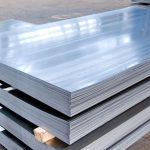
Understanding the weight of steel plate is essential for every buyer, engineer, fabricator, logistics planner, and steel importer. In steel export projects, plate weight directly affects quotation accuracy, container planning, freight cost, customs declaration, warehouse handling, structural design, and final project budgeting. A small error in calculating plate weight can result in incorrect shipment volume, overloaded transport equipment, unexpected costs, or technical non-compliance at the destination market.
For international steel trade, the weight of steel plate is not only a mathematical figure. It is a commercial and technical parameter used in purchase orders, mill test certificates, packing lists, bills of lading, project drawings, and inspection reports. Since steel plates are widely used in construction, shipbuilding, pressure vessels, bridges, machinery, offshore structures, energy projects, and industrial fabrication, buyers need a clear method to estimate and verify the weight before placing an order.
Stavian Industrial Metal provides steel products for international customers with a focus on reliable sourcing, export coordination, and industrial-grade supply solutions. For steel plate buyers, understanding how to calculate plate weight helps improve procurement efficiency, compare quotations correctly, and control total landed cost across different markets.
The weight of steel plate refers to the mass of a steel plate based on its length, width, thickness, and material density. In most international steel transactions, the weight is expressed in kilograms, metric tons, pounds, or short tons depending on the destination market. For export business, metric tons are commonly used because steel is usually traded in bulk quantities.
A steel plate may look simple, but its actual weight can vary significantly depending on thickness and size. For example, a thin 3 mm plate may weigh only a few dozen kilograms per sheet, while a heavy 50 mm plate can weigh several tons. This difference affects lifting equipment, loading plans, freight calculation, and site handling requirements.
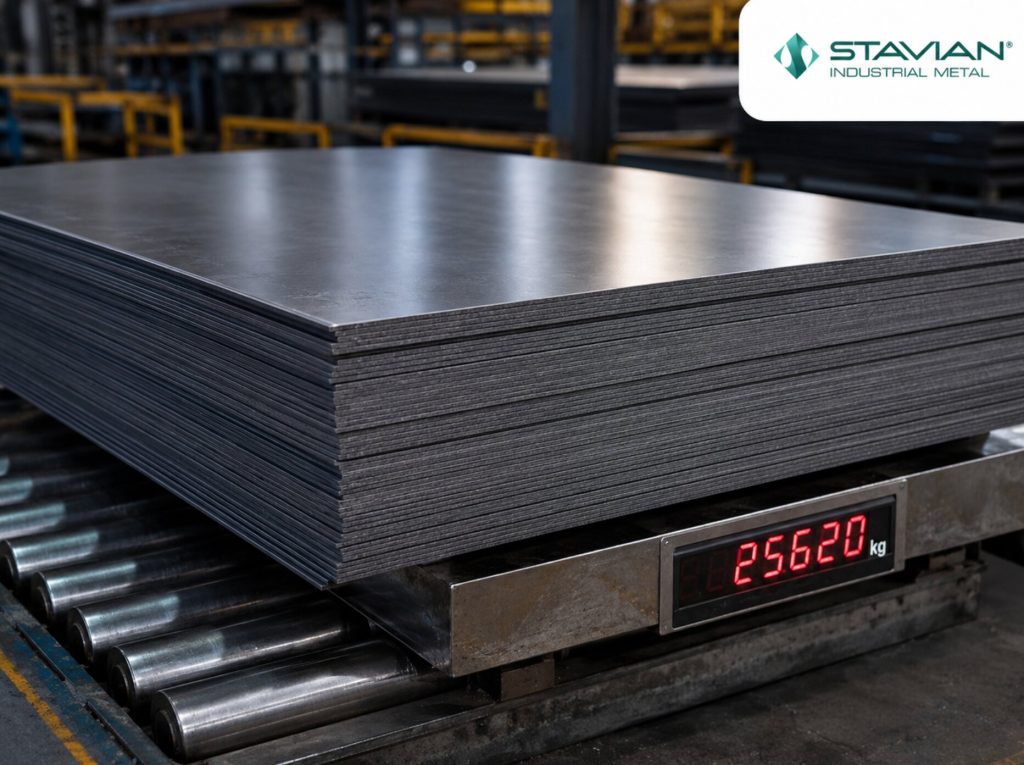
In global steel trade, the weight of steel plate is a key factor in pricing. Steel plates are usually quoted by metric ton rather than by piece. This means the final invoice value depends on total theoretical or actual weight. Buyers who understand plate weight can check whether a quotation is reasonable and whether the quantity offered matches the project requirement.
Plate weight also influences logistics. A 20-foot container, 40-foot container, breakbulk vessel, or flat rack has different payload limitations. If the calculated plate weight is inaccurate, the shipment may face loading delays, extra freight charges, or safety issues. For heavy plates, correct weight calculation is especially important because cranes, forklifts, trailers, and storage racks all have load limits.
The most common formula for calculating the weight of steel plate is:
Weight = Length × Width × Thickness × Density
When using metric units:
Therefore, the formula becomes:
Steel plate weight in kg = Length (m) × Width (m) × Thickness (m) × 7,850
For easier daily calculation, because thickness is often expressed in millimeters, the formula can be simplified as:
Steel plate weight in kg = Length (m) × Width (m) × Thickness (mm) × 7.85
Assume a steel plate has the following dimensions:
The calculation is:
6 × 1.5 × 10 × 7.85 = 706.5 kg
This means one steel plate with a size of 6,000 mm × 1,500 mm × 10 mm weighs approximately 706.5 kg. If a buyer orders 100 plates of this size, the theoretical total weight will be approximately 70.65 metric tons.
A practical way to calculate the weight of steel plate is to remember that 1 square meter of carbon steel plate with 1 mm thickness weighs approximately 7.85 kg. This is one of the most useful reference points for engineers and procurement teams.
The simplified rule is:
Weight per square meter = Thickness in mm × 7.85 kg
For example, a 10 mm steel plate weighs approximately 78.5 kg per square meter. A 20 mm plate weighs approximately 157 kg per square meter. A 50 mm plate weighs approximately 392.5 kg per square meter.
| Thickness | Approximate Weight per m² | Typical Application |
|---|---|---|
| 3 mm | 23.55 kg/m² | Light fabrication, covers, panels |
| 5 mm | 39.25 kg/m² | General fabrication, machinery parts |
| 6 mm | 47.10 kg/m² | Industrial flooring, structural parts |
| 8 mm | 62.80 kg/m² | Equipment frames, base plates |
| 10 mm | 78.50 kg/m² | Construction, platforms, tanks |
| 12 mm | 94.20 kg/m² | Bridges, heavy structures |
| 16 mm | 125.60 kg/m² | Shipbuilding, machinery bases |
| 20 mm | 157.00 kg/m² | Pressure vessels, structural fabrication |
| 25 mm | 196.25 kg/m² | Heavy engineering, industrial equipment |
| 50 mm | 392.50 kg/m² | Heavy-duty machinery, offshore structures |
The standard density used for carbon steel is 7,850 kg/m³. However, not every steel grade has exactly the same density. Stainless steel, alloy steel, wear-resistant steel, and special engineering steels may have slightly different densities depending on chemical composition. For most commercial carbon steel plates, 7.85 is accurate enough for theoretical weight calculation.
For highly technical projects, especially pressure vessels, offshore modules, defense equipment, or high-precision machinery, buyers should confirm the grade-specific density and applicable standard. Even a small density variation can become meaningful when the order volume reaches hundreds or thousands of metric tons.
Thickness tolerance is one of the most important reasons why actual plate weight may differ from theoretical weight. Steel plates are produced according to standards such as ASTM, EN, JIS, GB, or other national and international specifications. These standards usually allow a certain variation in thickness.
If the actual thickness is slightly higher than nominal thickness, the real weight will also be higher. If the actual thickness is lower within tolerance, the actual weight may be lower. This is why export documents may show theoretical weight, actual weight, or both depending on contract terms and inspection requirements.
The weight of steel plate can also be influenced by surface treatment and processing. Hot-rolled plates may have mill scale on the surface. Pickled, blasted, primed, galvanized, or coated plates may have additional or reduced surface mass. Cutting, drilling, beveling, and machining can reduce the final net weight compared with the original parent plate.
For export orders that include processed steel plates, the buyer should clearly define whether the commercial weight is based on raw plate weight, finished part weight, or theoretical drawing weight. This avoids confusion during invoicing and delivery inspection.
To calculate the weight of steel plate for an export order, buyers should follow a structured process. First, confirm the steel grade and density. Second, verify the exact plate dimensions. Third, calculate the weight per piece. Fourth, multiply by total quantity. Fifth, add packaging weight if logistics planning requires gross weight.
For example, if a buyer orders 250 plates sized 10 mm × 1,500 mm × 6,000 mm, the weight per piece is 706.5 kg. The total theoretical weight is 176,625 kg, equal to 176.625 metric tons. This figure can then be used for price comparison, freight estimation, and container or breakbulk planning.
For export shipments, plate weight usually appears in several documents. These may include the commercial invoice, packing list, mill test certificate, certificate of origin, bill of lading, inspection certificate, and customs declaration. Consistency between these documents is essential.
If the packing list shows a different weight from the bill of lading or customs declaration, the shipment may face clearance delays. Stavian Industrial Metal understands the importance of accurate documentation in international steel trade and supports customers with organized export coordination for industrial metal products.
Many steel plates are supplied in standard commercial sizes such as 1,500 mm × 6,000 mm, 2,000 mm × 6,000 mm, 2,000 mm × 12,000 mm, or customized dimensions. The larger the plate area, the higher the weight at the same thickness.
| Plate Size | Thickness | Approximate Weight per Plate |
|---|---|---|
| 1,500 mm × 6,000 mm | 6 mm | 423.9 kg |
| 1,500 mm × 6,000 mm | 10 mm | 706.5 kg |
| 1,500 mm × 6,000 mm | 20 mm | 1,413 kg |
| 2,000 mm × 6,000 mm | 10 mm | 942 kg |
| 2,000 mm × 12,000 mm | 12 mm | 2,260.8 kg |
| 2,500 mm × 12,000 mm | 25 mm | 5,887.5 kg |
A plate weighing 400 kg may be handled with standard warehouse equipment, while a plate above 2 tons requires more careful lifting and loading arrangements. When the weight per plate exceeds 5 tons, buyers should confirm crane capacity, spreader beam requirements, truck payload, and site unloading conditions before shipment.
This is especially relevant for export buyers who import steel plates for infrastructure, oil and gas, mining, shipyard, and heavy machinery projects. The steel may arrive at port safely, but if the project site does not have suitable unloading equipment, additional cost and delay may occur.
Carbon steel plates are among the most widely traded steel products in the world. They are used in construction, fabrication, bridges, storage tanks, machinery, and general engineering. For most carbon steel plates, the density value of 7,850 kg/m³ is used for calculating theoretical weight.
Common grades may include commercial quality, structural quality, shipbuilding quality, boiler quality, and pressure vessel quality plates. While mechanical properties differ, the weight calculation method is generally the same unless a project specifies grade-specific density.
Alloy steel plates may contain chromium, molybdenum, nickel, manganese, or other alloying elements. These elements can slightly change the density. For normal procurement estimation, the standard steel density may still be acceptable, but for precision engineering, the exact grade should be checked.
Wear-resistant plates, high-strength plates, and quenched and tempered plates are commonly used in mining, heavy equipment, crushers, dump trucks, and industrial machinery. In these applications, correct plate weight is important not only for purchasing but also for equipment design and load-bearing calculation.
Stavian Industrial Metal supplies industrial metal products for international markets, supporting buyers that require reliable steel sourcing, export documentation, and trade coordination. For customers purchasing steel plates, Stavian Industrial Metal focuses on helping them match specifications, quantities, shipment plans, and documentation requirements.
Steel plate buyers often need more than just product availability. They need accurate size confirmation, grade alignment, packing details, shipment coordination, and commercial clarity. Stavian Industrial Metal understands these requirements from the perspective of international trade and industrial supply.
Stavian Industrial Metal’s product scope is suitable for customers in construction, fabrication, manufacturing, energy, infrastructure, and heavy industry. Steel plate can be supplied together with other steel products depending on project needs, such as coils, sheets, structural steel, pipes, or related industrial metal materials.
For buyers who need to calculate the weight of steel plate, Stavian Industrial Metal can support specification review and order planning based on dimensions, thickness, grade, and shipment quantity. This helps customers reduce procurement risk and improve project execution.
The weight of steel plate is a fundamental factor in steel purchasing, engineering design, export documentation, logistics planning, and cost control. The standard calculation is simple: length × width × thickness × density. For most carbon steel plates, buyers can use the practical formula: length in meters × width in meters × thickness in millimeters × 7.85 to estimate weight in kilograms.
However, professional steel procurement requires more than basic calculation. Buyers must also consider thickness tolerance, theoretical versus actual weight, steel grade, surface condition, packaging, container payload, lifting equipment, and customs documentation. In export transactions, accurate weight calculation helps avoid cost overruns, shipment delays, and technical disputes.
Stavian Industrial Metal supports international customers with industrial metal products and export-oriented supply coordination. For steel plate buyers, working with an experienced supplier helps improve quotation accuracy, shipment planning, and documentation consistency. By understanding how to calculate and verify the weight of steel plate, buyers can make better purchasing decisions and manage steel projects with greater confidence.
Read more
Address
Website: https://stavianmetal.com
Email: info@stavianmetal.com