The iron ore price in Vietnam is a critical cost indicator for steel mills, construction-material manufacturers, engineering companies and industrial buyers. Although Vietnam has domestic mineral resources, the country’s expanding steel industry remains highly exposed to imported raw materials and international benchmark prices. Movements in iron ore quotations can therefore affect the cost of billet, hot-rolled coil, steel plate, rebar and other finished steel products across the domestic market.
As of May 2026, benchmark 62% Fe iron ore was trading at approximately USD 109–110 per metric tonne on a cost-and-freight basis for East Asian destinations. Converted at an exchange rate of roughly VND 26,000 per USD, this represents about VND 2.83–2.86 million per tonne before adjustments for port charges, inland logistics, financing costs, ore quality and contractual premiums or discounts. The actual delivered price paid by a Vietnamese steel producer can consequently be materially higher than the headline benchmark.
Understanding the iron ore price in Vietnam requires more than checking a single international quotation. Buyers must evaluate ore grade, moisture, impurities, freight routes, exchange rates, steel demand, Chinese production conditions and the purchasing structure of individual mills. Stavian Industrial Metal provides this detailed guide to help industrial buyers interpret market movements, estimate landed costs and make better-informed steel procurement decisions.
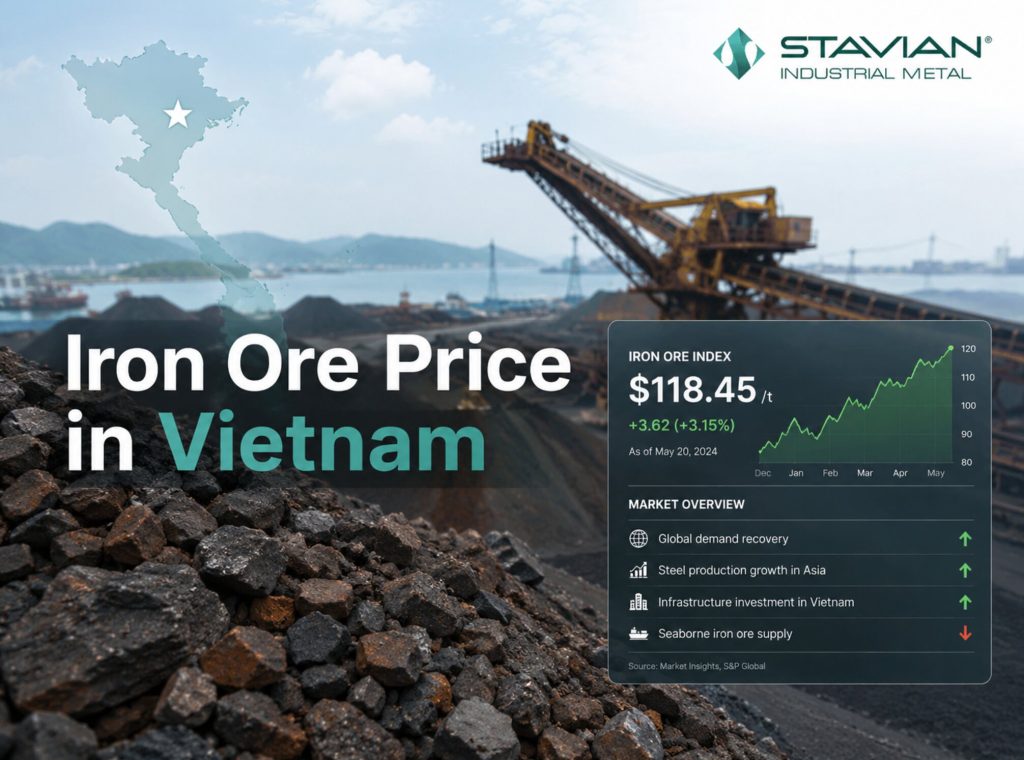
The most relevant reference for Vietnam’s imported ore market is the price of 62% Fe fines delivered to major East Asian ports. In May 2026, this benchmark remained around USD 109–110 per tonne CFR. This price level was supported by recovering steel production in China, resilient regional demand and periodic concerns about supply or shipping conditions in Australia and Brazil.
However, USD 109–110 per tonne should not be interpreted as a universal offer available to every buyer in Vietnam. It is a benchmark for a standardized grade under defined delivery conditions. A Vietnamese mill purchasing a different ore specification, shipment size or delivery term may receive a substantially different quotation. Long-term contracts may also use monthly averages or index-linked formulas rather than the spot price published on a particular day.
For practical procurement purposes, the Vietnam iron ore price should be divided into three levels:
At USD 109–110 per tonne and an assumed exchange rate of VND 26,000 per USD, the direct currency conversion is approximately VND 2.83–2.86 million per tonne. This calculation is useful for initial budgeting but does not represent the final cost delivered to a steel plant.
A procurement team should add handling fees, survey costs, quality inspection expenses, port storage, inland transport and financing. Depending on the port, destination, shipment size and payment structure, these additions may increase the effective material cost by several hundred thousand Vietnamese dong per tonne. Smaller cargoes generally carry a higher unit cost than large bulk shipments because fixed logistics expenses are distributed over fewer tonnes.
The following simplified formula can be used for budgeting:
Estimated delivered iron ore cost = CFR ore price × USD/VND exchange rate + port costs + inland logistics + financing and inventory costs ± quality adjustment
Two offers issued on the same day may differ even when both are described as iron ore. The most important reason is ore chemistry. A cargo with higher iron content typically provides more usable metallic units and may generate less slag per tonne of hot metal. It can therefore trade at a premium to the 62% Fe benchmark. Lower-grade material usually trades at a discount, but the apparent saving may be reduced by higher coke consumption, lower furnace productivity or greater waste generation.
Impurities also affect value. Elevated silica and alumina levels increase slag volume and may raise energy consumption. Phosphorus and sulphur can complicate steelmaking and require additional refining. Moisture affects the amount of dry ore actually received, while particle-size distribution influences sintering, pelletizing and blast-furnace performance.
Commercial conditions create further differences. A spot cargo, a quarterly formula contract and a long-term supply agreement can produce different effective prices. Payment terms, credit duration, loading speed, demurrage conditions and quality-claim procedures should all be evaluated alongside the quoted USD-per-tonne figure.
Reference prices updated in 2026
| Iron Ore Category | Reference Price | Estimated VND Price | Price Basis |
|---|---|---|---|
| Iron Ore Fines – 62% Fe | US$98–105/tonne | Approximately 2.56–2.74 million VND/tonne | International 62% Fe benchmark used as a reference for Vietnamese import transactions. |
| Imported Iron Ore – 62% Fe, CFR East Asia | US$109–110/tonne | Approximately 2.85–2.90 million VND/tonne | May 2026 CFR East Asia reference, including freight to the regional destination port. |
| Lower-grade Iron Ore – 58% Fe | US$82–94/tonne | Approximately 2.14–2.45 million VND/tonne | Indicative range calculated at a discount to the 62% Fe benchmark. |
| High-grade Iron Ore – 65% Fe | US$112–128/tonne | Approximately 2.92–3.34 million VND/tonne | Indicative range including the premium for higher iron content and lower impurities. |
| Iron Ore Lump | US$115–135/tonne | Approximately 3.00–3.52 million VND/tonne | Indicative imported lump-ore price, depending on Fe content, size and origin. |
| Iron Ore Pellets | US$135–165/tonne | Approximately 3.52–4.30 million VND/tonne | Indicative pellet price, subject to pellet premium, quality and delivery terms. |
The iron ore price in Vietnam is largely derived from international market indexes because the seaborne trade is concentrated among major mining regions and large steel-producing economies. Vietnam participates in this global system as both a growing steel producer and an importer of raw materials, semi-finished steel and finished steel products.
The pricing process normally begins with a benchmark for a defined iron content and delivery basis. The transaction price is then adjusted for grade, impurities, physical form, freight and commercial conditions. In many contracts, the final invoice price may be based on an average index over several days or an entire month, reducing exposure to extreme daily volatility.
Iron content is one of the primary determinants of ore value. The commonly quoted 62% Fe iron ore price serves as the central reference for mainstream fines. Higher-grade products, such as 65% Fe concentrate or premium fines, generally command additional value because they can support higher furnace productivity and lower emissions per tonne of steel.
Lower-grade ore may appear economical when compared only by wet metric tonne. A more accurate comparison is the cost per unit of contained iron. For example, one tonne of 58% Fe ore contains less usable iron than one tonne of 62% Fe ore. The buyer may therefore need more material to produce the same quantity of hot metal, while also processing a larger volume of gangue.
Steel mills should compare offers using:
Australia and Brazil are central suppliers to the global seaborne iron ore market. Australian routes to Asia are generally shorter, while Brazilian material travels a much longer distance. Freight rates can therefore alter the relative competitiveness of cargoes even when their free-on-board mine prices are similar.
Ocean freight is influenced by vessel availability, bunker fuel prices, weather, port congestion and geopolitical risks. Capesize vessels are commonly used for large bulk ore shipments, and changes in Capesize freight rates can have a visible impact on CFR quotations. A disruption at a major loading terminal or an increase in marine fuel costs can raise the landed price for Vietnamese buyers without any change in the mine’s production cost.
Vietnam’s port limitations must also be considered. Where a fully loaded large vessel cannot discharge directly, transshipment, lightering or delivery through an alternative terminal may be required. Each additional handling stage increases cost and introduces operational risk.
International iron ore is predominantly priced in US dollars, while most domestic revenue and operating expenses in Vietnam are denominated in Vietnamese dong. A stronger US dollar raises the local-currency cost of imported ore even when the USD benchmark remains unchanged.
Consider an ore quotation of USD 110 per tonne. At VND 24,500 per USD, its direct converted value is VND 2.695 million per tonne. At VND 26,000 per USD, the same cargo costs VND 2.86 million before logistics. The currency movement alone adds VND 165,000 per tonne. For a shipment of 100,000 tonnes, that difference equals VND 16.5 billion.
This exposure makes foreign-exchange planning an essential part of raw-material procurement. Buyers should coordinate purchasing schedules, payment terms and hedging policies rather than treating the ore price and exchange rate as separate issues.
China is the largest participant in the global seaborne iron ore market, so changes in Chinese steel output, mill margins and port inventories strongly influence regional prices. When Chinese mills increase operating rates or restock raw materials, spot demand can rise quickly. Conversely, production restrictions, weak property activity or poor steel margins may reduce ore purchasing.
Vietnamese buyers must therefore monitor conditions outside the domestic market. A Vietnamese construction cycle may be strong, but international ore prices can still fall if Chinese demand weakens. The opposite is also possible: domestic demand may be moderate while aggressive Chinese restocking pushes regional raw-material prices higher.
Key indicators include blast-furnace utilization, daily hot-metal production, imported ore stocks at Chinese ports, steel mill profitability, property-sector activity and government infrastructure policies.
Vietnam has become one of the world’s significant steel-producing countries. The country’s crude steel output reached approximately 24.6 million tonnes in 2025. During the first four months of 2026, crude steel production was estimated at 8.5 million tonnes, representing growth of about 8.4% compared with the same period of 2025. April 2026 output alone was approximately 2.1 million tonnes.
Broader steel production, including multiple finished and semi-finished product categories, was reported at around 55.3 million tonnes in 2025, up approximately 9.8% year on year. Flat-steel production was a major contributor, supported by domestic consumption and additional capacity. These figures demonstrate why raw-material pricing is becoming increasingly important to Vietnam’s industrial economy.
As steel capacity expands, demand for iron ore, coking coal, scrap, ferroalloys and other inputs also increases. Mills with blast-furnace and basic-oxygen-furnace routes are particularly exposed to iron ore price fluctuations. Electric-arc-furnace producers are less directly dependent on ore but remain affected because scrap, billet and finished steel prices are linked to the wider steelmaking cost structure.
Vietnam has iron ore deposits, but domestic availability has historically been insufficient to meet the full requirements of the steel industry. Earlier industry estimates indicated annual ore demand of approximately 15 million tonnes, with domestic supply covering only a limited share. Current requirements are affected by capacity additions, operating rates, raw-material blends and the growing scale of integrated steelmaking.
Domestic ore may reduce exposure to long-distance ocean freight, but it is not automatically cheaper in effective steelmaking terms. Mine scale, ore grade, beneficiation requirements, transport infrastructure and environmental compliance all influence competitiveness. Imported high-grade ore may deliver better productivity or lower emissions even when its nominal purchase price is higher.
A resilient supply strategy can include a controlled mix of domestic and imported material, provided that each source meets the mill’s technical requirements. Procurement decisions should be based on total hot-metal cost rather than the lowest mine-gate quotation.
New integrated capacity increases the structural demand for ore and other blast-furnace inputs. Large plants require stable cargo volumes, consistent chemistry and reliable delivery schedules. Interruptions can reduce furnace efficiency and create costs that greatly exceed a small difference in the purchase price.
Capacity expansion also changes the bargaining dynamics of the market. Larger and more predictable orders may allow mills to negotiate long-term supply arrangements, quality formulas and freight structures. At the same time, higher national consumption can increase exposure to international disruptions when multiple mills seek replacement cargoes simultaneously.
The growth of Vietnam’s flat-steel segment is especially relevant. Hot-rolled coil and plate production requires reliable upstream steelmaking operations, and raw-material costs can influence the competitiveness of downstream products used in manufacturing, shipbuilding, energy and infrastructure.
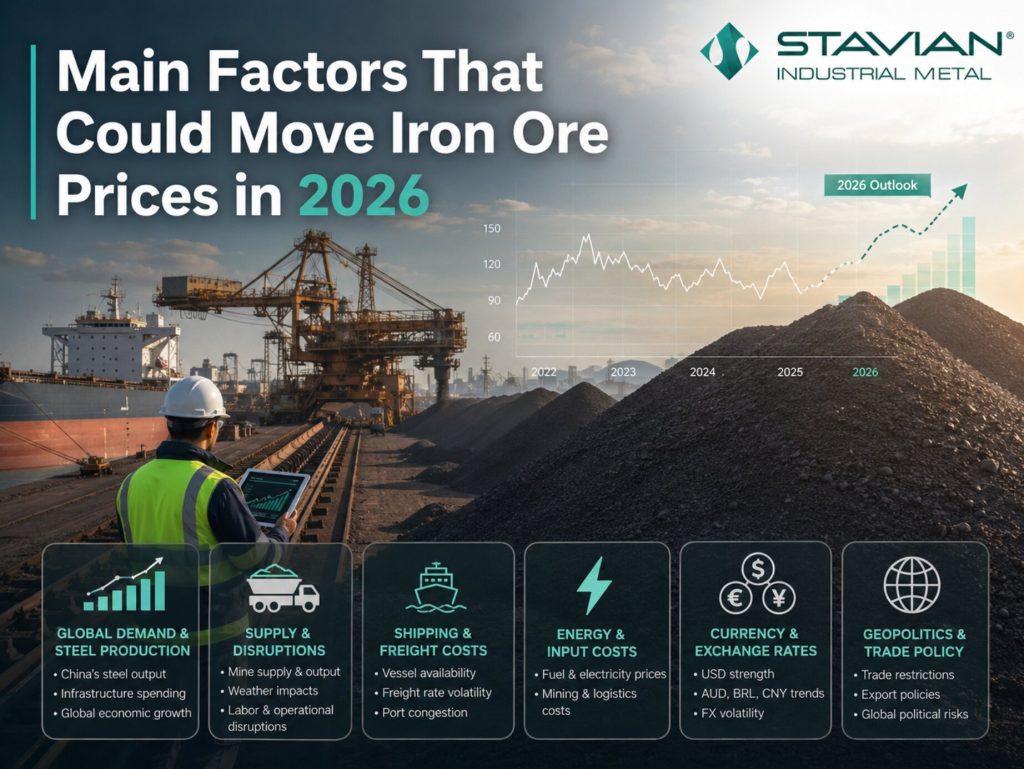
The 2026 iron ore market is being shaped by a combination of demand recovery, rising steel production in parts of Asia, new mining supply and wider commodity-market volatility. The balance between these forces will determine whether the iron ore price in Vietnam remains near current levels or moves into a higher or lower range.
Forecasts should be treated as scenarios rather than guaranteed outcomes. Iron ore can move sharply in response to weather events, production restrictions, stimulus measures or unexpected changes in mill inventories. Procurement teams should therefore prepare for multiple price paths.
China’s property sector has traditionally consumed large volumes of long steel products, while manufacturing and infrastructure support demand for flat steel and specialty products. Weak property construction may limit rebar consumption, but investment in machinery, vehicles, renewable energy, power grids and other industrial applications can partly offset that weakness.
The important factor for ore is not only final steel demand but also mill operating behavior. Producers may continue running at high rates to maintain market share even when margins are narrow. Alternatively, environmental restrictions or government production controls may reduce output. Changes in blast-furnace activity can influence ore demand within weeks.
Vietnamese buyers should avoid relying on a single headline such as property sales or gross domestic product growth. A more useful assessment combines steel inventories, mill margins, production levels and real downstream order activity.
Additional supply from established producers and developing mining regions could place downward pressure on long-term prices. New projects in Africa, including large high-grade deposits, have the potential to diversify global supply. However, the effect depends on commissioning schedules, infrastructure completion, ramp-up rates and the actual quality delivered to the market.
Mine supply rarely increases in a perfectly smooth pattern. Railways, ports and processing facilities may face delays, while existing operations can experience maintenance issues or weather disruptions. As a result, expectations of future supply may influence forward prices before physical cargoes become consistently available.
For Vietnam, a broader supplier base could improve purchasing flexibility. It may also create opportunities to source higher-grade material that supports productivity and lower-emission steelmaking.
Australia’s cyclone season and heavy rainfall in Brazil are recurring risks for the seaborne market. Severe weather can interrupt mining, rail transportation or port loading. Because major suppliers account for a large share of international trade, even a temporary reduction can affect spot availability.
Operational incidents, licensing issues and scheduled maintenance can have similar effects. The price response depends on inventory levels. When port and mill stocks are comfortable, the market may absorb a short disruption. When inventories are low, buyers can compete aggressively for prompt cargoes, producing a rapid price increase.
Importers should assess both price risk and physical availability. A low-priced contract has limited value when shipment reliability is uncertain or delivery delays could interrupt production.
Energy prices influence mining, processing, rail transport and shipping. A sustained increase in oil or marine fuel prices can raise freight expenses, especially for cargoes moving over long distances. Geopolitical tensions may also affect vessel routes, insurance premiums and the availability of shipping capacity.
These factors can widen the difference between free-on-board and CFR prices. They may also increase the relative advantage of geographically closer supply sources. However, distance should be considered alongside quality. A closer low-grade source may still be less economical than a distant high-grade cargo when total steelmaking performance is evaluated.
Iron ore is one component of integrated steel production, but it is not the only cost driver. Coking coal, coke, limestone, electricity, electrodes, refractories, labor, financing and logistics all contribute to the final cost of steel. Nevertheless, a sustained ore-price movement can have a meaningful effect on steelmaking margins and product quotations.
The impact is not always immediate. Mills may hold several weeks of raw-material inventory, and existing stock may have been purchased at different prices. Sales contracts can also delay the pass-through into finished steel. As a result, the current ore benchmark and today’s domestic steel price do not always move in parallel.
Blast-furnace operators consume iron-bearing materials directly, making them particularly sensitive to changes in the ore price. A USD 10-per-tonne increase in ore does not translate into exactly USD 10 per tonne of steel because the conversion depends on burden composition, iron yield, recovery rates and production efficiency.
A tonne of crude steel may require more than one tonne of ore-bearing material when impurities, slag and process losses are considered. The precise consumption varies by plant and feed mix. Consequently, even a modest change in the benchmark can create a substantial total cost impact at a large integrated mill.
Higher-grade ore may partially offset a higher purchase price through improved productivity, reduced coke consumption and lower slag generation. This is why purchasing decisions should be jointly reviewed by procurement, technical and operations teams.
Hot-rolled steel and steel plate are closely connected to integrated steelmaking economics. When raw-material costs rise and demand is sufficient, mills may increase HRC and plate offers to preserve margins. If the downstream market is weak, producers may absorb part of the increase, resulting in margin compression instead of an immediate price adjustment.
HRC is a fundamental input for cold-rolled steel, coated products, pipes, automotive components and machinery. A change in HRC pricing can therefore move through multiple manufacturing supply chains. Plate prices are similarly important for construction, pressure equipment, heavy engineering, energy projects and shipbuilding.
Industrial buyers can review the available hot-rolled steel products from Stavian Industrial Metal when planning material requirements affected by upstream ore and steel market movements.
Rebar and wire rod prices are influenced by ore, scrap, billet, energy and domestic construction demand. In Vietnam, infrastructure investment and property activity can be as important as raw-material costs in determining short-term construction steel prices.
When demand is strong, producers can pass higher input expenses to the market more rapidly. During weak demand periods, inventories may increase and competition can prevent full cost recovery. This explains why ore may rise while rebar prices remain stable, or why construction steel may increase because of demand even when ore is relatively unchanged.
Buyers sourcing construction steel should monitor both upstream commodity indicators and local project activity rather than relying on the iron ore benchmark alone.
The 2026 market outlook contains both upward and downward forces. Regional steel production and infrastructure demand can support iron ore consumption, while additional global mine supply may limit sustained price increases. Freight, currency and geopolitical developments could create volatility even when the underlying supply-demand balance appears stable.
With benchmark 62% Fe material around USD 109–110 per tonne CFR East Asia in May 2026, the market was above the lower levels anticipated by some earlier forecasts. Buyers should not assume that prices will automatically return to historical averages. At the same time, increased supply and uncertainty around Chinese steel demand may restrict the potential for a prolonged surge.
Under a balanced scenario, iron ore prices may remain within a broad range around current levels, with temporary increases caused by restocking or supply disruption and periodic declines caused by weaker mill margins. Vietnamese steel production growth would support import requirements, but the country remains a price taker in the much larger seaborne market.
In this environment, formula contracts and staggered purchasing may be more effective than attempting to predict each short-term movement. Buyers should focus on quality consistency, freight efficiency and working-capital control.
Prices could rise if Chinese steel output remains stronger than expected, major producers experience weather-related disruptions, freight costs increase or new mining projects are delayed. A weaker Vietnamese dong would amplify the effect for local importers.
Under this scenario, high-cost inventories and margin pressure could move downstream into HRC, plate and construction steel quotations. Buyers with fixed-price project contracts would face particular risk if their material costs were not protected.
Prices could decline if additional mine supply enters the market while Chinese steel demand weakens. High port inventories, low mill margins and production restrictions could accelerate the downward move.
Lower ore prices would not guarantee an equal decline in Vietnamese finished steel. Exchange rates, coking coal, electricity, freight and domestic demand may offset part of the benefit. Nevertheless, reduced raw-material pressure would generally improve the cost position of integrated producers.
Iron ore is an upstream material, while most manufacturers and project owners purchase finished or semi-finished steel. Stavian Industrial Metal supplies a broad steel portfolio designed for construction, manufacturing, infrastructure, shipbuilding and industrial applications. Product origins and specifications can be selected according to technical standards and project requirements.
Through its domestic distribution capabilities and international partner network, Stavian Industrial Metal supports buyers seeking reliable material supply, commercial flexibility and coordinated logistics. The company’s steel portfolio includes hot-rolled products, construction steel, coated steel and shipbuilding steel.
Hot-rolled steel is suitable for structural fabrication, pipe production, machinery, automotive components, storage tanks and general manufacturing. Buyers should specify grade, thickness, width, coil weight, surface condition, dimensional tolerances and testing requirements.
Because HRC pricing is linked to integrated mill economics, international ore and coking-coal movements are important purchasing indicators. However, regional supply, anti-dumping measures, mill maintenance and downstream demand must also be considered.
Construction steel includes rebar and related products used in residential, commercial, industrial and infrastructure projects. Selection should follow the applicable design standard, strength grade, ductility requirement and testing documentation.
For long-duration projects, buyers can reduce price risk through phased delivery schedules, clear quantity forecasts and contract mechanisms that address major market changes. Material traceability and consistent mechanical properties are as important as the initial quotation.
Steel plate is used in heavy structures, machinery, bridges, pressure equipment, energy projects and marine applications. Shipbuilding steel requires controlled mechanical properties, weldability and certification that complies with relevant classification requirements.
Ore quality can indirectly influence plate production by affecting steel cleanliness, furnace stability and overall production cost. For critical applications, buyers should prioritize verified specifications, mill certificates and appropriate inspection rather than selecting products solely on price.
Coated steel is used in roofing, cladding, appliances, ventilation systems and fabricated components requiring corrosion protection. Important purchasing parameters include base-metal thickness, coating mass, surface finish, paint system and intended service environment.
Coated steel prices reflect not only the cost of the base coil but also zinc or aluminum-zinc coatings, paint, processing and quality control. Consequently, the relationship between iron ore and the final coated product is indirect but still commercially relevant.
As of May 2026, benchmark 62% Fe iron ore was approximately USD 109–110 per tonne CFR East Asia, equivalent to around VND 2.83–2.86 million per tonne using an indicative exchange rate of VND 26,000 per USD. This is a benchmark conversion rather than the final delivered price to a Vietnamese steel mill.
The actual amount depends on grade, impurities, moisture, shipment size, freight basis, port charges, inland logistics, payment terms and currency movements.
Vietnam has domestic iron ore resources, but local material has historically supplied only part of the steel industry’s requirements. The country therefore relies on imported ore and other iron-bearing inputs to support integrated steel production.
The competitiveness of domestic ore depends on grade, mine scale, processing requirements, transport infrastructure and environmental costs. Local origin alone does not guarantee a lower effective steelmaking cost.
Sixty-two-percent iron fines represent a widely traded mainstream specification in the seaborne market. Using a standardized reference allows buyers and sellers to apply transparent premiums or discounts for different iron content and impurity levels.
Higher-grade ore generally trades above the benchmark, while lower-grade ore trades below it. The economic value depends on furnace performance, not only the quoted price per tonne.
No. Higher ore costs create upward pressure, but the final steel price also depends on coking coal, scrap, electricity, freight, inventories, mill utilization and market demand. A producer may absorb part of the increase when demand is weak or pass it through rapidly when supply is tight.
There may also be a time lag because mills hold raw-material inventory and operate under previously negotiated sales contracts.
Spot-market indicators can change daily. Contract prices may use daily, weekly or monthly averages, depending on the agreement. Physical offers can also change when freight, exchange rates or cargo availability move.
Industrial buyers should follow trends rather than reacting to every daily fluctuation. A structured purchasing plan is generally more reliable than attempting to time individual market lows.
Buyers should verify the iron grade, moisture, silica, alumina, phosphorus, sulphur, particle size, origin, shipment period and Incoterm. The contract should also define sampling, inspection, price adjustments, payment terms, demurrage, claims and dispute resolution.
The quotation should then be converted into a dry-tonne, delivered and quality-adjusted cost. This provides a fairer comparison between suppliers.
The iron ore price in Vietnam is closely linked to the international seaborne market. As of May 2026, benchmark 62% Fe ore was approximately USD 109–110 per tonne CFR East Asia, or roughly VND 2.83–2.86 million per tonne before domestic logistics and other adjustments. The final cost paid by a Vietnamese mill can differ significantly due to ore chemistry, moisture, freight, exchange rates, port handling, financing and contractual conditions.
Vietnam’s expanding steel capacity is increasing the importance of secure and cost-efficient raw-material supply. Crude steel production reached approximately 24.6 million tonnes in 2025, while output during the first four months of 2026 rose to around 8.5 million tonnes. This growth supports structural demand for iron-bearing materials and strengthens the connection between international ore markets and domestic steel prices.
For buyers, the most effective strategy is to monitor total steelmaking or material-acquisition cost rather than focusing on a single benchmark. Supply diversification, quality analysis, currency planning, suitable contract structures and disciplined inventory management can reduce exposure to market volatility. Stavian Industrial Metal supports industrial customers with suitable hot-rolled steel, construction steel, coated steel and shipbuilding steel solutions for a wide range of projects and manufacturing applications.
Read more
Address
Website: https://stavianmetal.com
Email: info@stavianmetal.com