Types of iron ore differ significantly in mineral composition, iron content, impurity profile, processing requirements, and suitability for steel production. The most commercially important varieties are hematite, magnetite, goethite, limonite, and siderite. Among these, hematite and magnetite dominate global mining because they can produce high-grade feedstock for blast furnaces, direct-reduction plants, sintering lines, and pelletizing facilities.
Understanding the characteristics of each ore type is essential for steelmakers, mining companies, traders, and industrial buyers. A material with high total iron content may appear attractive, but its commercial value also depends on silica, alumina, phosphorus, sulfur, moisture, particle size, loss on ignition, and metallurgical performance. These factors directly influence beneficiation costs, furnace productivity, coke consumption, slag volume, energy use, and finished-steel quality.
Global steel production remains close to 1.85 billion metric tonnes per year, making iron ore one of the most heavily traded bulk commodities in the world. Approximately 98% of mined iron ore is ultimately used in iron and steel production. Stavian Industrial Metal has prepared this detailed guide to explain the major types of iron ore, their advantages, limitations, processing routes, and practical purchasing considerations.
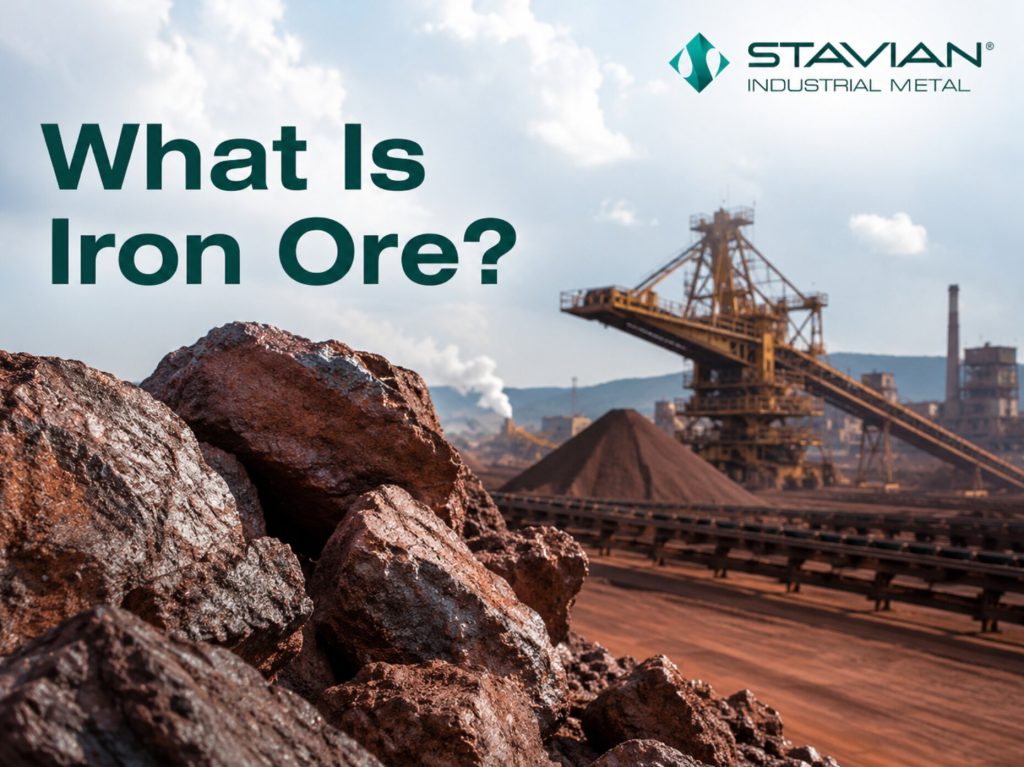
Iron ore is a naturally occurring rock or mineral deposit from which metallic iron can be extracted economically. Iron is present in many minerals within the Earth’s crust, but only deposits with suitable grades, volumes, mining conditions, and processing economics are classified as commercially viable ore. The iron usually occurs as oxides, hydroxides, or carbonates combined with unwanted minerals known as gangue.
Common gangue materials include quartz, clay, alumina-bearing minerals, carbonates, and silicates. Before iron ore can be used efficiently in a steel plant, much of this gangue must be removed or controlled through crushing, screening, washing, gravity separation, magnetic separation, flotation, and pelletizing. The selected treatment route depends mainly on the mineralogy and liberation characteristics of the deposit.
Theoretical iron content varies according to the mineral’s chemical formula. Pure magnetite can contain approximately 72.4% iron, while pure hematite contains about 69.9%. Goethite has a theoretical iron content of approximately 62.9%, limonite commonly contains around 55% or less, and siderite contains about 48.2%. Actual commercial ores usually have lower grades because natural deposits include moisture and gangue minerals.
There is no single classification system that covers every aspect of iron ore. Mining companies and steelmakers commonly classify material by mineral type, iron grade, geological origin, particle size, processing level, and intended metallurgical application. A single shipment may therefore be described in several ways, such as high-grade hematite fines, magnetite concentrate, direct-shipping lump ore, or blast-furnace pellets.
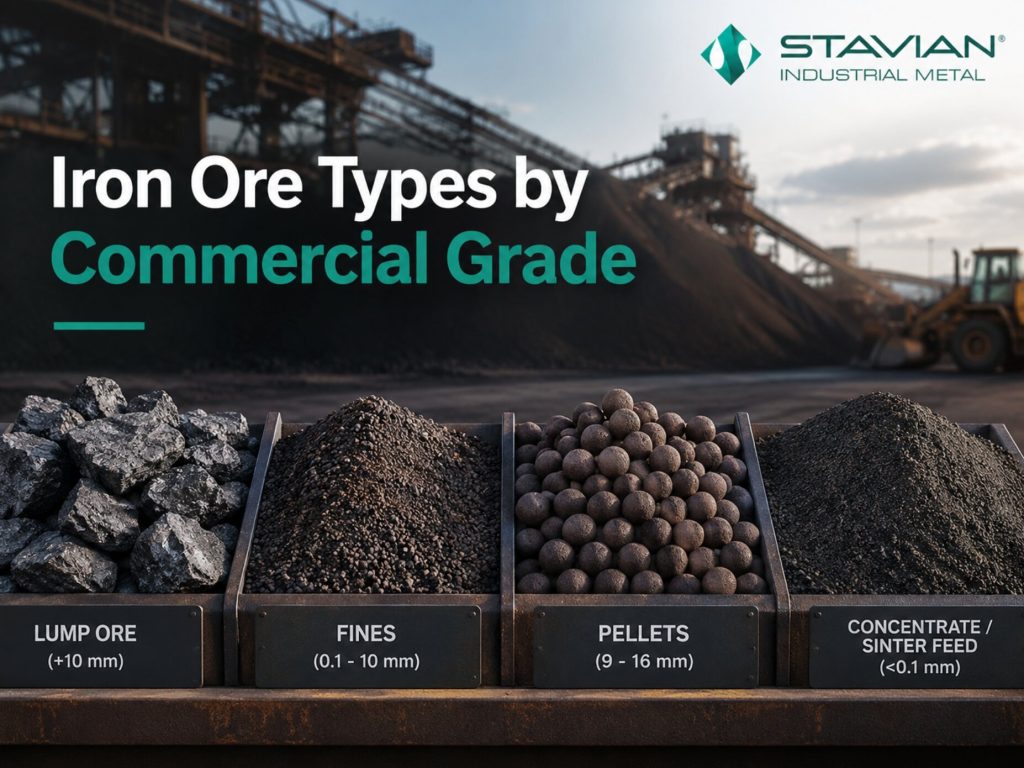
From a mineralogical perspective, the main categories are hematite, magnetite, goethite, limonite, and siderite. Commercial classifications also include direct-shipping ore, beneficiated concentrate, fines, lump, sinter feed, pellet feed, blast-furnace pellets, and direct-reduction pellets. Each category has different chemical and physical specifications.
The principal types of iron ore have distinct mineral structures and metallurgical behaviors. Their differences affect how easily iron can be liberated from gangue, how much energy is required for processing, and whether the final product is suitable for conventional blast-furnace steelmaking or lower-carbon direct-reduction technologies.
Hematite and magnetite represent the largest share of internationally traded ore products. Goethite and limonite are also commercially significant, particularly in weathered deposits and certain Australian ore systems. Siderite is less important in modern seaborne trade because of its lower iron content and the need for additional thermal treatment before reduction.
Hematite iron ore is one of the most widely mined and traded iron-bearing minerals. Its chemical formula is Fe2O3, and pure hematite contains approximately 69.9% iron. It is generally red, reddish-brown, silver-gray, or black, depending on crystal form and particle size. A red or reddish-brown streak is one of its most recognizable identifying characteristics.
Many large hematite deposits can be processed into direct-shipping ore with iron grades of approximately 58% to more than 65%. Higher-grade hematite often requires only crushing, screening, and blending before export. This relatively simple processing route can reduce capital expenditure and energy consumption compared with low-grade magnetite operations that require fine grinding and magnetic concentration.
Hematite is frequently used as lump ore or fines. Lump material can be charged directly into a blast furnace when it meets size, strength, and degradation requirements. Fines are generally agglomerated through sintering or pelletizing before furnace use. High-grade hematite is especially valuable when it contains low levels of silica, alumina, phosphorus, sulfur, and other penalty elements.
The main advantage of hematite is its combination of relatively high iron content and favorable reducibility. Oxygen can often be removed efficiently during blast-furnace or direct-reduction processing. High-grade hematite also reduces the amount of gangue entering the furnace, lowering slag production and the consumption of fluxes such as limestone and dolomite.
However, hematite quality varies considerably between deposits. Some ores contain elevated phosphorus, which can negatively affect steel toughness and increase refining requirements. Other products may have high alumina or ultrafine clay content, creating problems during sintering, material handling, and furnace operation. Hematite ores may also generate fines through degradation during transport or reduction.
Magnetite iron ore has the chemical formula Fe3O4 and the highest theoretical iron content among the major ore minerals, at approximately 72.4%. Magnetite is typically black or dark gray and is strongly magnetic. This magnetic property provides a major processing advantage because magnetite particles can be separated from non-magnetic gangue using magnetic separators.
Although pure magnetite is exceptionally rich in iron, natural magnetite deposits are often found in banded iron formations with substantial quantities of silica. Run-of-mine material may therefore contain only 20–40% iron. To produce a marketable concentrate, the ore is crushed and ground finely enough to liberate magnetite from quartz and other gangue minerals. Magnetic separation then upgrades the material, often producing concentrates containing approximately 67–71% iron.
Magnetite concentrate is commonly used to manufacture pellets because its fine particle size supports strong pellet formation. It also provides an energy-related benefit during pellet induration. Magnetite oxidizes to hematite during heating, and this exothermic reaction releases heat that can partially reduce external fuel demand in a well-designed pellet plant.
High-grade magnetite concentrate can have very low silica, alumina, phosphorus, and sulfur levels, making it an attractive feedstock for premium pellets. Its high iron concentration reduces gangue input and supports lower slag volume. These characteristics are increasingly relevant for direct-reduced iron and electric arc furnace routes, which generally require cleaner and higher-grade raw materials than conventional blast-furnace operations.
The main limitation is beneficiation intensity. Magnetite ore frequently requires multiple stages of crushing, fine grinding, magnetic separation, thickening, filtration, and pelletizing. These processes require substantial electricity, water, equipment, and operating expertise. Commercial performance therefore depends not only on the mineral’s theoretical iron content but also on ore hardness, liberation size, recoverability, power costs, and tailings management.
Goethite is a hydrated iron oxide mineral with the formula FeO(OH). Its theoretical iron content is approximately 62.9%, although commercial goethitic ores are normally lower because they contain water, clay, silica, alumina, and other minerals. Goethite is commonly yellow-brown, dark brown, or black and frequently forms through the weathering and oxidation of other iron-bearing minerals.
Goethitic ores are important components of many commercially mined deposits. They can be soft, porous, and relatively easy to crush, but their internal moisture and chemically bound water affect handling and metallurgical performance. During heating, goethite loses water and transforms into hematite. This process contributes to loss on ignition, commonly abbreviated as LOI.
High LOI reduces the effective mass of iron-bearing material delivered to the furnace and requires energy to remove the water. Goethitic fines can nevertheless perform well in a sinter blend because their porosity and reactivity may improve melt formation under controlled conditions. The final result depends on the proportion of goethite, particle structure, alumina content, and interaction with other blend components.
Goethitic materials may provide good reducibility because of their porous structure. Some products are also comparatively soft, reducing crushing energy. In sintering, selected goethitic ores can improve assimilation and help form bonding phases that support sinter strength. These benefits explain why goethite-rich ores remain important in many blast-furnace supply chains.
The challenges include high moisture, elevated LOI, variable alumina levels, and a tendency to generate ultrafines. High-alumina goethitic ore can increase slag viscosity and flux requirements. Excessively porous material may also absorb moisture during storage and transport, affecting weight, flowability, and stockyard management. Buyers should therefore assess both total iron and physical characteristics rather than relying on grade alone.
Limonite is traditionally described as a hydrated iron oxide ore, but it is not a single precisely defined mineral. It is generally a mixture dominated by goethite and other hydrated iron oxides, often combined with clay, silica, manganese compounds, and weathering products. Limonite is usually yellow, brown, or dark brown and commonly occurs in near-surface weathered zones.
The iron content of limonite is variable and is often lower than that of commercial hematite or magnetite products. Depending on the deposit, limonitic material may contain approximately 35–55% iron. High moisture and chemically combined water can further reduce the effective dry iron content. As a result, low-grade limonite generally requires washing, screening, gravity separation, or blending before it becomes suitable for steelmaking.
Limonite can still be economically attractive when deposits are shallow, extensive, and easy to mine. Lower mining costs may partially offset lower grades. It may also contain valuable associated metals such as nickel or cobalt in certain lateritic systems, although these deposits follow different extraction routes from conventional iron ore used in steel production.
The principal commercial advantages of limonite are its accessibility and relatively simple mining conditions in some deposits. Weathered material may require less drilling and blasting than hard magnetite-bearing rock. Appropriate washing can remove clay and upgrade certain limonitic ores, while blending can improve the consistency of iron grade and sintering performance.
Its limitations include lower iron grade, high moisture, high LOI, and variable impurities. Transporting water and gangue adds cost without increasing metallic output. Fine or clay-rich limonite may also create handling difficulties, including stockpile compaction, conveyor carryback, blocked chutes, and reduced screening efficiency. Accurate moisture control and representative sampling are therefore essential in commercial transactions.
Siderite is an iron carbonate mineral with the formula FeCO3. Pure siderite contains approximately 48.2% iron, considerably less than pure hematite or magnetite. It is commonly pale yellow, brown, gray, or greenish and may occur in sedimentary deposits, hydrothermal veins, and carbonate-rich geological formations.
Siderite requires calcination or roasting before efficient iron reduction. Heating decomposes the carbonate structure, releasing carbon dioxide and forming an iron oxide product. This additional step increases energy use and causes a substantial loss of mass. Siderite may also contain magnesium, manganese, calcium, or other elements that influence processing behavior and concentrate quality.
Although siderite has played an important role in historical ironmaking regions, it accounts for a relatively limited share of modern seaborne iron ore trade. It is usually considered where local deposits are abundant, logistics are favorable, and suitable roasting or beneficiation facilities are available.
Comparing the main types of iron ore requires more than checking theoretical iron content. Magnetite has the highest theoretical grade, but it often occurs in low-grade deposits requiring intensive concentration. Hematite has a slightly lower theoretical grade, yet high-grade deposits may be shipped after relatively simple processing. Goethite and limonite may be easy to mine but can carry high moisture and LOI.
The following comparison presents typical characteristics rather than fixed purchasing specifications. Actual values depend on the mine, geological zone, beneficiation plant, blending strategy, and contractual basis. Buyers should always use shipment-specific certificates of analysis and testing results.
| Iron Ore Type | Main Formula | Theoretical Fe Content | Typical Commercial Characteristics | Common Uses |
|---|---|---|---|---|
| Hematite | Fe2O3 | Approximately 69.9% | High-grade products may require limited beneficiation | Lump ore, sinter feed, pellet feed |
| Magnetite | Fe3O4 | Approximately 72.4% | Usually concentrated through fine grinding and magnetic separation | Premium concentrate and pellets |
| Goethite | FeO(OH) | Approximately 62.9% | Porous, hydrated, and commonly associated with higher LOI | Sinter blends and selected lump products |
| Limonite | Variable hydrated oxides | Usually below 60% | Variable grade, high moisture, and weathered structure | Blending and regional steelmaking feed |
| Siderite | FeCO3 | Approximately 48.2% | Requires thermal decomposition before reduction | Regional or specialized applications |
Commercial buyers frequently classify ore according to total iron percentage because iron grade has a direct impact on furnace productivity and the amount of slag generated. A higher-grade product allows a steel plant to produce more hot metal from each tonne of burden, assuming comparable metallurgical properties.
However, grade categories are market conventions rather than universal legal standards. A 62% Fe fines product is often used as a broad benchmark in seaborne trade, while 65% Fe products may command a premium and 58% Fe material may trade at a discount. The actual price adjustment depends on impurity levels, physical quality, market conditions, freight, and the operating priorities of steel mills.
Low-grade iron ore generally contains less than approximately 50–55% iron, although the threshold varies by region and processing route. It may consist of magnetite-bearing banded iron formation, limonite, low-grade hematite, or complex mixed ore. Such material is rarely suitable for direct use without beneficiation.
Processing may include grinding, magnetic separation, gravity separation, flotation, desliming, and dewatering. The economics depend on recovery, concentrate quality, power consumption, water availability, tailings disposal, and proximity to infrastructure. Low-grade deposits can become commercially important when they are large, consistent, and capable of producing premium concentrate at competitive cost.
Medium-grade iron ore typically falls within an approximate range of 55–62% Fe. These products often require blending or agglomeration before blast-furnace use. Their value is strongly influenced by silica, alumina, phosphorus, moisture, and particle-size distribution.
A medium-grade material with low impurities may outperform a higher-iron product containing excessive alumina or phosphorus. Steelmakers therefore calculate the value-in-use of a shipment rather than evaluating total iron in isolation. This calculation estimates how the ore affects productivity, fuel rate, slag volume, emissions, and operating stability.
High-grade iron ore commonly refers to products containing at least 62% Fe, while premium materials may reach 65–68% or more. High-grade hematite fines, lump ore, magnetite concentrate, and pellets fall within this category. These products are particularly desirable when steelmakers seek to raise output or reduce fuel and emissions intensity.
Direct-reduction plants normally require especially clean feedstock. Direct-reduction-grade pellets often target iron content near or above 67% with tightly controlled silica, alumina, phosphorus, sulfur, and physical strength. As hydrogen-based reduction technologies develop, demand for premium pellet feed and low-gangue concentrates is expected to become increasingly important.
Processing transforms mined rock into a consistent product that meets steelmaking specifications. The selected flowsheet depends on mineralogy, grain size, ore hardness, impurity distribution, and the degree of liberation between iron minerals and gangue.
High-grade hematite may require only crushing and screening, whereas low-grade magnetite may pass through grinding, magnetic separation, classification, flotation, thickening, filtration, and pelletizing. The goal is not simply to maximize Fe grade but to achieve the best balance between recovery, quality, cost, and environmental performance.
Primary, secondary, and tertiary crushing reduce run-of-mine ore to manageable particle sizes. Screening separates lump products from fines and ensures that downstream equipment receives suitable feed. High-grade direct-shipping hematite may be marketable after these stages, subject to washing and quality control.
Crushing strategy affects fines generation. Excessive breakage can reduce lump yield and product value, while insufficient crushing may prevent liberation of gangue. Equipment selection depends on hardness, abrasiveness, moisture, throughput, and target size.
Washing removes clay, soil, and loosely attached fine gangue. It is frequently applied to weathered hematite, goethite, and limonite. Effective washing can improve Fe grade, reduce alumina, and enhance screening performance without the energy demand of fine grinding.
Desliming removes very fine particles that interfere with gravity or flotation processes. However, slimes may contain recoverable iron, so plants must balance product quality against metal loss. Water recycling and tailings treatment are important design considerations.
Gravity separation uses density differences between iron minerals and lighter gangue. Jigs, spirals, shaking tables, and dense-media systems may be used depending on particle size and mineral characteristics. Hematite and goethite can often be upgraded through gravity methods when liberation is adequate.
Magnetic separation is especially effective for magnetite because of its strong magnetic response. Low-intensity magnetic separators recover magnetite, while high-intensity equipment may be used for weakly magnetic hematite or goethite. Multiple cleaning stages can produce a high-grade concentrate.
Flotation separates minerals according to surface properties and is often used to remove silica from finely ground concentrate. Reagent selection, water chemistry, particle size, and mineralogy must be carefully controlled. Flotation can achieve premium grades but increases process complexity and operating cost.
Pelletizing agglomerates fine concentrate into uniform balls, while sintering transforms a broader mixture of fines into a porous furnace feed. The choice depends on raw-material size, steel-plant configuration, environmental requirements, and intended reduction route.
There is no universally superior iron ore for every steel plant. The best option is the product that delivers the lowest total cost per tonne of hot metal, direct-reduced iron, or finished steel while meeting operational and environmental requirements.
High-grade hematite can be ideal for plants seeking direct-shipping lump or efficient sinter feed. Magnetite concentrate is well suited to premium pellet production. Goethitic ores can contribute valuable sintering characteristics when blended correctly. Lower-grade products may remain competitive when their purchase price, logistics, and plant capabilities compensate for additional processing.
Blast furnaces commonly use a blend of sinter, pellets, and lump ore. The optimal mixture depends on burden permeability, coke rate, furnace design, productivity targets, and raw-material availability. High-grade hematite lump can reduce agglomeration requirements, while pellets provide uniform size and predictable chemistry.
A well-designed burden balances reducibility, mechanical strength, softening behavior, and cost. Steelmakers often combine multiple ore origins to control silica, alumina, phosphorus, and LOI. Consistency between shipments is often as important as the average specification.
Direct-reduction plants require high-grade, low-gangue pellets or lump material with strong reducibility. Magnetite-derived concentrate and premium hematite concentrate are frequently used to manufacture direct-reduction-grade pellets containing approximately 67% Fe or more.
Low silica and alumina are critical because gangue remains in the direct-reduced iron and enters the electric arc furnace. Excess gangue increases slag volume, electricity consumption, flux demand, and metallic yield loss. As steelmakers adopt natural-gas and hydrogen-based reduction, demand for clean pellet feed is likely to grow.
Stavian Industrial Metal supplies iron ore products for customers operating across the metals and steel value chain. Products are carefully inspected, supported by transparent origin documentation, and can be certified through recognized independent inspection organizations such as SGS according to applicable transaction requirements.
Stavian Industrial Metal focuses on matching ore characteristics with customer applications rather than treating all iron-bearing materials as interchangeable commodities. Key factors include total Fe, silica, alumina, phosphorus, sulfur, moisture, particle size, product form, loading location, delivery schedule, and intended steelmaking route.
In addition to raw materials, Stavian Industrial Metal provides access to a diversified portfolio of steel products, supporting customers that require integrated sourcing across upstream feedstock, semi-finished materials, and finished steel. This broader market perspective helps the company understand how raw-material quality affects downstream production and product performance.
Reliable iron ore trading depends on consistent verification. Stavian Industrial Metal prioritizes clear specifications, origin transparency, inspection coordination, and appropriate documentation. Depending on the contract, quality parameters may be confirmed through sampling and analysis at the mine, stockyard, loading port, or discharge location.
The company works with customers to define suitable commercial terms, including grade basis, moisture basis, size tolerances, inspection procedures, loading schedules, and shipping documentation. This structured approach helps reduce disputes and improves the predictability of delivered material.
Iron ore logistics require coordination between producers, processing facilities, stockyards, ports, vessel operators, inspectors, and buyers. Delays or documentation errors can result in demurrage, inventory shortages, and production disruption.
Stavian Industrial Metal supports international trading activities with attention to supply continuity and infrastructure requirements. Customers seeking product information, specifications, or shipment discussions can communicate with Stavian Industrial Metal through the company’s industrial metal supply team.
The four types most frequently discussed are hematite, magnetite, limonite, and siderite. Goethite is also commercially significant and is often listed separately because it is a defined mineral, while limonite is generally a mixture of hydrated iron oxides dominated by goethite.
Hematite and magnetite are the most important for global steel production. Goethite and limonite contribute to many commercial ore blends, while siderite has a more limited regional role.
Pure magnetite has the highest theoretical iron content at approximately 72.4%, compared with approximately 69.9% for pure hematite. However, mined magnetite rock frequently contains substantial silica and must be beneficiated before sale.
Consequently, a high-grade hematite direct-shipping ore may have a higher run-of-mine grade than an unprocessed magnetite deposit. The relevant commercial comparison is the delivered product specification, not the theoretical mineral composition alone.
Hematite is widely used because large deposits can provide high-grade ore with favorable reducibility. Some hematite products require only crushing and screening, reducing processing complexity and enabling direct shipment as lump or fines.
Its commercial suitability still depends on impurities, strength, moisture, and particle size. High-phosphorus or high-alumina hematite may require blending or additional treatment.
Magnetite ore is usually ground finely during beneficiation, producing a concentrate with suitable particle size for pellet formation. Magnetic separation can create high-grade, low-impurity feedstock.
During pellet induration, magnetite oxidizes to hematite and releases heat. This reaction can contribute to efficient firing, although the total energy performance depends on the plant design and concentrate characteristics.
Direct-shipping ore, or DSO, is material that can be sold after relatively simple operations such as crushing, screening, and blending. It does not require intensive concentration before export.
DSO is commonly associated with high-grade hematite deposits. The term does not mean the ore can always be placed directly into a blast furnace, because fines may still require sintering or pelletizing.
Iron ore fines are small particles generated during mining, crushing, and screening. Their grade may be similar to the original ore, and they are commonly used as sinter feed.
Concentrate is a processed material from which gangue has been removed through beneficiation. It is normally finer and higher in iron than ordinary fines. Concentrate is commonly pelletized before use.
The quantity varies by process, ore grade, scrap usage, yield, and plant efficiency. A traditional integrated blast-furnace route may require roughly 1.4–1.6 tonnes of iron ore feed to produce one tonne of crude steel, along with coke, coal, fluxes, and recycled materials.
This figure should be treated as an operational range rather than a universal conversion factor. Higher-grade ore generally reduces the mass of raw material and slag required per tonne of metal.
Low-grade ore can be used after beneficiation upgrades its iron content and removes sufficient gangue. Magnetite deposits with relatively low run-of-mine grades can produce premium concentrate when mineral liberation and recovery are favorable.
The decisive factor is economic performance. Power, water, grinding, tailings treatment, transport, recovery, and concentrate value must be considered together.
The major types of iron ore are hematite, magnetite, goethite, limonite, and siderite. Hematite offers high grades and relatively straightforward processing in suitable deposits. Magnetite can produce exceptionally clean concentrates but usually requires energy-intensive grinding and magnetic separation. Goethite and limonite are important components of weathered deposits but often contain higher moisture and loss on ignition. Siderite has lower iron content and normally requires roasting before reduction.
For industrial buyers, the best ore cannot be identified by Fe percentage alone. Silica, alumina, phosphorus, sulfur, moisture, LOI, particle size, strength, reducibility, logistics, and consistency all contribute to delivered value. The preferred product must match the steel plant’s burden design, agglomeration facilities, furnace technology, emissions objectives, and cost structure.
Stavian Industrial Metal provides inspected iron ore with transparent product origins and coordinated supply support for international customers. By combining technical specification management with industrial metal trading capabilities, Stavian Industrial Metal helps buyers select feedstock that supports stable operations, efficient ironmaking, and consistent steel quality.
Read more
Address
Website: https://stavianmetal.com
Email: info@stavianmetal.com