The 62% Fe iron ore price is the most widely used benchmark for evaluating internationally traded iron ore fines. It represents the value of iron ore containing approximately 62% iron, typically delivered on a cost-and-freight basis to major Chinese ports. Because China remains the largest destination for seaborne iron ore and the world’s leading steel-producing market, movements in this benchmark have a direct influence on raw-material purchasing, blast-furnace costs, steel margins and finished-steel prices worldwide.
As of July 2026, market references for 62% Fe fines delivered to China were trading at approximately USD 98–99 per dry metric ton. On July 10, 2026, a widely followed market indicator stood near USD 98.57 per ton, representing a decline of about 3.08% over the preceding month while remaining approximately 1.87% higher year on year. Another 62% Fe futures reference indicated a 52-week range of roughly USD 96.50–111.42 per ton. These figures demonstrate that even when the market appears relatively stable around USD 100 per ton, purchasing costs can still change materially over short periods.
For steel mills, traders, fabricators and industrial buyers, understanding the quoted price alone is not enough. The final cost depends on iron content, moisture, impurities, freight, origin, shipment size, payment terms and quality adjustments. Stavian Industrial Metal explains these factors below to help buyers evaluate quotations more accurately and establish a more reliable procurement strategy.
The 62% Fe iron ore price is a benchmark assessment for iron ore fines with a standard iron content of 62%. It is commonly quoted in US dollars per dry metric ton, usually under CFR China terms. CFR means that the seller’s quotation includes the cost of the cargo and ocean freight to the named destination port, while insurance and certain post-arrival expenses may remain outside the quoted value depending on the contract.
The term “dry metric ton” is important because iron ore is transported with varying levels of moisture. A wet metric ton includes the weight of water, whereas a dry metric ton reflects the actual dry material. Price assessments based on dry tonnage allow buyers and sellers to compare cargos more consistently. A cargo quoted at USD 100 per dry metric ton may have a different payable wet-ton value after the moisture percentage is applied.
The 62% Fe benchmark does not mean that every cargo contains exactly 62.00% iron. Physical cargoes may be slightly above or below the benchmark specification. Commercial contracts therefore include premiums or penalties to normalize the cargo value according to its actual chemical analysis.
Iron ore is available in several grades, including lower-grade fines near 58% Fe, benchmark-grade material around 62% Fe and higher-grade ores containing 65% Fe or more. The 62% category became the principal benchmark because it represents a widely traded, internationally available grade suitable for conventional blast-furnace steelmaking.
Compared with lower-grade ore, 62% Fe material normally delivers more iron units for each ton charged into a steelmaking operation. It also tends to produce less slag, although actual furnace performance depends on gangue minerals and the complete burden mix. Compared with premium 65% Fe ore, benchmark-grade material is usually more affordable and more readily available, making it a practical balance between quality, cost and supply security.
As a result, the iron ore benchmark price serves as the starting point for valuing many physical products. Lower-grade ore is generally priced at a discount, while higher-grade ore may receive a premium. Lump ore, pellets and concentrate may also be valued relative to the 62% Fe fines benchmark, with adjustments for their physical and metallurgical characteristics.
Most international references for iron ore 62% Fe CFR China represent cargoes delivered to major Chinese ports such as Qingdao. Under CFR terms, the seller arranges and pays for transportation to the agreed port. The buyer generally becomes responsible for insurance unless otherwise agreed, as well as unloading, customs procedures, import taxes and inland transportation after arrival.
CFR quotations should not be compared directly with free-on-board prices without accounting for freight. For example, an FOB quotation from an Australian or Brazilian loading port excludes ocean transportation, while a CFR China quotation includes freight to China. The difference between the two can expand when fuel prices rise, shipping capacity tightens or voyage distances increase.
When evaluating an offer, buyers should confirm whether the price is expressed in wet or dry metric tons, which port is named, whether demurrage provisions apply and which expenses are included. These details can create a substantial difference between the published benchmark and the cargo’s final landed cost.
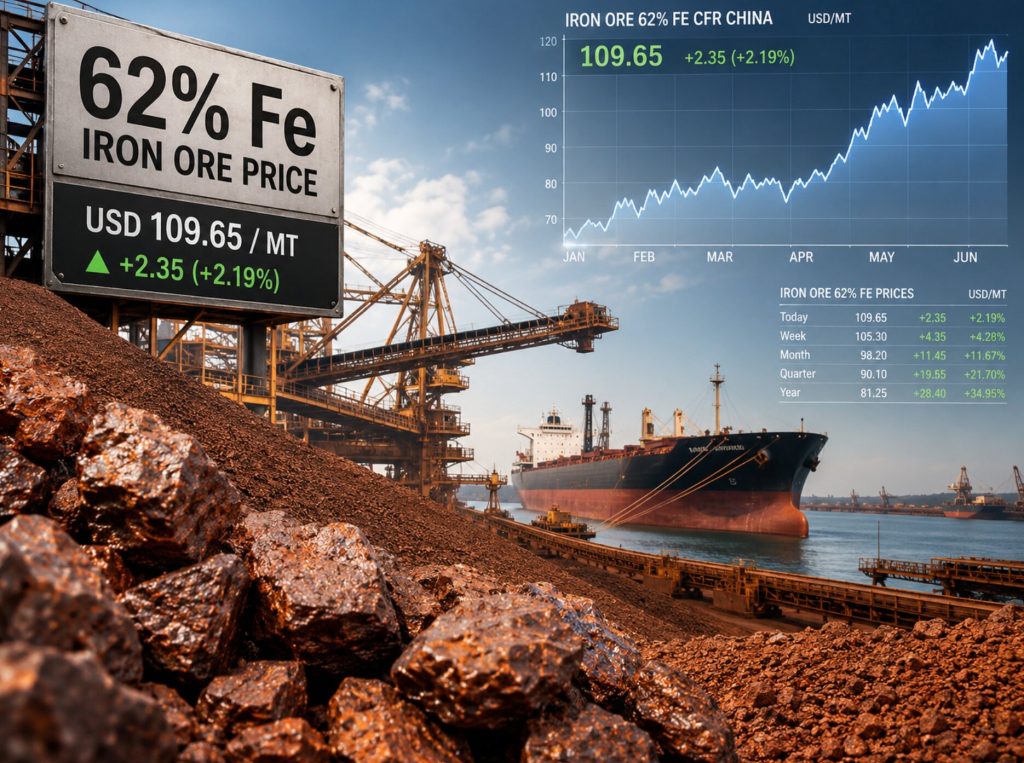
The benchmark entered 2026 with prices close to or slightly above USD 100 per ton. By February 20, Qingdao-delivered 62% Fe material was reported near USD 100.26 per ton, approximately 6.3% below the level recorded on December 26, 2025. This decline reflected cautious steel demand, pressure on mill profitability and expectations of sufficient seaborne supply.
The market subsequently strengthened during April. The average price for 62% Fe ore delivered to Qingdao reached approximately USD 108.78 per ton during the first half of the month, about 2.3% above the corresponding March average. Seasonal construction activity, restocking and changes in steel production expectations contributed to the improvement.
By early July 2026, the market had returned to approximately USD 98–99 per ton. The movement from around USD 108.78 in April to below USD 100 in July illustrates how quickly the iron ore spot price can respond to changing steel margins, policy expectations, inventory levels and supply conditions.
These values should be treated as market references rather than fixed transaction prices. Published indices, futures contracts and physical cargo assessments can differ because they reflect different specifications, delivery periods, liquidity conditions and pricing methodologies. A physical cargo may trade above or below the headline benchmark according to origin, quality and availability.
Buyers should also note that a difference of USD 5 per ton becomes commercially significant at scale. For a 50,000-ton shipment, a USD 5 movement changes the cargo value by USD 250,000 before considering freight adjustments, moisture, port costs or quality penalties.
The USD 100-per-ton level receives considerable attention because it influences sentiment, producer economics and steelmakers’ expectations. However, it should not be treated as a universal break-even point. Large low-cost producers can remain profitable below USD 100, while higher-cost mines may experience significant pressure at the same price.
For buyers, USD 100 is more useful as a psychological and budgeting reference than as a strict indicator of value. A cargo priced at USD 99 may still be relatively expensive when freight, impurities and low metallurgical performance are considered. Conversely, a high-quality cargo priced above USD 100 may reduce coke consumption, slag generation or production losses sufficiently to justify the premium.
Effective procurement therefore requires a value-in-use approach. Buyers should compare the cost per usable iron unit and estimate how the material will perform in their specific production process rather than selecting a cargo solely because its headline price is below a round-number threshold.
The published 62% Fe iron ore price is a reference point. If laboratory analysis confirms that a cargo contains more than 62% iron, the seller may receive a premium. If the cargo contains less, the buyer normally applies a discount or penalty according to the contract’s adjustment formula.
A simplified example demonstrates the impact. Suppose the benchmark is USD 100 per dry metric ton and the contract applies an adjustment of USD 2.00 for each percentage point of Fe above or below 62%. A cargo assaying 61.5% Fe would receive a deduction of approximately USD 1.00 per ton. For a 50,000-ton cargo, that difference equals USD 50,000.
Actual commercial formulas may be more complex. They can include proportional adjustments, fixed differentials, nonlinear penalties outside an accepted range and separate treatment for multiple chemical components. Buyers should confirm the formula before loading rather than attempting to resolve ambiguity after discharge.
Silica and alumina are major gangue components in iron ore. Higher levels generally increase slag volume and may require additional fluxes and energy during ironmaking. Excess alumina can also affect sintering performance and blast-furnace permeability.
For this reason, two cargos with the same Fe percentage may have different commercial values. A 62% Fe cargo with favorable silica and alumina levels may be more valuable than another 62% Fe cargo containing higher impurities. Price assessments commonly define standard impurity levels and calculate penalties when the actual cargo exceeds them.
Buyers should evaluate the combined effect of Fe, silica, alumina and loss on ignition. Focusing only on iron content may lead to an inaccurate estimate of furnace performance and total production cost.
Phosphorus is a critical consideration because excessive phosphorus may affect steel quality and require additional refining effort. Sulfur can also create operational and product-quality challenges. Other elements, including alkalis and certain trace metals, may be restricted according to the mill’s process and final steel specifications.
Commercial contracts normally specify maximum acceptable limits and penalty schedules. Material exceeding a rejection limit may be refused or subject to renegotiation. The financial and operational consequences can be substantial, particularly when a cargo has already arrived at the destination port.
Independent inspection and representative sampling are therefore essential. Stavian Industrial Metal emphasizes documented quality verification so buyers can assess the material before committing it to their production program.
Moisture influences the relationship between wet and dry tonnage. If a cargo contains 8% free moisture, one wet metric ton represents only 0.92 dry metric tons before other adjustments. Since many benchmark prices are quoted on a dry basis, incorrect moisture conversion can distort the apparent purchase cost.
Loss on ignition measures weight change when a sample is heated under specified conditions. It may reflect combined water, carbonates and other volatile components. A high loss-on-ignition value can affect the amount of usable material and the thermal behavior of the ore.
Contracts should define the sampling method, moisture determination, conversion formula and responsible inspection party. Consistency in these procedures reduces settlement disputes and improves cost forecasting.
The iron ore spot price reflects the value of physical material available for relatively prompt shipment or delivery. Spot transactions provide important information about current supply and demand, but individual deals may differ in quality, brand, loading period, port and contractual terms.
Price-reporting agencies collect bids, offers and transactions and normalize them to a defined specification. Their assessments are widely used in contracts, but each index has its own methodology. Buyers must ensure that the selected index matches the physical product and delivery conditions as closely as possible.
A quotation described simply as “iron ore price” is therefore insufficient. It should identify the index, Fe grade, product form, delivery basis, location, quotation date and pricing period.
Iron ore futures are financial contracts linked to the expected value of iron ore for future settlement periods. They are used for price discovery, risk management and speculation. Futures prices may trade above or below current spot prices depending on expectations for supply, demand, inventories and financing costs.
A futures price should not automatically be interpreted as the price at which a buyer can purchase a specific physical cargo. Physical premiums, discounts, freight, quality adjustments and basis risk remain relevant. Nevertheless, futures curves provide useful information about market expectations and can support budgeting or hedging strategies.
Companies using derivatives should understand contract specifications, settlement indices, margin requirements and basis risk. A hedge that references a 62% Fe index may not fully offset the price movement of a lower-grade, higher-grade or differently delivered physical product.
Long-term supply contracts often use an index-linked formula rather than a single fixed price. The final settlement may be based on the average of daily index values during the loading month, shipment month or arrival month, plus or minus quality and brand differentials.
This structure provides transparency and reduces the need to negotiate a completely new price for every shipment. However, the choice of averaging period can materially affect the payable amount in a volatile market. A loading-month average may differ significantly from an arrival-month average when the voyage is long or prices move rapidly.
Buyers should align the pricing period with their inventory, sales and hedging processes. Contract language must clearly define non-publication days, index discontinuation, provisional invoices and final settlement procedures.
The quoted benchmark is only one component of the buyer’s total cost. A practical landed-cost calculation may include the base iron ore value, grade adjustment, impurity penalties, freight, insurance, port charges, inspection, financing, import duties, taxes and inland transportation.
Consider a simplified example for a 50,000-dry-ton cargo:
The indicative pre-tax delivered cost would be USD 108.50 per dry metric ton. At 50,000 dry tons, the total cargo cost would be approximately USD 5.425 million. This example excludes financing, import taxation, demurrage and potential moisture-related differences.
A useful comparison method is to calculate the cost per contained iron unit. At USD 100 per dry ton, a 62% Fe cargo contains approximately 0.62 tons of iron before process losses. Dividing USD 100 by 62 gives an indicative cost of USD 1.613 per percentage point of Fe per ton.
Suppose a 65% Fe cargo costs USD 110 per ton. Its indicative cost per Fe unit is approximately USD 1.692. Based only on iron units, the 62% cargo appears cheaper. However, the 65% cargo may create less slag, support higher productivity or reduce fuel requirements. A complete value-in-use model is needed to determine which option is economically superior.
The correct decision depends on the mill’s burden mix, coke price, furnace constraints, productivity targets, emissions requirements and final steel demand.
Iron ore is traded in large volumes, so apparently minor price changes produce substantial financial exposure. For a 50,000-ton cargo:
This scale explains why steel mills and traders closely monitor index movements and may use averaging formulas or derivatives to manage price risk. It also highlights the importance of accurate sampling: a small quality adjustment can alter the settlement value by tens or hundreds of thousands of dollars.
58% Fe ore is generally priced below the 62% benchmark because it contains fewer iron units and often has higher gangue content. It can be attractive when steel margins are weak and mills prioritize lower upfront raw-material costs.
However, the discount must be sufficient to compensate for lower yield, higher slag generation and possible productivity constraints. Environmental restrictions may also reduce the attractiveness of lower-grade material if mills need to limit fuel consumption or emissions.
The value of 58% Fe ore should therefore be assessed relative to the 62% iron ore benchmark, coke costs and the specific operating conditions of the consuming mill.
High-grade iron ore containing approximately 65% Fe normally trades at a premium to the benchmark. It offers more iron units per ton and may contain lower levels of certain impurities. This can support higher productivity and reduce slag volume.
The premium tends to strengthen when steel margins are high, environmental controls become stricter or mills seek to maximize output from limited furnace capacity. It may weaken when profitability is poor and mills focus on minimizing cash costs.
Buyers should monitor the high-grade premium separately from the benchmark. Even when the 62% Fe iron ore price is stable, changes in the premium can significantly affect the relative economics of premium ore.
Iron ore fines normally require agglomeration through sintering or pelletizing before being charged into a blast furnace. Lump ore can be used more directly, subject to burden design and furnace requirements. Pellets offer consistent size and often higher Fe content but require additional processing during production.
These products are priced with different premiums and adjustments. Lump premiums may reflect the value of avoiding part of the agglomeration process, while pellet premiums incorporate concentration and pelletizing costs as well as metallurgical performance.
Buyers should compare total burden cost rather than purchasing each material independently. The optimal combination of sinter feed, lump and pellets depends on furnace operation, raw-material availability and environmental objectives.
Depending on one mine, origin or trading partner can expose a buyer to operational disruption, weather events, shipping delays and commercial concentration risk. A diversified supplier portfolio improves resilience and gives the procurement team more flexibility when market conditions change.
Diversification should not mean purchasing incompatible materials without technical review. Each ore should be tested for chemistry, size distribution, sintering performance and interaction with the existing burden mix. The objective is to build qualified alternatives that can be substituted without destabilizing production.
Stavian Industrial Metal supports buyers seeking consistent access to internationally sourced iron ore supply with clear product information and quality-control documentation.
Spot purchasing gives buyers flexibility and may capture favorable market opportunities. However, relying entirely on spot cargoes can expose the company to sudden price increases or supply shortages. Formula-based term contracts provide greater predictability but may limit the ability to benefit from temporary discounts.
A blended strategy can balance these considerations. Core volume may be secured under indexed contracts, while a smaller portion is purchased in the spot market. The appropriate ratio depends on production stability, storage capacity, risk tolerance and access to alternative suppliers.
Procurement teams should define decision rules in advance, including inventory thresholds, maximum spot exposure and acceptable price differentials. This reduces the risk of making large purchasing decisions based solely on short-term market sentiment.
Total inventory tonnage can be misleading when production rates change. A mill holding 500,000 tons has 25 days of supply at a consumption rate of 20,000 tons per day but only 16.7 days at 30,000 tons per day.
Inventory should therefore be monitored in days of consumption, with separate visibility for each qualified grade and brand. Buyers should also account for cargoes at sea, port congestion, unloading capacity and inland transportation constraints.
A disciplined inventory model helps avoid emergency purchases when prices are high. It also prevents excessive stock accumulation, which increases financing costs and exposes the company to inventory losses when market prices fall.
A reliable iron ore contract should specify Fe content, moisture, silica, alumina, phosphorus, sulfur, size distribution and other relevant characteristics. It should define the basis price, adjustment formulas, sampling procedure, inspection company, rejection limits and dispute-resolution process.
Terms such as “typical specification” and “guaranteed specification” should not be used interchangeably. A typical value describes expected quality, while a guaranteed limit establishes a contractual obligation. Buyers should identify which parameters are guaranteed and how deviations will be handled.
Clear contract language reduces settlement delays and protects both parties when laboratory results differ from expectations.
The lowest quotation may not deliver the lowest total cost. Delayed shipments, inconsistent quality, incomplete documentation and poor communication can interrupt production and create additional expenses. Supplier evaluation should include delivery performance, cargo traceability, inspection procedures, financial capability and issue-resolution history.
For industrial consumers, supply continuity can be as important as a small unit-price saving. A reliable partner should provide timely shipping documents, quality certificates and updates throughout the transaction.
Stavian Industrial Metal combines product sourcing with quality verification and logistics coordination to support stable raw-material procurement for steel-industry customers.
Stavian Industrial Metal supplies iron ore for industrial and steelmaking applications. The company emphasizes transparent product origin, quality inspection and certification by an independent inspection organization. These controls help buyers evaluate chemistry and cargo conformity before the material enters production.
For customers purchasing material against the 62% Fe iron ore price, the most suitable product is benchmark-grade iron ore fines or another qualified grade selected according to the buyer’s furnace requirements. Product selection should consider Fe content, silica, alumina, phosphorus, sulfur, moisture, size distribution and expected metallurgical performance.
Stavian Industrial Metal also focuses on supply availability and logistics infrastructure, helping customers reduce the risk of interruptions in raw-material trading and delivery.
Some customers may prefer to purchase semi-finished steel rather than process iron ore through ironmaking and primary steelmaking. Steel billet is suitable for rolling mills producing rebar, wire rod and other long products. Its cost is influenced by iron ore, coking coal, scrap, energy and regional steel-market conditions.
Purchasing billet can reduce the need for upstream production assets, although the buyer remains exposed to conversion margins and billet availability. Mills should compare the delivered billet price with the internal cost of producing crude steel from raw materials.
Stavian Industrial Metal suppliessteel billet for re-rolling alongside upstream raw materials, allowing industrial customers to evaluate alternative positions within the steel value chain.
Hot-rolled steel is a suitable finished or intermediate material for structural fabrication, pipes, machinery, transport equipment and general manufacturing. Its price is connected to the cost of iron ore and other steelmaking inputs, but it is also affected by rolling costs, capacity utilization, regional demand and trade measures.
Buyers that do not operate primary or secondary steelmaking facilities can source hot-rolled products directly instead of purchasing ore or billet. Specifications should be selected according to thickness, width, grade, mechanical properties, surface condition and end-use requirements.
Stavian Industrial Metal provides hot-rolled steel products for customers requiring practical material solutions for industrial processing and manufacturing.
Price forecasts are scenarios rather than guarantees. Iron ore is affected by multiple variables that can change rapidly, including Chinese steel output, weather, mine disruptions, port inventories, freight and government policy. A forecast should therefore be evaluated according to its assumptions, time horizon and sensitivity to alternative outcomes.
For the remainder of 2026, the market’s position near USD 98–99 per ton suggests that supply availability and cautious steel demand are limiting upward pressure. However, the movement above USD 108 during April demonstrates that seasonal restocking or improved steel expectations can still generate meaningful rallies.
Rather than relying on a single number, buyers should prepare at least three budgeting cases:
A practical weekly dashboard should include the current 62% Fe spot assessment, futures curve, high-grade and low-grade differentials, steel mill margins, blast-furnace utilization, Chinese port stocks and daily port outflows. Freight rates and major producer shipment data should also be included.
Finished-steel indicators provide essential context. Rising rebar or hot-rolled coil prices can improve mill margins and support raw-material demand. Falling steel prices combined with stable ore costs often pressure margins and may cause mills to reduce purchasing.
The objective is not to predict every daily movement. It is to identify whether market conditions are tightening, loosening or remaining balanced so procurement decisions can be made with greater discipline.
Longer-term analysis should review Chinese property investment, infrastructure spending, manufacturing activity, steel exports, global mine production and new supply projects. Major producers’ quarterly reports provide information on shipments, operating costs, maintenance and production guidance.
Buyers should also monitor regulatory changes and decarbonization policies. The transition toward electric-arc furnaces, direct-reduced iron and lower-emission steelmaking may gradually change the preferred mix of iron ore grades and processed products.
These structural trends may not determine tomorrow’s price, but they influence long-term demand quality, grade premiums and the strategic value of secure supply relationships.
In early July 2026, commonly followed market references placed the price near USD 98–99 per dry metric ton. One indicator recorded approximately USD 98.57 per ton on July 10, 2026. Actual cargo prices can differ according to the assessment provider, delivery period, brand, origin, chemistry and commercial terms.
Because iron ore trades continuously across physical and derivatives markets, buyers should verify the applicable index and quotation date when preparing a purchase or budget.
62% Fe is generally considered benchmark or medium-grade iron ore in the international market. Material near 58% Fe is categorized as lower grade, while ore containing about 65% Fe or more is commonly described as high grade.
However, Fe content alone does not determine quality. Silica, alumina, phosphorus, moisture, size distribution and metallurgical behavior also influence the ore’s value to a steel mill.
Iron ore contains moisture, and moisture levels differ between cargos. Pricing on a dry metric ton basis removes the weight of water and makes the underlying quantity of dry material easier to compare.
The payable wet tonnage must be converted according to the measured moisture content and the contract’s agreed formula. Accurate moisture testing is therefore financially important.
Cargos with the same nominal Fe grade may differ in silica, alumina, phosphorus, sulfur, moisture, loss on ignition, particle size, origin, availability and brand reputation. These differences affect sintering, blast-furnace productivity, slag generation and fuel consumption.
Freight, payment terms, shipment timing and destination port also affect the final quotation. The headline Fe percentage should therefore be treated as only one part of the evaluation.
Iron ore is a major raw material for blast-furnace steelmaking. When ore prices rise without a corresponding increase in finished-steel prices, mill margins can decline. Mills may attempt to pass higher costs to customers, reduce production or change their burden mix.
The relationship is not one-to-one because steel prices also depend on coking coal, scrap, energy, labor, rolling costs, capacity utilization and end-user demand.
A price below USD 100 may present an attractive purchasing opportunity, but the decision should depend on inventory needs, steel margins, market direction, product quality and total landed cost. A lower benchmark does not guarantee that every cargo is competitively priced.
Buyers should compare the offer with recent averages, futures prices, freight rates and alternative grades. Purchasing can also be divided into several tranches to reduce timing risk.
The 62% Fe iron ore price is the central benchmark for the global seaborne iron ore trade and a critical cost indicator for blast-furnace steelmakers. In July 2026, the market was positioned near USD 98–99 per dry metric ton after trading above USD 108 per ton during part of April. The recent 52-week range of approximately USD 96.50–111.42 per ton highlights the need for active market monitoring and disciplined purchasing.
Buyers should not evaluate iron ore solely through the published benchmark. The final economic value depends on Fe content, silica, alumina, phosphorus, sulfur, moisture, freight, port expenses and metallurgical performance. Cost-per-iron-unit and value-in-use calculations provide a more accurate comparison between 58%, 62% and 65% Fe materials.
Stavian Industrial Metal supports steel producers, traders and industrial customers with iron ore, steel billet, hot-rolled steel and other metal products. Through transparent origin information, independent quality inspection and coordinated supply capabilities, Stavian Industrial Metal helps customers manage quality risk, purchasing costs and continuity across the steel value chain.
Address
Website: https://stavianmetal.com
Email: info@stavianmetal.com