Iron Ore Mining is the industrial process of extracting iron-bearing minerals from the earth and preparing them for use in iron and steel production. Although iron occurs widely in the planet’s crust, only deposits with suitable iron content, mineralogy, scale, location and processing characteristics can be developed economically. The resulting products—such as lump ore, fines, concentrates and pellets—form the primary metallic feedstock for blast furnaces and direct reduction plants worldwide.
The scale of the sector reflects its strategic importance. Global usable iron ore mine production was estimated at approximately 2.6 billion metric tons in 2025. Australia produced about 980 million tons, Brazil approximately 420 million tons, India around 310 million tons and China roughly 290 million tons. Together, these four countries represented close to 77% of estimated global output. Australia and Brazil remain especially influential because their large, high-volume mining systems supply a substantial share of the seaborne market.
For steel manufacturers, traders, fabricators and industrial buyers, understanding Iron Ore Mining is important because ore grade, impurities, physical size, moisture and processing route affect every downstream stage. These variables influence coke consumption, furnace productivity, slag generation, energy use, emissions, steel cleanliness and ultimately the cost of finished products. Stavian Industrial Metal provides this detailed overview to explain how iron ore moves from a geological resource to a commercially usable steelmaking material.
Iron Ore Mining involves locating an economically viable mineral deposit, removing overburden and waste rock, extracting iron-bearing material and processing it into a product that meets steelmaking specifications. The activity is not limited to digging ore from the ground. A complete operation may include geological modelling, drilling, blasting, crushing, screening, concentration, filtration, pelletizing, stockpiling, rail transport, port handling and environmental rehabilitation.
Iron ore is valuable because it contains iron minerals that can be reduced into metallic iron. The most important minerals are hematite, with the chemical formula Fe2O3, and magnetite, with the formula Fe3O4. Other iron-bearing minerals include goethite, limonite and siderite. The theoretical iron content of pure hematite is about 69.9%, while pure magnetite contains approximately 72.4% iron. Natural ore, however, also includes silica, alumina, phosphorus, sulfur, moisture and other gangue minerals.
A deposit becomes a mine only when its expected revenues justify the capital and operating costs required for development. High iron content alone does not guarantee commercial success. Mining companies must also evaluate stripping ratio, ore hardness, processing recovery, water availability, power supply, logistics, environmental restrictions, workforce access, commodity prices and the anticipated life of the resource.
An iron ore resource is a concentration of mineralized material with reasonable prospects for eventual economic extraction. A reserve is the economically mineable part of a measured or indicated resource after technical, financial, legal, environmental and social factors have been assessed. Reserves are therefore more restrictive than resources and provide a stronger basis for production planning and investment decisions.
Current estimates place global iron ore reserves at approximately 200 billion metric tons of crude ore containing about 87 billion tons of iron. Australia has the largest reported reserve base, with roughly 59 billion tons of crude ore and approximately 27 billion tons of contained iron. Brazil, Russia, China and Ukraine also hold substantial deposits. These figures can change as new exploration data becomes available, extraction technologies improve or economic assumptions are revised.
Mining companies regularly update their models because every ton of material does not have the same value. An operation may classify part of a deposit as high-grade direct-shipping ore, another part as material requiring beneficiation and a lower-grade section as uneconomic waste under current conditions. A change in iron ore prices, processing costs or product premiums may alter these classifications.
Hematite iron ore is one of the most important feedstocks for global steelmaking. High-grade hematite deposits can often be crushed and screened into saleable products without intensive concentration. This characteristic has supported the growth of major direct-shipping operations in Australia and Brazil, where large-scale mines are connected to dedicated railways and export terminals.
Commercial hematite products commonly contain approximately 58% to more than 65% iron. Higher-grade material generally commands a premium because it introduces more iron units and less gangue into the furnace. Lower silica and alumina can reduce slag volume, lower flux requirements and support improved blast furnace productivity. Nevertheless, the value of a cargo depends on its complete chemical and physical specification rather than iron content alone.
Hematite may be sold as fines for sintering, calibrated lump ore for direct furnace charging or feedstock for beneficiation and pellet production. Its suitability depends on particle size distribution, reducibility, degradation behavior, moisture and impurity levels.
Magnetite has a high theoretical iron content and strong magnetic properties, but many magnetite deposits occur in low-grade rock that requires extensive processing. The mined material is typically crushed and ground into fine particles before magnetic separation recovers the iron-rich fraction. The concentrate may then be filtered and converted into pellets.
Magnetite projects can require more electricity than direct-shipping hematite operations because of the energy needed for fine grinding. However, beneficiation can produce concentrates with iron content above 65% and relatively controlled impurity levels. These characteristics are increasingly important for efficient blast furnaces and direct reduction processes.
Magnetite oxidation also releases heat during agglomeration, which can partially support pellet induration. The overall environmental and commercial performance of a magnetite project therefore depends on ore hardness, power source, recovery rate, concentrate quality, tailings management and transportation distance.
Goethite and limonite are hydrated iron minerals that often occur in weathered deposits. They can contain significant chemically bound water, creating additional mass loss during heating. This characteristic affects furnace energy requirements and may reduce the effective quantity of iron delivered per wet ton.
Siderite is an iron carbonate mineral with a lower theoretical iron content than hematite or magnetite. It generally requires calcination or additional treatment before efficient use. Because of these processing requirements, siderite is less dominant in international iron ore trade.
Buyers should avoid evaluating ore solely by mineral name. Two hematite products from different mines may perform differently because of variations in porosity, mineral associations, impurity distribution, strength and thermal behavior. Laboratory analysis and metallurgical testing are therefore essential before a new ore is introduced into a steel plant burden.
The Iron Ore Mining process begins with exploration. Geologists study regional structures, historical records, satellite imagery and geophysical data to identify potential deposits. Field teams then conduct mapping, sampling and drilling to determine the depth, thickness, grade and continuity of mineralization.
Core samples and drill cuttings are tested for iron content, mineralogy, density, moisture and impurities. The results are entered into three-dimensional geological models that estimate the amount and distribution of ore. Because drilling covers only a small portion of the deposit, geostatistical methods are used to interpolate conditions between known data points.
A reliable model supports mine design and reduces the risk of unexpected variations during production. Poor geological control can result in unstable plant feed, excessive dilution, lower recovery and off-specification shipments. Mature operations therefore continue drilling throughout the mine life rather than relying only on information collected during initial development.
After a commercially promising deposit is identified, engineers determine how it should be mined. They design pit limits, benches, haul roads, waste dumps, stockpiles, drainage systems and processing facilities. The schedule must balance ore quality, stripping requirements, equipment capacity, customer demand and cash flow.
One key indicator is the stripping ratio, which compares the volume or mass of waste removed with the quantity of ore recovered. A rising stripping ratio increases drilling, blasting, loading, hauling and waste-management costs. Deposit geometry and slope stability therefore have a direct impact on project economics.
Before production begins, the operator may need to build roads, power lines, water systems, accommodation, rail infrastructure and port facilities. Large iron ore projects frequently require billions of dollars in capital and several years of permitting and construction. Logistics can represent a decisive part of the investment, particularly when deposits are located hundreds of kilometers from an export terminal.
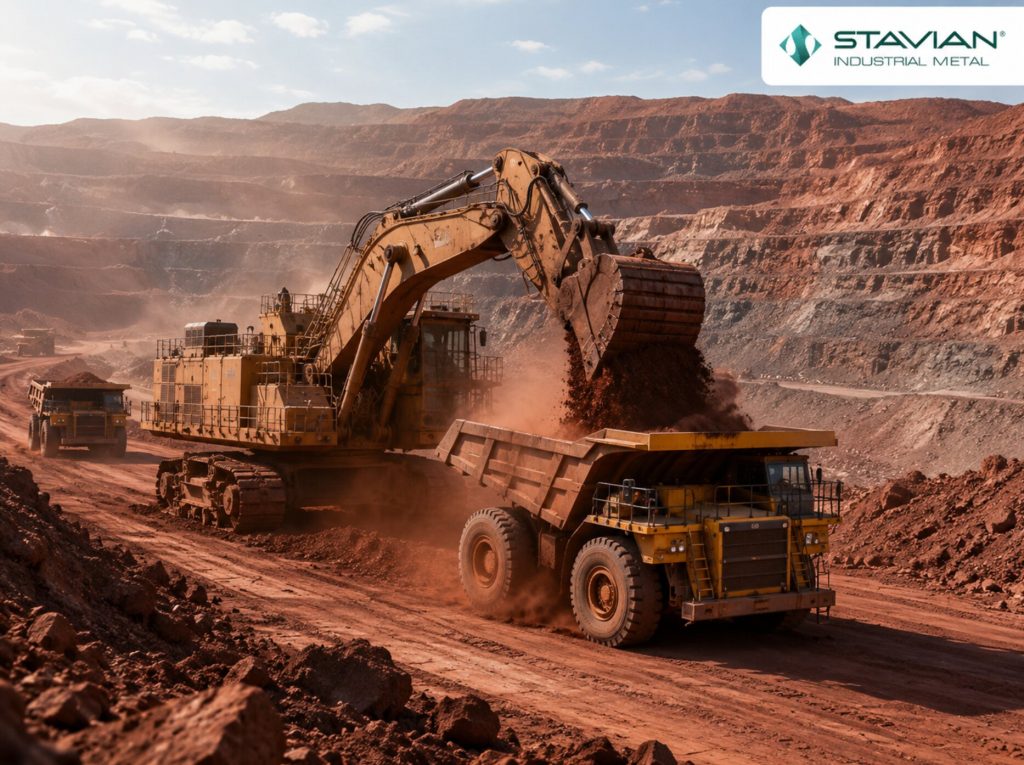
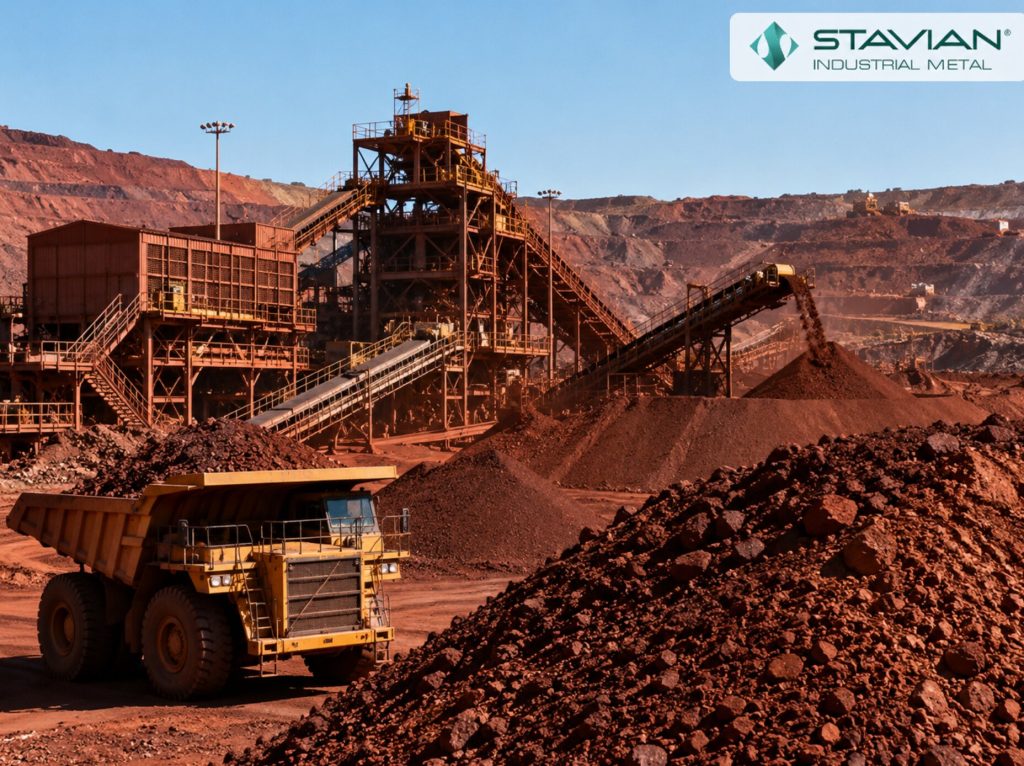
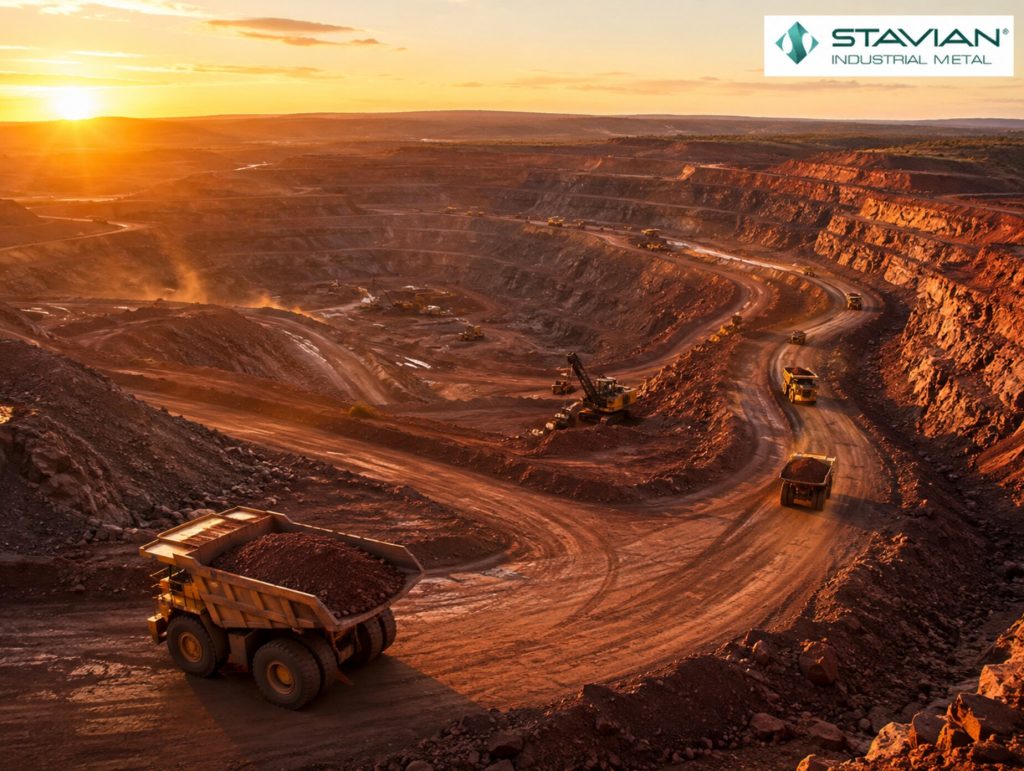
Most large iron ore mines operate as open pits. Production drills create patterned blast holes across designated benches. Explosives are loaded into the holes and detonated according to a controlled sequence that fragments the rock while managing vibration, flyrock and wall damage.
Effective blasting should produce fragments that excavators can load efficiently and crushers can process without excessive energy consumption. Oversized blocks may require secondary breaking, while excessive fines can complicate handling and reduce lump recovery. Modern mines use electronic detonators, blast modelling and fragmentation analysis to improve consistency.
Selective blasting also helps limit dilution. Dilution occurs when waste rock is unintentionally mixed with ore, reducing feed grade. Ore loss is the opposite problem: valuable material is incorrectly classified or left behind. Both conditions weaken recovery and financial performance.
After blasting, hydraulic excavators or electric shovels load material into large haul trucks. Ore is transported to crushers or run-of-mine stockpiles, while waste is moved to designated disposal areas. Some operations increasingly use autonomous haulage systems to improve consistency, reduce exposure to hazardous conditions and optimize fleet utilization.
Grade-control teams determine where ore and waste boundaries lie within each mining block. They use blast-hole assays, geological observations, sensors and real-time dispatch information to direct equipment. Different ore types may be sent to separate stockpiles for blending before processing.
Blending is crucial because a processing plant and its customers require stable feed. A mine may combine higher-grade ore with lower-grade material to achieve a consistent iron specification while controlling silica, alumina and phosphorus. Proper blending allows the operation to use more of the deposit without causing unacceptable product variability.
Run-of-mine ore may contain fragments ranging from fine particles to rocks larger than one meter. Primary crushers reduce the largest pieces, while secondary and tertiary units may perform additional size reduction. Screens then separate material into defined size fractions.
For direct-shipping operations, crushing and screening may be sufficient to create lump and fines products. Lump ore often falls within a range such as 6–30 millimeters, although exact specifications vary. Fines below the lump threshold are generally supplied to sinter plants or used as pellet feed after further treatment.
Size control affects shipping, handling and furnace behavior. Excessive ultrafines can create dust, increase moisture retention and reduce bed permeability. Oversized material may reduce reaction uniformity. Product specifications therefore include particle size distribution in addition to chemical composition.
Iron ore beneficiation removes gangue and raises the concentration of iron. Depending on the ore, the flowsheet may use crushing, grinding, washing, screening, gravity separation, magnetic separation, flotation or combinations of these methods.
Magnetite is commonly recovered through magnetic separators after fine grinding. Some hematite deposits require gravity separation or flotation to remove silica. The objective is to maximize iron recovery while producing a concentrate that meets chemical and particle-size requirements.
Beneficiation creates tailings consisting of finely ground waste minerals and process water. Tailings storage and water management are among the most important technical and environmental responsibilities at a mine. Operators must control embankment stability, seepage, dust, water quality and long-term closure risks. Dry stacking, filtered tailings and improved monitoring are being adopted where technically and economically feasible.
Finely ground concentrate cannot always be charged directly into a blast furnace because it can restrict gas flow. Pelletizing converts the concentrate into strong, rounded agglomerates, commonly measuring about 8–16 millimeters. The concentrate is mixed with binders and, where necessary, fluxes before being rolled into green pellets.
The green pellets are dried, heated and hardened in an induration furnace. Finished pellets must withstand storage, shipping and handling while maintaining suitable reducibility inside the ironmaking unit. Products may be designed for blast furnaces or direct reduction plants.
Direct reduction pellets generally require higher iron content and tighter control of silica, alumina, phosphorus and sulfur. As steel producers invest in natural-gas- and hydrogen-based direct reduction, demand for high-grade pellet feed and DR-quality pellets is expected to become increasingly important.
Lump ore is a sized product that can be charged directly into a blast furnace without sintering or pelletizing. It can reduce the need for agglomeration capacity, but the product must possess adequate strength, reducibility and resistance to thermal degradation.
A high iron percentage does not automatically make a lump product suitable. If it generates excessive fines during transport or heating, furnace permeability may deteriorate. Steelmakers commonly examine tumble strength, reduction degradation index, reducibility and softening-melting behavior before selecting a lump ore.
The proportion of lump used in the burden depends on availability, price, furnace design and the performance of alternative materials. Lump premiums can therefore change considerably with market conditions.
Fines represent a major share of internationally traded iron ore. They are generally blended with fluxes and recycled iron-bearing materials before being agglomerated in a sinter plant. The resulting sinter provides a permeable blast furnace burden with controlled chemistry.
Fines are commonly benchmarked around standard iron grades, including the widely referenced 62% Fe category. Commercial adjustments may apply for deviations in iron, silica, alumina, phosphorus, moisture and particle size. High-grade fines can command premiums, while excessive impurities usually lead to penalties.
Because fines can retain significant water, moisture measurement is important in commercial transactions. Cargoes are often traded on a dry-metric-ton basis, so inaccurate moisture determination can cause disagreement over the actual amount of contained material.
Concentrate is a fine, upgraded product created through beneficiation. Its iron content is often higher than that of untreated ore, but its very fine particle size requires agglomeration or specialized handling. Pellet feed specifications may include surface area, particle-size distribution and filtration behavior in addition to chemistry.
Pellets offer consistent sizing, high mechanical strength and controllable metallurgical characteristics. Acid pellets, fluxed pellets, blast furnace pellets and direct reduction pellets serve different operating requirements. Their higher processing level typically results in a price premium over standard fines.
Industrial buyers reviewing iron ore products should define the intended furnace route, acceptable impurity limits, size specification, moisture basis and required documentation before confirming a purchase.
Estimated global usable ore production remained near 2.6 billion metric tons in both 2024 and 2025, although performance varied by country. Australia produced approximately 980 million tons in 2025, slightly below its estimated 2024 level. Brazil produced around 420 million tons, while India increased output to about 310 million tons. China produced approximately 290 million tons, but its domestic material often requires beneficiation because of lower average grades.
In iron-content terms, global mine production was estimated at roughly 1.6 billion tons in 2025. Australia contributed approximately 600 million tons of contained iron and Brazil around 260 million tons. This distinction is important because two countries may report similar quantities of crude or usable ore while supplying different amounts of actual iron.
Seaborne trade is more concentrated than total mine production. Australia’s large Pilbara operations and Brazil’s integrated mine-rail-port systems supply major steel-producing markets in Asia. China is the largest iron ore importer, and changes in its steel output, port inventories, property activity, environmental policies and mill margins can materially influence global prices.
Australia combines extensive hematite deposits, large mines, established rail networks and high-capacity ports. Its geographic position also provides relatively efficient shipping access to East Asian markets. The scale of these systems allows producers to move hundreds of millions of tons annually.
Brazil possesses high-quality ore bodies, including products with iron content above common benchmark grades. Higher-grade Brazilian material can support lower slag generation and improved furnace efficiency, although the longer voyage to Asian customers increases freight exposure.
Both countries benefit from decades of infrastructure development and customer qualification. New producers must compete not only on grade but also on volume reliability, loading performance, product consistency, shipping frequency and technical support.
India’s estimated iron ore output rose from approximately 282 million tons in 2024 to 310 million tons in 2025. Much of the material supports domestic steel expansion. As India develops infrastructure, manufacturing and construction capacity, its balance between domestic consumption and exports will become increasingly relevant to regional markets.
New and expanding projects in Africa may gradually diversify seaborne supply. However, bringing a large deposit into production requires more than constructing a mine. Railways, bridges, power systems, ports and cross-border agreements may determine whether the ore can reach customers reliably and at a competitive delivered cost.
Emerging suppliers must also demonstrate consistent product quality. Steelmakers are cautious when changing burden composition because variations can affect sinter performance, coke rate, hot-metal chemistry and furnace stability.
Iron content is the most visible quality indicator because it represents the proportion of useful metal in the ore. A higher Fe grade generally reduces the mass of material required to deliver each ton of iron. It can also reduce gangue input, slag generation and energy consumption.
The economic value of a one-percentage-point increase depends on furnace conditions and market spreads. During periods of strong steel margins or strict production limits, mills may pay more for premium grades that support higher output. When margins are weak, buyers may increase their use of discounted lower-grade ores.
Grade must be assessed on a dry basis and verified through representative sampling. Errors can occur when a cargo contains segregated size fractions or moisture varies across a stockpile.
Silica and alumina are major gangue components. They usually require fluxes such as limestone or dolomite and leave the furnace as slag. Higher gangue levels increase slag volume, coke consumption and handling requirements.
Alumina can be particularly challenging because it affects slag viscosity and sinter quality. The acceptable silica-to-alumina relationship depends on the plant’s burden mix, flux availability and operating practice. A mill may therefore value two ores with the same iron content differently.
Buyers should evaluate the total burden rather than one cargo in isolation. A higher-alumina ore may remain usable when blended with low-alumina material, provided the resulting mixture stays within operational limits.
Phosphorus can reduce steel toughness and may require additional refining effort. Ores with elevated phosphorus are typically discounted unless a steel plant has an effective removal route or produces grades with less restrictive limits.
Sulfur is also undesirable because it can contribute to hot shortness and interfere with steel quality. Sulfur may enter ironmaking through ore, coke and injected fuels. Control across all raw materials is therefore necessary.
Trace elements such as arsenic, lead, zinc, copper, alkalis and chlorine may also affect furnace operation, emissions, refractory life or finished-steel properties. A comprehensive certificate of analysis should cover relevant minor elements rather than reporting only Fe, silica and alumina.
Moisture affects the payable dry tonnage and the energy required to heat a burden. Excessive water can also create handling problems, especially during wet seasons. Fine products may become sticky, block transfer points or increase the risk of cargo liquefaction if transportable moisture limits are not properly managed.
Loss on ignition measures mass lost when a sample is heated under specified conditions. It may reflect bound water, carbonates or other volatile components. Goethitic ores can show higher loss on ignition because of their hydrated mineral structure.
Moisture and loss on ignition should not be treated as the same parameter. Free water affects shipping mass and handling, while chemically bound water influences thermal behavior during processing.
Size distribution influences permeability, sintering and material handling. Strength tests indicate how much degradation may occur before the ore reaches the furnace. Reducibility measures how readily oxygen can be removed from the iron oxides, while reduction degradation tests assess the generation of fines during early reduction.
For pellets and lump ore, swelling, softening and melting characteristics are also important. Excessive swelling can reduce bed permeability, while unfavorable softening behavior may disrupt gas flow in the lower furnace.
Steelmakers often conduct trial campaigns before adopting a new source. Commercial samples should therefore be representative of long-term production rather than specially selected high-quality material.
The traditional integrated steelmaking route uses iron ore, metallurgical coal and fluxes. Iron ore fines are generally converted into sinter, while concentrates may be pelletized. These agglomerated materials, together with lump ore, are charged into a blast furnace. Carbon monoxide generated from coke reduces the iron oxides, producing hot metal that is refined in a basic oxygen furnace.
An alternative route converts pellets or lump ore into direct reduced iron using natural gas or hydrogen-rich reducing gas. The DRI is then melted in an electric arc furnace, often together with steel scrap. Direct reduction requires high-quality feed because the process has less ability than a blast furnace to accommodate gangue.
After primary steelmaking, molten steel is cast into semi-finished forms. Billet is used for long products such as bar and wire rod, while slab is used for flat products such as plate and coil. Companies sourcing downstream feedstock may therefore consider qualified steel billet and slab products alongside their iron ore and metallic raw-material strategies.
A higher-grade ore can deliver more iron with less burden mass. This can lower slag volume and reduce the energy needed to melt impurities. It may also increase productivity when furnace capacity is limited by gas flow or slag handling.
However, the highest-grade ore is not automatically the lowest-cost choice. Procurement teams compare the premium against savings in coke, flux, transport, emissions and production time. They also assess whether the ore improves sinter strength, burden permeability and hot-metal chemistry.
The optimum blend changes with raw-material prices and operating priorities. A mill maximizing production may prefer premium ore, while a mill operating below capacity may focus more heavily on purchase price.
Open-pit mining changes landforms and removes vegetation across mine areas, roads, waste dumps and infrastructure corridors. Responsible operations identify sensitive habitats, separate topsoil, control erosion and progressively rehabilitate areas no longer needed for production.
Rehabilitation may include reshaping slopes, replacing soil, restoring drainage and establishing native vegetation. Successful closure requires long-term monitoring because physical and ecological stability may take years to confirm.
Mine planning should incorporate closure from the beginning rather than treating it as an end-of-life activity. Progressive rehabilitation can reduce final liabilities and demonstrate performance to regulators and communities.
Water is used for mineral processing, dust suppression and equipment cleaning. Mines must balance operational demand with local availability, particularly in dry regions. Recycling process water reduces freshwater withdrawal but requires treatment and careful control of dissolved contaminants.
Tailings facilities must be designed, operated and monitored according to site-specific geotechnical conditions. Instrumentation may track pore pressure, seepage, movement and water levels. Emergency planning and independent review are essential because a failure can have severe human and environmental consequences.
Filtered or dry-stacked tailings can reduce stored water and improve material stability in certain conditions, but they require additional filtration equipment, energy and handling capacity. No single method is appropriate for every deposit.
Mining emissions arise from diesel equipment, electricity consumption, explosives, processing and transportation. Magnetite concentration can be especially energy intensive because fine grinding is required. Operations can reduce emissions through renewable electricity, efficient comminution, electric haulage, trolley-assist systems and optimized logistics.
The wider iron and steel industry accounts for roughly 7% of global energy-related carbon dioxide emissions. Most of this impact occurs during ironmaking and steelmaking rather than ore extraction, but mine product quality influences downstream energy use. High-grade ore can reduce gangue processing, while DR-grade material supports lower-carbon direct reduction routes.
As steel customers measure product-level emissions, mining companies face growing demand for transparent data covering energy sources, operational emissions, shipping and beneficiation.
Digital technologies are improving geological interpretation, equipment utilization and product quality. High-precision positioning systems guide drills and excavators, while fleet-management platforms allocate trucks according to crusher demand and haul-road conditions. Drones and laser scanners capture rapid surveys of pits, stockpiles and waste facilities.
Autonomous trucks can operate continuously with consistent speeds and reduced variability. Remote operation centers allow teams to supervise multiple parts of the value chain from centralized locations. Predictive-maintenance systems analyze vibration, temperature and lubricant data to identify equipment problems before failure.
Ore-sorting sensors are another important development. X-ray, optical, magnetic or other sensing systems can distinguish mineralized material from waste before energy-intensive grinding. When the ore body is suitable, early waste rejection increases plant feed grade and lowers water and energy consumption per ton of product.
Artificial intelligence can combine geological, operational and market data to improve short-term scheduling. Models may recommend which mining blocks to extract, how to blend stockpiles and when to ship particular products. The objective is to meet customer specifications while maximizing recovery and minimizing rehandling.
Integrated planning is especially valuable for operations with several mines, processing plants, rail lines and ports. A disruption at one point can affect the entire system. Digital twins allow operators to test alternative schedules before implementing them.
Technology does not eliminate the need for experienced personnel. Algorithms depend on accurate data, appropriate assumptions and human oversight. Cybersecurity, system reliability and workforce training become more important as operations become increasingly connected.
Scrap-based electric arc furnaces will play a growing role in steel decarbonization, but scrap alone cannot satisfy all future demand or quality requirements. Primary iron production from ore will remain necessary to replace metal lost through oxidation, support expanding steel stocks and dilute residual elements in recycled material.
The key change is the method used to remove oxygen from the ore. Conventional blast furnaces rely heavily on carbon, while direct reduction can use natural gas and progressively higher proportions of hydrogen. When hydrogen is produced from low-carbon electricity, the process can substantially reduce direct carbon emissions.
This transition creates a stronger requirement for high-grade concentrate and pellets. Direct reduction plants typically need products with high iron content and low gangue because impurities remain in the solid DRI and must later be melted as slag. Mining companies are therefore investing in beneficiation, pellet feed capacity and new product development.
Not every deposit can economically produce direct-reduction-quality material. Upgrading lower-grade ore may require very fine grinding, flotation, additional water, energy and tailings capacity. The environmental benefit at the steel plant must therefore be considered together with the processing impact at the mine.
There is also a timing challenge. New direct reduction plants require confidence that suitable feed will be available over decades, while mining companies need long-term demand commitments before approving major beneficiation investments.
Collaboration between miners, pellet producers, steelmakers, energy suppliers and logistics companies will be necessary. Product specifications may evolve as furnace technologies become more flexible and as new methods for processing gangue-rich DRI are commercialized.
Stavian Industrial Metal participates in the industrial metals value chain by providing products and commercial solutions for domestic and international customers. Its portfolio includes iron ore, steel billet, hot-rolled steel, cold-rolled steel, coated steel, project steel and shipbuilding steel, as well as aluminum, copper and zinc products.
For manufacturers that convert primary steel into structural, mechanical or fabricated products, hot-rolled coil and plate are particularly relevant. These materials originate from slab produced after ironmaking, steel refining and continuous casting. They are widely used in construction structures, machinery, industrial frames, tanks, pipes, automotive components and general fabrication.
Customers can review hot-rolled steel from Stavian Industrial Metal when selecting materials for applications that require suitable strength, weldability, formability and dimensional specifications. Procurement should be based on the intended use, steel grade, applicable standard, thickness, width, surface condition, edge condition, mechanical properties and required mill documentation.
Iron ore and finished steel markets are connected, but price movements do not pass through at a fixed ratio. Steel costs also reflect coal, scrap, alloys, energy, electrodes, freight, labor, capacity utilization and trade measures. A supplier with knowledge across several stages of the value chain can help industrial buyers understand how raw-material changes may affect product availability and lead times.
Stavian Industrial Metal combines industrial-metal trading with domestic and international business solutions, logistics coordination and risk-management support. The wider Stavian Group operates across more than 100 countries and territories, with over 30 global branches and a network of approximately 20,000 customers and partners.
For buyers, the practical priority is not simply access to material. It is access to products with suitable specifications, traceable documentation, appropriate delivery planning and commercial terms aligned with production requirements.
The amount varies by ore grade, furnace route, yield and burden composition. A conventional integrated mill may require roughly 1.4–1.6 tons of iron ore to produce one ton of crude steel, together with coke, pulverized coal, fluxes and recycled steel. Lower-grade ore or higher process losses can increase the required quantity.
This figure should be treated as an operational range rather than a universal conversion factor. Blast furnaces use different proportions of sinter, pellets and lump ore, while the basic oxygen furnace may include a significant scrap charge.
Electric arc furnaces using primarily scrap require little or no direct iron ore input, although they may consume DRI or hot-briquetted iron produced from ore.
In commercial terms, ore above approximately 62% Fe is generally considered higher grade than many standard products, while material around 65% Fe or above is commonly marketed as premium grade. Direct reduction feed may require even tighter specifications.
Iron percentage is only one part of the classification. A high-Fe ore with elevated phosphorus or poor physical strength may be less desirable than a slightly lower-grade product with cleaner chemistry and better furnace performance.
The definition also changes with market conditions. Premiums tend to widen when mills prioritize productivity, emissions reduction and lower coke rates.
Most global iron ore production comes from open-pit mines because many major deposits are large, near the surface and suitable for high-volume extraction. Open-pit methods allow large equipment and generally provide lower unit costs than underground mining.
Underground extraction may be used where ore bodies extend to depth, surface constraints are significant or the value of the deposit supports higher mining costs. The chosen method depends on geometry, rock conditions, grade, environmental factors and economics.
Steel scrap can be recycled repeatedly and is essential to a circular economy, but it cannot completely eliminate primary iron demand under foreseeable conditions. Growing infrastructure and manufacturing increase the total steel stock, while some metal is lost during use, collection and processing.
Scrap also accumulates residual elements such as copper, tin and chromium. Primary iron from ore helps dilute these elements when producing steel grades with strict chemistry requirements.
The future steel system is therefore likely to combine greater scrap use with lower-carbon primary iron produced from high-quality ore.
Higher-grade ore contains more iron and less unwanted mineral matter. Steelmakers therefore need to heat and melt less gangue for each ton of metal produced. This can reduce fuel consumption, flux additions and slag generation.
High-grade materials are also more suitable for direct reduction, which can replace coal-based reduction with natural gas or hydrogen. However, the energy required to beneficiate low-grade ore must be included when comparing complete lifecycle emissions.
Iron Ore Mining is a complex, capital-intensive industry that connects geology, mineral processing, logistics and steelmaking. The process begins with exploration and resource modelling, continues through mine development, drilling, blasting, loading and hauling, and may include crushing, screening, concentration and pelletizing before the product reaches a steel plant.
Global production remains concentrated, with Australia, Brazil, India and China accounting for most mined output. Yet tonnage alone does not determine commercial value. Iron content, silica, alumina, phosphorus, sulfur, moisture, particle size, strength and reducibility directly influence steelmaking cost and performance. Buyers should evaluate the full delivered value of a product rather than comparing only benchmark prices.
As steelmakers pursue lower emissions, demand is expected to increase for high-grade concentrates, pellets and other materials suitable for direct reduction. At the same time, mine operators must improve energy efficiency, water management, tailings safety, rehabilitation and supply-chain transparency. Through its portfolio of iron ore, semi-finished steel and finished steel products, Stavian Industrial Metal supports industrial customers seeking reliable materials and a clearer understanding of the connection between upstream mining and downstream steel production.
Address
Website: https://stavianmetal.com
Email: info@stavianmetal.com