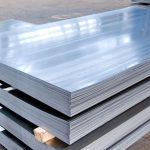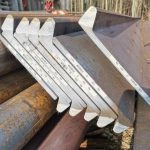
EH36 steel plate is a high-strength shipbuilding steel known for its load-bearing capacity, impact toughness, and weldability, making it suitable for marine structures. With a minimum yield strength of 355 MPa and an impact testing requirement at -40°C, this material is commonly used in the construction of ship hulls, decks, and offshore structures. Join Stavian Industrial Metal in exploring the characteristics, chemical composition, mechanical properties, and specifications of EH36 steel plates.
EH36 steel plate is a high-strength structural steel belonging to the shipbuilding steel category. It is manufactured to meet requirements for load-bearing capacity, toughness, and impact resistance in marine environments. EH36 is one of the steel grades commonly used in the construction of cargo ships, container ships, bulk carriers, and offshore structures subjected to heavy loads.
The outstanding feature of EH36 shipbuilding steel is its combination of high yield strength and the ability to maintain toughness at low temperatures. The material typically has a minimum yield strength of 355 MPa, a tensile strength of approximately 490–620 MPa, and a Charpy impact testing requirement at -40°C. These properties make EH36 suitable for structural components where the risk of brittle fracture must be controlled under dynamic loading or cold operating conditions.
Compared with conventional structural steel, EH36 is subject to stricter controls on chemical composition, mechanical properties, and acceptance requirements. When used in accordance with an approved design, high-strength steel can help reduce plate thickness in certain components, optimizing structural weight while maintaining the required load-bearing capacity.
To select the appropriate EH36 steel plate, businesses must consider manufacturing standards, classification requirements, chemical composition, mechanical properties, and product dimensions. These criteria determine whether the material meets the design requirements, fabrication methods, and acceptance conditions of each project.
Technical specifications may vary depending on the manufacturer, plate thickness, delivery condition, and applicable standard edition. Therefore, the following tables are intended for technical reference. The requirements applicable to a specific batch must be verified through material documentation and relevant certificates.
| Parameter | Reference Value |
| Product Name | EH36 Steel Plate |
| English Name | EH36 Shipbuilding Steel Plate |
| Steel Category | High-Strength Shipbuilding Steel |
| Steel Grade | EH36 |
| Product Standard | ASTM A131/A131M and applicable classification society rules |
| Common Classification Societies | ABS, DNV, LR, BV, NK, KR, RINA, CCS |
| Minimum Yield Strength | 355 MPa within the applicable thickness range |
| Tensile Strength | 490–620 MPa |
| Impact Testing Temperature | -40°C |
| Density Used for Calculations | Approximately 7,850 kg/m³ |
| Reference Thickness Range on the Market | 4–260 mm, depending on the manufacturing source |
| Reference Width | 1,200–4,000 mm |
| Reference Length | 3,000–18,000 mm |
| Main Applications | Ship hulls, ship decks, load-bearing structures, and offshore structures |
Note: The dimensional ranges above represent specifications that may be available on the market. They do not mean that every thickness can be manufactured, certified, or supplied across the entire dimensional range. Yield strength and other mechanical properties must be verified against the actual plate thickness.
The chemical composition of EH36 steel directly influences its strength, toughness, weldability, and material stability. Carbon content is controlled to minimize adverse effects on weldability, while manganese contributes to improved strength. Silicon supports the deoxidation process, and elements such as niobium, vanadium, and titanium may be used to control the steel’s microstructure and enhance its mechanical properties.
The following chemical composition table presents reference values commonly associated with EH36-grade shipbuilding steel. Element limits and combined alloying requirements must be determined according to the applicable product standard, classification society rules, and steelmaking process.
| Element | Symbol | Reference Content (%) |
| Carbon | C | ≤ 0.18 |
| Silicon | Si | 0.10–0.50 |
| Manganese | Mn | 0.90–1.60 |
| Phosphorus | P | ≤ 0.035 |
| Sulfur | S | ≤ 0.035 |
| Vanadium | V | 0.05–0.10, where applicable |
| Acid-Soluble Aluminum | Als | ≥ 0.015, where applicable |
| Chromium | Cr | ≤ 0.20 |
| Copper | Cu | ≤ 0.35 |
| Molybdenum | Mo | ≤ 0.08 |
| Niobium | Nb | 0.02–0.05, where applicable |
| Nickel | Ni | ≤ 0.40 |
| Titanium | Ti | ≤ 0.02 |
Note: This table provides reference values for certain EH36 chemical composition variants. Not all alloying elements are required to fall within the listed ranges simultaneously. Current chemical limits, total microalloying element content, and any applicable exceptions must be verified against the relevant classification rules.
In actual manufacturing, steel quality should not be assessed solely by its carbon content. Weldability is also influenced by the carbon equivalent value (CEV), impurity levels, and cooling rate after welding. Even when a steel plate has an acceptable chemical composition, an improper welding procedure can still cause defects in the weld metal or heat-affected zone.
The mechanical properties of EH36 steel provide engineers with a basis for evaluating load-bearing capacity, deformation behavior, and impact energy absorption. The most important indicators include yield strength, tensile strength, elongation, and Charpy impact energy at the specified testing temperature.
Yield strength indicates the stress level at which significant plastic deformation begins, while tensile strength represents the maximum tensile stress reached during testing. Charpy impact energy indicates the amount of energy absorbed by a test specimen during impact, making it particularly important for marine structures operating in cold environments.
| Steel Grade | Thickness (mm) | Minimum Yield Strength (MPa) | Tensile Strength (MPa) | Reference Elongation (%) | Charpy Test Temperature (°C) | Minimum Longitudinal Impact Energy (J) |
| EH36 | 8–50 | 355 | 490–620 | 21 | -40 | 34 |
| EH36 | Over 50 to 70 | 355* | 490–620* | 21* | -40 | 41 |
| EH36 | Over 70 to 100 | 355* | 490–620* | 21* | -40 | 50 |
* Mechanical property values for thick plates must be confirmed according to the applicable standard and classification society rules. The impact energy values in the table are reference values for longitudinal testing; transverse testing may have different requirements. Elongation also depends on the gauge length and test specimen.
It is important to note that impact testing at -40°C does not automatically mean that structures made from EH36 steel are suitable for operation under all conditions at -40°C. The performance of the complete structure also depends on plate thickness, stress conditions, welds, defects, loading conditions, and structural design calculations.
AH36, DH36, and EH36 all belong to Grade 36 high-strength shipbuilding steel. Therefore, their basic yield strength and tensile strength requirements may be similar under the same standard conditions. The key difference lies in the Charpy impact testing temperature. As low-temperature toughness requirements become more demanding, material control and certification conditions must also be evaluated accordingly.
| Parameter | AH36 | DH36 | EH36 |
| Reference Tensile Strength (MPa) | 490–620 | 490–620 | 490–620 |
| Typical Minimum Yield Strength (MPa) | 355 | 355 | 355 |
| Reference Elongation, 50 mm Gauge Length (%) | 21 | 21 | 21 |
| Charpy Test Temperature (°C) | 0 | -20 | -40 |
| Strength Category | High-Strength Grade 36 | High-Strength Grade 36 | High-Strength Grade 36 |
The use of AH36, DH36, or EH36 must comply with the approved drawings and classification documentation. In many cases, selecting steel with a higher toughness grade does not automatically permit substitution for the specified design grade. Any change must be evaluated in terms of welding procedures, mechanical properties, certification, and acceptance requirements.
EH36 shipbuilding steel plate must meet the technical requirements applicable to its intended use and the relevant ship classification society. In addition to product standards, the material generally requires inspection, certification, and traceability to support acceptance procedures in the maritime industry.
For newbuilding and ship repair projects, material certificates are an important part of quality documentation. These certificates must accurately identify the steel grade, test results, delivery condition, dimensions, and relevant batch identification information.
ASTM A131/A131M is one of the product standards used for structural steel intended for shipbuilding, covering both ordinary-strength and higher-strength steel grades. Specific requirements may also be established according to the material rules of the classification society designated for the project.
Several standard systems commonly appear in industrial steel procurement documents, including ASTM, ASME, JIS, EN, DIN, BS, and GB. However, this does not mean that all these standards directly use the EH36 designation or can be considered interchangeable. For shipbuilding materials, the applicable standards and classification rules must be clearly identified.
Businesses can explore additional information about shipbuilding steel standards to better understand the role of classification systems in material quality control.
Different classification societies may use different steel grade designations. Although these designations belong to the same E36 high-strength steel category, material acceptance must still be determined according to the applicable rule edition, certification status, and project requirements.
| Classification Society | Common Steel Grade Designation |
| ABS | EH36 / ABS EH36 |
| DNV | NV E36 |
| GL | GL-E36 |
| LR | EH36 / LR EH36 |
| BV | EH36 / BV EH36 |
| CCS | E36 / CCS E36 |
| NK | KE36 |
| KR | RE36 |
| RINA | EH36 |
Note: This table is intended to identify steel grade designations within the same classification category. It does not provide grounds for automatically transferring certification between classification societies. Historical designations such as GL must also be checked against the applicable rules and current certification body.
In technical documentation, a steel plate designated ABS EH36 is not automatically accepted as a substitute for material requiring LR, DNV, or another classification certificate. Where necessary, its use must be approved by the designer, project owner, and relevant classification society.
EH36 steel plate specifications are essential for material quantity takeoffs, fabrication planning, and weight estimation. In shipbuilding, selecting the correct thickness, width, and length helps optimize cutting layouts, reduce steel waste, and control the number of welded joints.
Steel plates with large widths or lengths are commonly used to manufacture hull sections, ship decks, and load-bearing structures. However, plate dimensions must be compatible with lifting equipment, cutting machines, assembly fixtures, and transportation conditions at the construction site.
EH36 steel plates are available on the market in various dimensional ranges, depending on the manufacturer and project requirements. Some suppliers offer thicknesses ranging from approximately 4 mm to 260 mm, widths of 1,200–4,000 mm, and lengths of 3,000–18,000 mm. However, these ranges are not universally guaranteed by every steel mill.
| Item | Reference Range | Notes |
| Thickness | 4–260 mm | Depends on manufacturing capabilities and certification scope |
| Width | 1,200–4,000 mm | Rolling capabilities and transportation requirements must be checked |
| Length | 3,000–18,000 mm | May vary depending on the manufacturer and order requirements |
| Cutting and Fabrication | According to drawings | Fabrication capabilities and certificate traceability after cutting must be confirmed |
For materials used in ship hull structures, dimensions are not the only selection criteria. Businesses must also check thickness tolerances, flatness, surface quality, and delivery conditions to minimize assembly inaccuracies.
The theoretical weight of an EH36 steel plate can be estimated using a density of 7,850 kg/m³. When thickness is expressed in millimeters, each millimeter of thickness corresponds to approximately 7.85 kg/m².
The table below presents commonly referenced plate thicknesses and width ranges, along with the corresponding weight per square meter. These values are intended for material calculations and do not confirm actual inventory availability or the supply capability of any particular specification.
| Product | Thickness (mm) | Reference Width (mm) | Reference Length (mm) | Theoretical Weight (kg/m²) |
| EH36 Steel Plate | 2 | 1,200 / 1,250 / 1,500 | Subject to manufacturing capabilities | 15.70 |
| EH36 Steel Plate | 3 | 1,200 / 1,250 / 1,500 | Subject to manufacturing capabilities | 23.55 |
| EH36 Steel Plate | 4 | 1,200 / 1,250 / 1,500 | 6,000 / 9,000 / 12,000 | 31.40 |
| EH36 Steel Plate | 5 | 1,200 / 1,250 / 1,500 | 6,000 / 9,000 / 12,000 | 39.25 |
| EH36 Steel Plate | 6 | 1,500 / 2,000 | 6,000 / 9,000 / 12,000 | 47.10 |
| EH36 Steel Plate | 7 | 1,500 / 2,000 / 2,500 | 6,000 / 9,000 / 12,000 | 54.95 |
| EH36 Steel Plate | 8 | 1,500 / 2,000 / 2,500 | 6,000 / 9,000 / 12,000 | 62.80 |
| EH36 Steel Plate | 9 | 1,500 / 2,000 / 2,500 | 6,000 / 9,000 / 12,000 | 70.65 |
| EH36 Steel Plate | 10 | 1,500 / 2,000 / 2,500 | 6,000 / 9,000 / 12,000 | 78.50 |
| EH36 Steel Plate | 11 | 1,500 / 2,000 / 2,500 | 6,000 / 9,000 / 12,000 | 86.35 |
| EH36 Steel Plate | 12 | 1,500 / 2,000 / 2,500 | 6,000 / 9,000 / 12,000 | 94.20 |
| EH36 Steel Plate | 13 | 1,500 / 2,000 / 2,500 / 3,000 | 6,000 / 9,000 / 12,000 | 102.05 |
| EH36 Steel Plate | 14 | 1,500 / 2,000 / 2,500 / 3,000 | 6,000 / 9,000 / 12,000 | 109.90 |
| EH36 Steel Plate | 15 | 1,500 / 2,000 / 2,500 / 3,000 | 6,000 / 9,000 / 12,000 | 117.75 |
| EH36 Steel Plate | 16 | 1,500 / 2,000 / 2,500 / 3,000 / 3,500 | 6,000 / 9,000 / 12,000 | 125.60 |
| EH36 Steel Plate | 17 | 1,500 / 2,000 / 2,500 / 3,000 / 3,500 | 6,000 / 9,000 / 12,000 | 133.45 |
| EH36 Steel Plate | 18 | 1,500 / 2,000 / 2,500 / 3,000 / 3,500 | 6,000 / 9,000 / 12,000 | 141.30 |
| EH36 Steel Plate | 19 | 1,500 / 2,000 / 2,500 / 3,000 / 3,500 | 6,000 / 9,000 / 12,000 | 149.15 |
| EH36 Steel Plate | 20 | 1,500 / 2,000 / 2,500 / 3,000 / 3,500 | 6,000 / 9,000 / 12,000 | 157.00 |
| EH36 Steel Plate | 21 | 1,500 / 2,000 / 2,500 / 3,000 / 3,500 | 6,000 / 9,000 / 12,000 | 164.85 |
| EH36 Steel Plate | 22 | 1,500 / 2,000 / 2,500 / 3,000 / 3,500 | 6,000 / 9,000 / 12,000 | 172.70 |
| EH36 Steel Plate | 25 | 1,500 / 2,000 / 2,500 / 3,000 / 3,500 | 6,000 / 9,000 / 12,000 | 196.25 |
| EH36 Steel Plate | 28 | 1,500 / 2,000 / 2,500 / 3,000 / 3,500 | 6,000 / 9,000 / 12,000 | 219.80 |
| EH36 Steel Plate | 30 | 1,500 / 2,000 / 2,500 / 3,000 / 3,500 | 6,000 / 9,000 / 12,000 | 235.50 |
| EH36 Steel Plate | 35 | 1,500 / 2,000 / 2,500 / 3,000 / 3,500 | 6,000 / 9,000 / 12,000 | 274.75 |
| EH36 Steel Plate | 40 | 1,500 / 2,000 / 2,500 / 3,000 / 3,500 | 6,000 / 9,000 / 12,000 | 314.00 |
| EH36 Steel Plate | 45 | 1,500 / 2,000 / 2,500 / 3,000 / 3,500 | 6,000 / 9,000 / 12,000 | 353.25 |
| EH36 Steel Plate | 50 | 1,500 / 2,000 / 2,500 / 3,000 / 3,500 | 6,000 / 9,000 / 12,000 | 392.50 |
| EH36 Steel Plate | 55 | 1,500 / 2,000 / 2,500 / 3,000 / 3,500 | 6,000 / 9,000 / 12,000 | 431.75 |
| EH36 Steel Plate | 60 | 1,500 / 2,000 / 2,500 / 3,000 / 3,500 | 6,000 / 9,000 / 12,000 | 471.00 |
| EH36 Steel Plate | 80 | 1,500 / 2,000 / 2,500 / 3,000 / 3,500 | 6,000 / 9,000 / 12,000 | 628.00 |
Important Note: The table presents theoretical weights based on nominal thickness and reference dimensional ranges. Very thin plates, particularly those with thicknesses of 2–3 mm, should not automatically be assumed to be available as certified EH36 shipbuilding steel plates. Specific dimensions must be confirmed with the manufacturer, supplier, and classification society before use.
For cost estimation and material control, theoretical weight can be calculated from the steel plate’s volume and material density. This formula applies to rectangular steel plates and does not account for cutouts, beveled edges, or material losses during fabrication.
Weight (kg) = Thickness (mm) × Width (m) × Length (m) × 7.85
For example, an EH36 steel plate with a thickness of 20 mm, a width of 2 m, and a length of 12 m has the following theoretical weight:
20 × 2 × 12 × 7.85 = 3,768 kg/plate.
Therefore, a steel plate with these dimensions has a theoretical weight of approximately 3.768 metric tons. The actual measured weight may differ due to rolling tolerances and actual product dimensions. When planning transportation or lifting operations, appropriately verified weight data should be used.
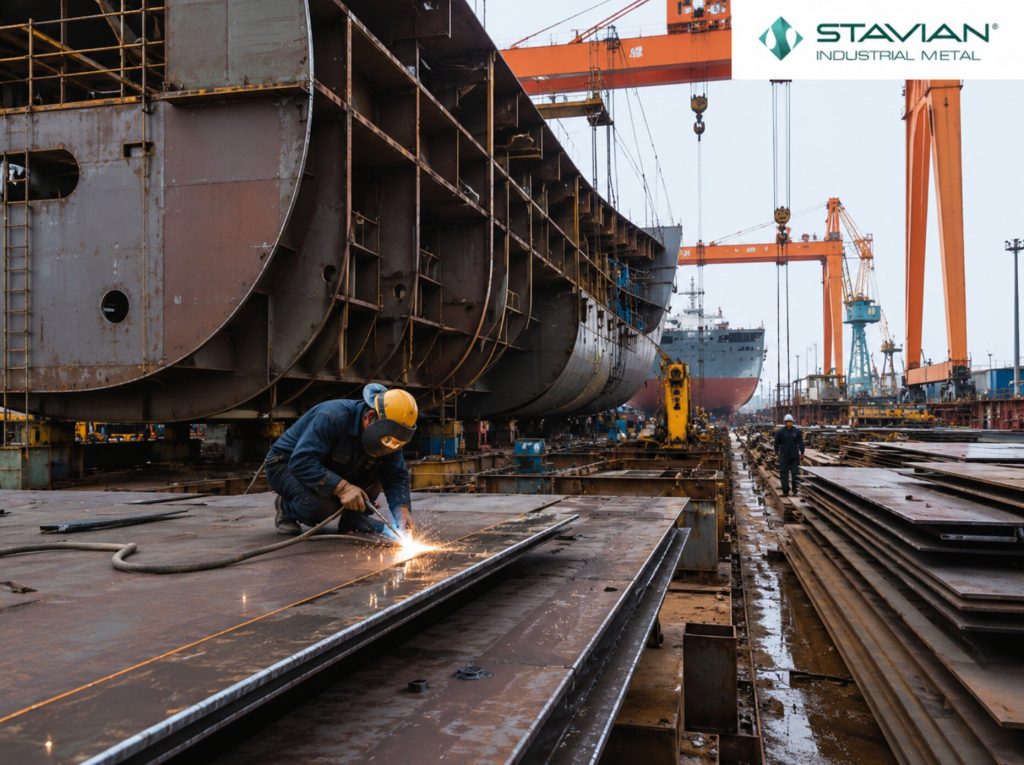
Thanks to its high strength and low-temperature impact toughness requirements, EH36 steel plate is primarily used in ship structures and certain offshore construction applications. The material is suitable for structural components requiring high load-bearing capacity, structural durability, and resistance to brittle fracture.
EH36 shipbuilding steel plate is used to manufacture load-bearing structural components of vessels. Areas where high-strength steel is often considered include main decks, stiffeners, bottom structures, ship sides, and regions subjected to high stress. For vessels operating in cold waters, the impact testing requirement at -40°C is an important material selection criterion.
During shipbuilding, steel plates are cut, formed, and welded into structural sections. Fabrication characteristics and material quality consistency directly affect assembly accuracy, deformation control, and production efficiency. Therefore, plates used within the same structural section must be consistently controlled in terms of steel grade, thickness, certification, and fabrication methods.
Common applications include:
In addition to shipbuilding, EH36 steel may be considered for offshore structures requiring appropriate strength and toughness. Marine environments create complex operating conditions due to the combined effects of wave loads, wind loads, structural vibrations, and temperature fluctuations.
Some components that may use high-strength shipbuilding steel include working platforms, load-bearing frames, reinforcement components, and auxiliary offshore structures. However, selecting EH36 for drilling platforms or offshore structures must be evaluated against the specific design standards applicable to each component.
Offshore structures often have particularly strict requirements for weld quality, non-destructive testing, toughness at the design temperature, and corrosion resistance. EH36 should only be used when the material satisfies all relevant technical requirements.
In ship repair, EH36 steel plates may be used to replace structural components originally designed with the same material grade or an approved equivalent. Typical applications include hull plating replacement, deck reinforcement, frame repairs, and restoration of load-bearing structural areas.
It is essential that replacement materials be compatible with the original structure, particularly in terms of strength grade and impact toughness. EH36 should not be substituted for another steel grade solely because its strength values appear higher. Such replacements must be evaluated in conjunction with welding design, structural stiffness, and post-repair inspection procedures.
Stavian Industrial Metal operates in the supply and distribution of industrial metals, offering a product portfolio serving manufacturing, construction, and maritime industries. Within the Stavian Industrial Metal shipbuilding steel category, the company supplies steel plates, structural steel sections, and marine bulb flats for shipbuilding, ship repair, and structural fabrication applications.
The shipbuilding steel portfolio includes both ordinary-strength and high-strength grades, including AH36, DH36, and EH36. For projects requiring EH36 steel plates, supply availability, dimensions, classification standards, and certification requirements must be confirmed for each specific order.
For industrial customers, material selection often involves multiple product categories rather than a single steel grade. Stavian Industrial Metal offers a range of steel products designed to meet different structural, fabrication, manufacturing, and industrial production requirements.
Available product categories for reference include:
For conventional hot-rolled steel plates, Stavian Industrial Metal offers grades such as SS400, ASTM A36, Q345B, Q235B, and Q355B. However, ASTM A36 steel plate is not the same as EH36 steel plate. These materials are subject to different technical requirements and should not be considered directly interchangeable in shipbuilding structures requiring classification approval.
EH36 steel plate is an important structural material in shipbuilding and offshore engineering, offering high strength, impact toughness at -40°C, and suitable weldability and fabrication characteristics. When selecting this product, businesses must carefully verify its chemical composition, mechanical properties, dimensions, and classification certificates. Stavian Industrial Metal supplies shipbuilding steel products for industrial applications, helping businesses identify materials that meet the technical requirements of their projects.
Related Articles
Address
Website: https://stavianmetal.com
Email: info@stavianmetal.com