Important Notice: Stavian Industrial Metal only offers volume discounts for large orders: 200 tons or more of steel, 100 tons or more of aluminum, and 50 tons or more of copper or zinc.
Shipbuilding steel plate is an essential material in the shipbuilding industry, widely used to manufacture ship hulls, decks, bulkheads, and load-bearing structures. Due to the demanding requirements for strength, weldability, and impact toughness, this type of steel must comply with stringent technical standards. Stavian Industrial Metal provides a comprehensive overview of shipbuilding steel plates, including their characteristics, steel grades, chemical composition, specifications, applications, and factors affecting pricing.
Shipbuilding steel plate is a specialized steel product typically manufactured through hot rolling and subject to quality control requirements established for the shipbuilding industry. It is used to construct hull structures, ship bottoms, decks, bulkheads, cargo holds, and various other structural components. Beyond shipbuilding, these steel plates are also used in certain offshore structures and industrial applications that require comparable technical properties.
Unlike conventional structural steel plates, steel plates used in shipbuilding must meet multiple requirements simultaneously, including strength, ductility, impact toughness, weldability, and surface quality. During operation, vessels are continuously exposed to waves, cargo loads, vibrations, temperature fluctuations, and corrosive marine environments. Therefore, selecting the appropriate steel grade, thickness, and classification standards is essential for ensuring the safety and service life of marine structures.
The defining characteristics of high-quality shipbuilding steel plates extend beyond load-bearing capacity to include a balance between strength and workability. The material must provide sufficient ductility for cutting, bending, rolling, and welding during hull fabrication. At the same time, its mechanical properties must be carefully controlled to minimize the risk of cracking or structural failure under actual operating conditions.
It is important to note that carbon steel and low-alloy steel used in shipbuilding are not equivalent to stainless steel. Prolonged exposure to seawater can still cause corrosion. Therefore, protective coatings, cathodic protection, and regular maintenance play important roles in preserving the structural integrity of ship hulls.
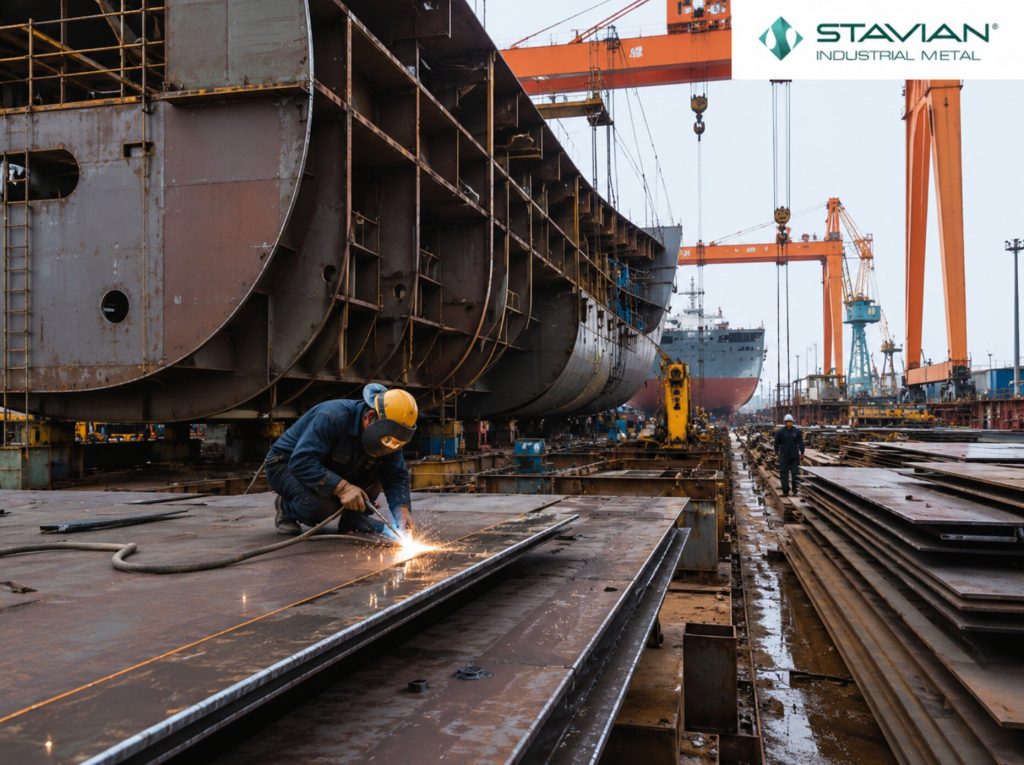
Shipbuilding steel plates are processed and assembled into ship hull structures.
Shipbuilding steel plate standards establish technical requirements to ensure that materials are suitable for use in marine structures. These requirements may cover chemical composition, yield strength, tensile strength, elongation, impact toughness, dimensions, tolerances, testing methods, and acceptance conditions.
In practice, businesses must distinguish between product standards and the rules established by classification societies. Product standards define the technical properties of steel, while classification society rules may impose additional requirements regarding manufacturing processes, testing, certification, and approved applications. Compliance with a general structural steel standard does not automatically qualify a material for use in ship hull construction.
ASTM A131/A131M is an important American standard for structural steel used in shipbuilding. It specifies requirements for multiple steel grades with different strength levels and impact toughness properties. Steel grades covered by ASTM A131 may be used in hull construction and marine structures within the standard’s applicable scope.
Not all steel products complying with JIS G3106, EN 10025, or EN 10225 are automatically suitable for direct use in ship hull construction. Proper material selection requires checking the applicable standard against classification society rules, engineering drawings, and project-specific technical requirements.
In the shipbuilding industry, certification by classification societies is particularly important. These organizations establish technical rules and conduct assessments, inspections, or material certification activities within their respective scopes. The selection of a classification society depends on the shipowner’s requirements, vessel design, operating markets, and vessel registration documentation.
For example, if a project specifies AH36 shipbuilding steel plate with ABS certification, the supplied material must be accompanied by documentation that satisfies those requirements. Certification under another classification system should only be accepted when technically justified and approved by the relevant authorities. Stavian Industrial Metal supplies shipbuilding steel in various grades and classification options to support different project requirements.
Shipbuilding steel grades are classified according to strength levels and impact toughness requirements. Common categories include normal-strength steel grades A, B, D, and E, as well as high-strength grades AH32, DH32, EH32, AH36, DH36, and EH36. Certain projects may also require Grade 40 steel or other grades with more demanding technical specifications.
This classification enables engineers to select materials suitable for specific structural locations. Components exposed to high loads may require high-strength steel, while sections requiring resistance to brittle fracture at low temperatures must use appropriate toughness grades. No single steel grade is necessarily optimal for every structural component of a vessel.
Grade A shipbuilding steel plate belongs to the normal-strength steel category and is widely used in hull structures where operating conditions and load-bearing requirements are appropriate. Grades B, D, and E also belong to the normal-strength category but have different impact toughness requirements and testing conditions.
These steel grades generally have a nominal minimum yield strength of approximately 235 MPa under commonly applied shipbuilding classification rules, while their tensile strength typically ranges from 400 to 520 MPa. Exact mechanical properties must be verified against the applicable standard, material thickness, and delivery condition.
AH32, DH32, and EH32 belong to the Grade 32 high-strength shipbuilding steel category, with a nominal minimum yield strength of 315 MPa. Compared with normal-strength grades A, B, D, and E, these steels can withstand higher stress levels, enabling engineers to optimize structural thickness and weight when permitted by the design.
The primary differences among AH32, DH32, and EH32 concern their impact toughness requirements at different testing temperatures. These grades may be considered for ship decks, side shells, frames, load-bearing bulkheads, and reinforced structural components. Selection must be based on design loads and the applicable classification society requirements.
AH36, DH36, and EH36 steel plates are high-strength Grade 36 shipbuilding steels. Under commonly applied specifications, they generally have a nominal minimum yield strength of approximately 355 MPa and a tensile strength ranging from 490 to 620 MPa. These grades are widely used in cargo vessels, container ships, oil tankers, and marine structures requiring high load-bearing capacity.
Although these three grades have comparable strength levels, their impact testing requirements differ. Under common classification systems, AH36 is typically associated with impact testing at 0°C, DH36 at -20°C, and EH36 at -40°C. This does not mean that each grade may only operate at its corresponding test temperature. Rather, the testing temperature is one of several criteria used to assess material suitability under applicable design and classification requirements.
| Steel Grade | Nominal Minimum Yield Strength | Typical Impact Testing Temperature |
| AH32 | 315 MPa | 0°C |
| DH32 | 315 MPa | -20°C |
| EH32 | 315 MPa | -40°C |
| AH36 | 355 MPa | 0°C |
| DH36 | 355 MPa | -20°C |
| EH36 | 355 MPa | -40°C |
Note: The values above are provided as general references for commonly used shipbuilding steel grades. Testing conditions, mechanical property limits, and acceptance requirements must be verified against the applicable standards and material certificates for each batch.
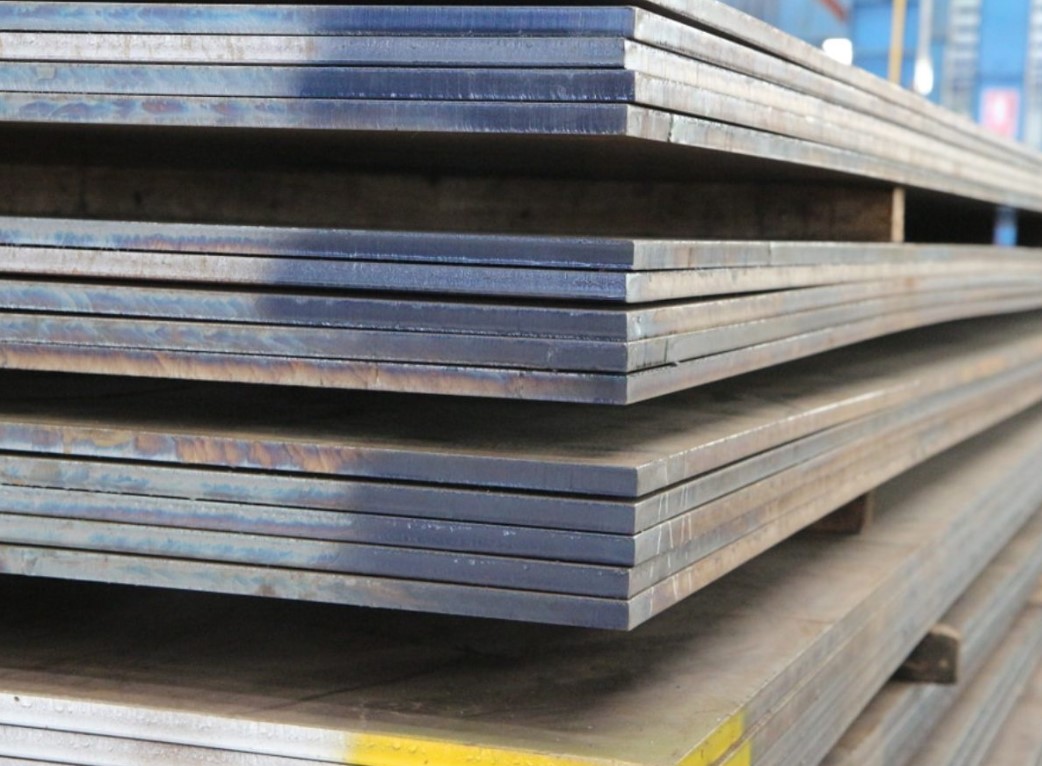
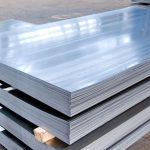
Shipbuilding steel plates are available in different strength grades and dimensions to meet specific structural requirements.
In addition to Grades 32 and 36, the shipbuilding industry also uses AH40, DH40, EH40, and FH40 for structures requiring higher strength. Grade 40 steel has a nominal minimum yield strength of approximately 390 MPa. The letters A, D, E, and F indicate different impact toughness requirements, with Grade F generally associated with lower testing temperatures than Grade E.
Grade 40 steel may be considered for heavily loaded structures, large vessels, or offshore projects with demanding technical requirements. However, choosing higher-strength steel does not always result in better economic efficiency. Businesses must also evaluate material costs, weldability, fabrication requirements, and structural design alternatives.
The mechanical properties of shipbuilding steel plates determine their load-bearing capacity, deformation behavior, and ability to perform safely under operating conditions. Important properties include yield strength, tensile strength, elongation, impact toughness, and weldability. Each property represents a different aspect of material performance and should be evaluated collectively rather than focusing solely on tensile strength.
Yield strength indicates the stress level at which a material begins to undergo plastic deformation under specified testing conditions. It is an essential parameter when calculating the load-bearing capacity of ship structures. Meanwhile, tensile strength represents the maximum tensile stress reached during a standardized tensile test.
Normal-strength shipbuilding steel generally has a nominal minimum yield strength of approximately 235 MPa, while Grade 32 and Grade 36 steels have corresponding values of approximately 315 MPa and 355 MPa. Using high-strength steel can help reduce structural weight when supported by appropriate engineering calculations. However, the actual plate thickness must still meet requirements for structural stability, fatigue resistance, corrosion allowances, and other design criteria.
Elongation indicates the ability of steel to undergo plastic deformation before fracture during a tensile test. It is an important parameter for evaluating material behavior under deformation. Steel with high strength but insufficient ductility may create difficulties during forming or increase the risk of damage under certain loading conditions.
Impact toughness describes a material’s ability to absorb energy under sudden loading, commonly evaluated through the Charpy impact test. This property is particularly important for vessels operating in low-temperature environments and structures exposed to dynamic loads. The selection of Grades A, D, E, or F must be based on the testing requirements for each structural location and the applicable classification rules.
Hardness indicates a material’s resistance to localized deformation when subjected to an indenter or another object. In shipbuilding, hardness may be controlled in certain applications, but it is not the only parameter determining steel quality. Excessive hardness in some welded areas may also increase the risk of cracking if fabrication conditions are unsuitable.
Bendability and weldability directly affect manufacturing efficiency. Steel plates must be formed into components that match the curved geometry of ship hulls and deck structures. When processing high-strength steel, shipyards must control bending radii, forming methods, welding consumables, and fabrication procedures according to technical requirements to maintain product quality.
Seawater contains salts and dissolved oxygen, creating conditions that promote metal corrosion. Therefore, corrosion resistance is an important consideration for marine structures. However, conventional shipbuilding steel plates can still rust without appropriate protection, particularly in submerged areas, splash zones, and locations where protective coatings have been damaged.
To extend structural service life, appropriate material selection must be combined with surface preparation, anti-corrosion coatings, cathodic protection where necessary, and regular maintenance. For certain specialized applications, designs may specify steel grades with separately verified corrosion-resistant properties. It should not be assumed that all shipbuilding steel grades provide the same level of corrosion resistance.
Shipbuilding steel plate specifications are determined by thickness, width, length, weight, dimensional tolerances, and additional technical requirements. The selected dimensions depend on engineering drawings, fabrication methods, lifting capacity, and project transportation conditions.
Shipbuilding steel may be supplied as full-size plates or cut-to-size products when manufacturing conditions and certification requirements permit. For large-volume projects, selecting suitable plate dimensions can reduce material waste, optimize cutting layouts, and minimize unnecessary weld seams.
Shipbuilding steel plates are available in a wide range of thicknesses, from relatively thin plates used in secondary structures to thick plates intended for heavily loaded components. The Stavian Industrial Metal shipbuilding steel product range includes reference thicknesses from 4.75 mm to 100 mm. Actual supply specifications must be confirmed according to steel grade, applicable standards, and individual production batches.
| Parameter | Reference Specifications | Notes |
| Thickness | 4.75–100 mm | Subject to product range and supply conditions |
| Width | 1,500–3,500 mm | Depends on manufacturer and product type |
| Length | 6,000–12,000 mm | Other dimensions may be available for specific orders |
| Steel Grades | A, B, D, E, AH32–FH40 | Selected according to design and classification requirements |
| Surface | Hot-rolled surface or specified surface treatment | Delivery conditions must be confirmed |
| Certification | According to the designated classification system | Material certificates must be checked for each batch |
Note: The dimensions above are provided as reference ranges and do not guarantee that every specification is available in stock or applicable to all steel grades.
Steel plate weight is an important factor in material budgeting, lifting equipment planning, and transportation cost calculations. For conventional carbon steel, a nominal density of approximately 7,850 kg/m³ can be used to calculate theoretical weight. The formula is as follows:
Weight (kg) = Thickness (mm) × Width (m) × Length (m) × 7.85
For example, a steel plate measuring 10 × 2,000 × 6,000 mm has a theoretical weight of:
10 × 2 × 6 × 7.85 = 942 kg/plate.
This is a reference calculation. Actual weight may vary due to rolling tolerances, actual dimensions, material composition, and weighing methods. When preparing purchase contracts, businesses should clearly agree on whether material quantities will be calculated using theoretical weight or actual measured weight.
Shipbuilding steel plate applications primarily include new vessel construction, ship repair, and vessel conversion. These materials may also be selected for marine infrastructure and industrial structures when they meet the technical requirements of specific projects.
This is the most common application of shipbuilding steel plates. Steel plates are cut, bent, rolled, and welded into structural sections before being assembled into a complete ship hull. In bottom structures, the material must withstand hydrostatic pressure, structural loads, and mechanical forces generated during operation.
Along the ship’s sides and decks, steel is exposed to waves, wind, cargo loads, and equipment loads. Selecting AH36, DH36, or EH36 steel plates for heavily loaded areas must be based on the engineering design. In addition to strength requirements, weld quality and surface protection systems play important roles in determining hull service life.
Commercial vessels use steel plates to manufacture hull structures, cargo holds, decks, and various reinforced components. In container ships, structures must be designed to withstand loads distributed by cargo and handling equipment. For oil tankers, structural integrity and the tightness of cargo compartments are particularly important.
Bulk carriers commonly have cargo holds exposed to mechanical impacts during loading, unloading, and transportation. Therefore, material selection must consider load-bearing capacity, toughness, abrasion risks, and surface protection requirements. Depending on the structural location, specialized materials may be specified in addition to conventional shipbuilding steel plates.
Steel plates for barge construction are used to manufacture the bottom, sides, decks, and bulkheads of inland waterway and marine transport vessels. For cargo barges, loading conditions and operating requirements determine the appropriate steel grade and structural thickness. Not all barges require high-strength steel, but the materials must still comply with applicable design and regulatory requirements.
For fishing vessels and service boats, steel plates are used in hull components and load-bearing structures. Fabrication processes typically require materials with suitable weldability and formability. Selecting appropriate plate specifications helps shipyards control material consumption and minimize waste during manufacturing.
Shipbuilding steel plates and certain specialized structural steels may be used to manufacture working platforms, floating structures, offshore modules, and load-bearing components of marine infrastructure. These structures are often exposed to combinations of dynamic loads, wind, waves, and corrosive environments.
For offshore platforms and other offshore engineering projects, materials must be selected according to specific design standards. Certain components may require low-temperature impact toughness, ultrasonic testing, or through-thickness mechanical properties. Therefore, conventional shipbuilding steel plates should not automatically be considered suitable substitutes for all offshore structural steel products.
After prolonged operation, ship hull components may experience corrosion, thickness reduction, deformation, or mechanical damage. Shipbuilding steel plates are then used to replace or reinforce areas that no longer meet technical requirements.
During repairs, replacement materials must have steel grades, mechanical properties, and weldability compatible with the existing structures under the approved repair plan. Unauthorized substitution with another steel grade may create welding and inspection difficulties. For critical components, repair procedures must be reviewed in accordance with the relevant classification society requirements.
Shipbuilding steel plate prices depend on steel grade, classification requirements, thickness, dimensions, origin, order volume, and delivery conditions. High-strength steel grades or products requiring special inspections may involve different costs compared with normal-strength steel.
Because raw material prices and transportation costs fluctuate over time, outdated price lists should not be used as fixed unit prices for current project estimates. For shipbuilding projects, prices should be compared based on equivalent steel grades, specifications, standards, and delivery conditions to ensure meaningful evaluations.
AH32 shipbuilding steel plate belongs to the high-strength Grade 32 category and is suitable for structures with corresponding load-bearing requirements. Product prices vary depending on thickness, width, length, classification certification, and the available supply source for each batch.
| Reference Thickness | Reference Width | Reference Length | Price |
| 6 mm | 1,500–2,000 mm | 6,000–12,000 mm | Quoted per batch |
| 8 mm | 1,500–2,000 mm | 6,000–12,000 mm | Quoted per batch |
| 10 mm | 1,500–3,000 mm | 6,000–12,000 mm | Quoted per batch |
| 12 mm | 1,500–3,000 mm | 6,000–12,000 mm | Quoted per batch |
| 14 mm | 1,500–3,000 mm | 6,000–12,000 mm | Quoted per batch |
The specifications above illustrate how products may be categorized when preparing quotation requests. They do not confirm current stock availability or supply capability at any particular time.
AH36 steel plate prices are generally calculated per kilogram, metric ton, or plate, depending on commercial terms and weight determination methods. For AH36 steel, businesses should note that differences in classification standards and dimensions can significantly affect total costs.
The following table presents the theoretical weights of several AH36 plate dimensions to support budgeting and unit price conversion. The calculations use a nominal steel density of 7,850 kg/m³.
| AH36 Plate Dimensions (mm) | Theoretical Weight (kg/plate) | Price |
| 4 × 1,500 × 6,000 | 282.60 | Upon quotation |
| 5 × 1,500 × 6,000 | 353.25 | Upon quotation |
| 6 × 1,500 × 6,000 | 423.90 | Upon quotation |
| 8 × 1,500 × 6,000 | 565.20 | Upon quotation |
| 10 × 1,500 × 6,000 | 706.50 | Upon quotation |
| 6 × 2,000 × 12,000 | 1,130.40 | Upon quotation |
| 8 × 2,000 × 12,000 | 1,507.20 | Upon quotation |
| 10 × 2,000 × 12,000 | 1,884.00 | Upon quotation |
| 12 × 2,000 × 12,000 | 2,260.80 | Upon quotation |
| 14 × 2,000 × 12,000 | 2,637.60 | Upon quotation |
Note: The weight table does not confirm that every listed dimension is manufactured or readily available in AH36 grade. Supply availability must be verified for each order.
For further information on market conditions and detailed pricing methods, refer to Stavian Industrial Metal’s article on shipbuilding steel plate prices.
Stavian Industrial Metal is an industrial metal materials distributor offering steel products for the shipbuilding industry and various manufacturing sectors. The company’s shipbuilding steel product portfolio includes steel plates, structural steel sections, and bulb flats, supporting material requirements for ship hulls, decks, and reinforced structures.
Recognizing the specialized requirements of the marine industry, Stavian Industrial Metal focuses on matching materials with project specifications, including steel grades, strength levels, dimensions, and classification society standards. Its product portfolio covers both normal-strength and high-strength steel categories, supporting applications with different technical requirements.
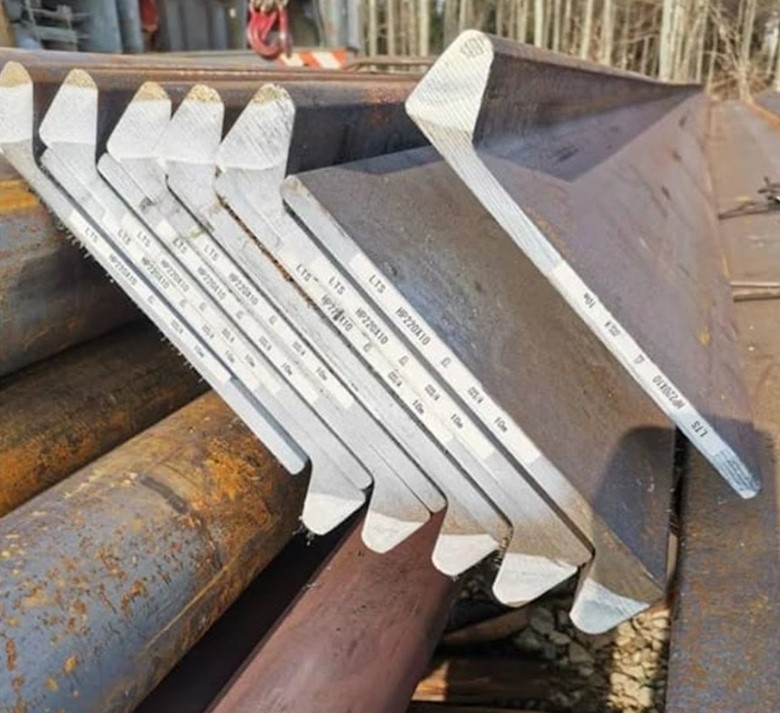
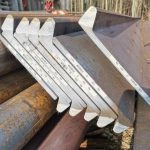
Bulb flat steel is one of the material categories used to reinforce marine structures.
Stavian Industrial Metal supplies steel products suitable for structural material requirements in the shipbuilding industry. In addition to steel plates, structural steel sections play important roles in forming frameworks and reinforcing load-bearing components. Coordinating material supply across different product categories can help businesses organize procurement plans for individual ship sections.
Shipbuilding steel plate is a critical material that directly affects the strength and safety of marine structures. Selecting the right product requires careful consideration of steel grade, mechanical properties, chemical composition, dimensions, and classification certification. Grades such as AH32, AH36, DH36, and EH36 meet different technical requirements. With its diverse range of shipbuilding steel products, Stavian Industrial Metal provides material solutions for new vessel construction, ship repair, and marine structural applications.
Related Articles
Address
Website: https://stavianmetal.com
Email: info@stavianmetal.com