AH32 steel plate is a high-strength shipbuilding steel with a minimum yield strength of 315 MPa, widely used in the construction of ship hulls, decks, and offshore structures. With its excellent mechanical strength, good weldability, and suitable impact toughness, this material meets the demanding technical requirements of the maritime industry. In this article, Stavian Industrial Metal provides a detailed overview of AH32 steel plate, including its characteristics, chemical composition, mechanical properties, standards, and applications.
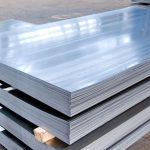
AH32 steel plate is a type of high-strength structural steel used in shipbuilding. It belongs to the low-alloy steel category and is manufactured to meet specific requirements for load-bearing capacity, ductility, impact toughness, and weldability. This material is typically produced as hot-rolled steel plates and used in ship hull structures and certain offshore construction applications.
Under shipbuilding steel classification systems, AH32 belongs to the Grade 32 high-strength steel category, with a minimum yield strength of 315 MPa and a typical tensile strength ranging from 440 to 570 MPa. These properties enable the material to withstand the mechanical loads encountered during vessel operation. Compared with ordinary-strength shipbuilding steel, AH32 can help optimize plate thickness and structural weight in appropriately designed applications.
In practice, AH32 shipbuilding steel is commonly selected for projects requiring a balance of strength, workability, and material efficiency, particularly new shipbuilding projects, vessel repairs, and the fabrication of marine steel structures.
The chemical composition of AH32 steel directly influences its strength, ductility, impact toughness, and weldability. During manufacturing, the contents of carbon, manganese, silicon, phosphorus, sulfur, and other alloying elements are carefully controlled to achieve the metallurgical structure required for high-strength shipbuilding steel.
For marine projects, verifying the chemical composition is essential not only for steel classification but also for assessing compatibility with welding procedures and operating conditions. Deviations beyond specified limits may affect workability, weld quality, and material acceptance results.
The following table presents reference chemical composition values for AH32 steel plate. All values are expressed as percentages by mass, where “max” indicates the maximum permitted content and “min” indicates the minimum required content.
| Steel Grade | C max | Si max | Mn | P max | S max | Als min | Ti max | Cu max | Cr max | Ni max | Mo max |
| AH32 | 0.18 | 0.50 | 0.90–1.60 | 0.035 | 0.035 | 0.015 | 0.02 | 0.35 | 0.20 | 0.40 | 0.08 |
Note: This table provides reference values based on the presented AH32 specifications. Actual limits may vary depending on the standard edition, classification society, plate thickness, and manufacturing process. Certain microalloying elements, such as Nb and V, may also be controlled according to specific technical requirements. During material inspection and acceptance, the relevant material certificate and project-specific classification rules should be used for verification.
The mechanical properties of AH32 steel plate are essential for determining its load-bearing capacity and suitability for ship hull structures. Key parameters include yield strength, tensile strength, elongation, and Charpy impact energy.
Unlike many conventional steel structures, ships are continuously exposed to variable loads, vibration, bending, and impact. Therefore, material selection cannot be based solely on tensile strength. Plastic deformation capacity and resistance to brittle fracture are equally important for ensuring structural reliability.
The following table summarizes the typical mechanical properties of AH32 steel. Actual values should be verified according to product thickness, testing standards, and the corresponding inspection documentation.
| Steel Grade | Minimum Yield Strength ReH (MPa) | Tensile Strength Rm (MPa) | Minimum Elongation A (%) | Impact Test Temperature (°C) |
| AH32 | 315 | 440–570 | 22 | 0 |
Note: The 22% elongation value is a reference figure associated with specific testing conditions. Elongation requirements may vary depending on gauge length, specimen type, and classification rules. For thicker plates or products supplied under special delivery conditions, the applicable mechanical property requirements should be verified.
The minimum yield strength of 315 MPa represents the stress level at which the material begins to undergo significant plastic deformation under the specified testing method. This parameter is directly relevant to structural strength calculations for ship hulls, decks, and reinforced components.
Meanwhile, the tensile strength of 440–570 MPa indicates the maximum tensile stress the material can withstand during a standard tensile test. These two properties are evaluated together when assessing steel performance and should not be considered interchangeable.
Because AH32 offers higher strength than ordinary-strength shipbuilding steel, it can help optimize the dimensions and weight of certain structural components. However, any reduction in plate thickness must be based on structural calculations, stability limits, fatigue requirements, and classification society rules rather than yield strength alone.
Impact toughness refers to a material’s ability to absorb energy when subjected to impact loading. For AH32 shipbuilding steel, the Charpy V-notch impact test is typically conducted at 0°C to evaluate resistance to brittle fracture under specified testing conditions.
Required impact energy values may vary depending on plate thickness and specimen orientation. The following table presents reference impact energy requirements for AH32 steel.
| Steel Grade | Test Temperature | Thickness ≤ 50 mm | Thickness >50–70 mm | Thickness >70–100 mm | |||
| Longitudinal (L) | Transverse (C) | Longitudinal (L) | Transverse (C) | Longitudinal (L) | Transverse (C) | ||
| AH32 | 0°C | 31 J | 22 J | 38 J | 26 J | 46 J | 31 J |
Notes: L indicates the longitudinal testing direction, while C indicates the transverse testing direction. The values represent reference minimum impact energy requirements for different thickness ranges. Actual acceptance requirements also depend on Charpy specimen dimensions, sampling procedures, and applicable classification society rules.
For structures operating at lower temperatures, AH32 should not automatically be considered suitable simply because it passes impact testing at 0°C. When a design requires impact toughness at -20°C or -40°C, steel grades such as DH32 or EH32 may need to be considered according to engineering specifications and classification requirements.
AH32 steel plate is widely used in the maritime industry and may appear under different designations depending on the applicable standards and classification societies. Understanding these designations helps businesses compare technical requirements when selecting materials for domestic and international shipbuilding projects.
Although these materials belong to the same Grade 32 high-strength steel category, products certified by different classification societies are not automatically interchangeable. Each case requires an assessment of certification scope, manufacturing standards, testing methods, and design documentation requirements.
ASTM A131/A131M is a standard covering structural steel for shipbuilding, including ordinary-strength and high-strength steel grades. AH32 is one of the high-strength grades covered by requirements relating to chemical composition, mechanical properties, and testing under applicable conditions.
For AH32 steel manufactured in accordance with ASTM A131/A131M, the following information should be considered:
Compliance with ASTM standards does not automatically mean that a steel batch holds certification from every classification society. For projects requiring specific classification approval, inspection documentation must demonstrate compliance with the designated classification society’s requirements.
In the shipbuilding steel market, AH32 may be identified through corresponding grade designations used by different classification societies. Common organizations include ABS, BV, LR, DNV, NK, KR, CCS, and RINA.
| Classification Society | Common Designation |
| ABS – American Bureau of Shipping | ABS AH32 / AB-AH32 |
| CCS – China Classification Society | CCS AH32 |
| BV – Bureau Veritas | BV AH32 |
| DNV | NV A32 / AH32, depending on the applicable designation system |
| Lloyd’s Register (LR) | LR AH32 |
| Korean Register (KR) | KR AH32 |
| Nippon Kaiji Kyokai (NK) | KA32 |
| RINA | RINA AH32 |
These designations help identify corresponding material categories. However, during procurement and acceptance, the applicable classification rules, standard editions, and certification scope of each steel batch must be verified.
In addition to classification society designations, AH32 is sometimes compared with steel grades covered by national standards or other structural steel specifications. Such comparisons are for reference purposes, particularly when businesses need to identify differences in mechanical requirements and application scope.
| ASTM A131/A131M | GOST 5521 | JIS G3106 | BS/LR | GB 712 |
| AH32 | A32 | SM490B / SM490C | AH32 | A32 |
Important Note: This is a reference comparison table, not a list of directly interchangeable steel grades. In particular, SM490B and SM490C are structural steel grades under JIS G3106 and do not automatically satisfy all toughness, certification, and classification requirements applicable to AH32 shipbuilding steel.
In actual projects, replacing AH32 with a grade from another standard must be evaluated against specific technical requirements and approved by the relevant authorized parties.
AH32 steel plate specifications are generally defined by three main dimensions: thickness, width, and length. These parameters directly influence fabrication capabilities, cutting waste, transportation weight, and ship hull section assembly methods.
In shipbuilding, selecting appropriate plate dimensions can reduce the number of weld joints and help shorten fabrication time. However, oversized steel plates may create difficulties during lifting, transportation, and workshop handling if they exceed equipment capacity.
Stavian Industrial Metal’s shipbuilding steel portfolio includes high-strength grades such as AH32. The reference specification ranges for shipbuilding steel plates and cut-to-length plates are presented below:
| Parameter | Shipbuilding Steel Plate | Cut-to-Length Steel Plate Available in AH32 Grade |
| Steel Grades | A, B, D, E, and AH32–FH40 grades | A, B, D, AH32, AH36, DH32, DH36 |
| Thickness | 4.75–100 mm | 3–25 mm |
| Width | Up to 4,800 mm | 900–2,050 mm |
| Length | Up to 25,000 mm | 2,000–16,000 mm |
| Delivery Condition | Depending on steel grade and technical requirements | AR, CR, or normalized |
| Surface Treatment | According to product requirements | Shot blasting and shop primer coating may be available upon request |
The ranges above represent the product portfolio and do not imply that every combination of thickness, width, and length is available for AH32. The availability of individual specifications must be confirmed according to the manufacturer, production batch, and classification requirements.
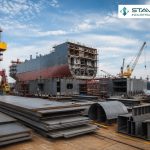
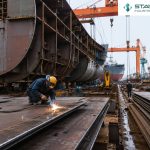
AH32 steel plate applications primarily involve high-load-bearing structures in the shipbuilding industry. The material can be used in new vessel construction, ship repair, and vessel conversion projects, provided it meets all applicable design and classification requirements.
Beyond ship hull structures, AH32 steel may also be considered for certain offshore construction applications. However, these applications often involve additional requirements for toughness, weld quality, dynamic load resistance, and through-thickness material inspection.
Ship hulls are among the largest consumers of steel plate in the maritime industry. These structures must withstand cargo loads, hydrostatic pressure, vibration, and various forces generated during vessel movement.
AH32 steel can be used in locations designed for high-strength shipbuilding steel, including:
For cargo ships, container vessels, and large transport ships, high-strength steel provides engineers with additional opportunities to optimize structural design. Nevertheless, potential weight reductions must be assessed together with plate stability, fatigue strength, and overall hull safety requirements.
During operation, ship hull structures may experience corrosion, deformation, or damage caused by impact and repeated loading. When repairs are required, damaged steel plates that no longer meet technical standards must be replaced with materials compatible with the original structure.
AH32 steel plate can be selected to replace components originally designed with the same steel grade or where an equivalent material has been approved. Replacement work must ensure compatibility in thickness, mechanical properties, inspection standards, and welding procedures.
In vessel conversion or upgrading projects, structural modifications may alter load distribution compared with the original design. Therefore, material selection must be based on engineering calculations and technical approval rather than tensile strength alone.
Certain offshore structures require steel plates capable of withstanding significant loads and exposure to wind, waves, and marine environments. AH32 high-strength shipbuilding steel may be considered for applications that meet the relevant mechanical property and material standard requirements.
Potential applications include:
Not all offshore platform components are suitable for AH32 steel. Critical structures exposed to exceptional loads or requiring low-temperature toughness may require other specialized steel grades, ultrasonic testing, or through-thickness tensile properties.
Stavian Industrial Metal operates in the industrial metal distribution sector, supplying a wide range of steel materials for industrial and maritime projects. Stavian Industrial Metal’s shipbuilding steel portfolio includes steel plates, structural steel sections, and other materials used in ship construction, including high-strength grades such as AH32.
With a network of partners and domestic and international trading operations, Stavian Industrial Metal aims to meet the diverse raw material requirements of shipbuilders, ship repair companies, and marine engineering projects. Material supply is arranged based on technical requirements, product specifications, and the practical conditions of each order.
Key product categories include:
For AH32 products, the available specifications, delivery conditions, and certification requirements should be verified for each production batch. This is essential to ensure that the supplied material meets the technical requirements of the intended project.
AH32 steel plate is a high-strength shipbuilding material characterized by a minimum yield strength of 315 MPa, tensile strength of 440–570 MPa, and appropriate impact toughness requirements. Thanks to its load-bearing capacity, weldability, and workability, AH32 is used in ship hulls, decks, and various marine structures. Stavian Industrial Metal supplies a diverse range of shipbuilding steel products, supporting the technical specifications and material requirements of industrial and maritime projects.
Related Articles
Address
Website: https://stavianmetal.com
Email: info@stavianmetal.com