Direct reduced iron (DRI) has become one of the most important metallic feedstocks in the global steel industry, especially as steelmakers face stronger pressure to improve productivity, reduce dependence on prime scrap, and prepare for lower-emission steelmaking routes. In export-oriented steel supply chains, DRI is no longer viewed only as an alternative iron unit. It is increasingly considered a strategic raw material that supports electric arc furnace operations, improves steel quality consistency, and gives mills greater flexibility when scrap availability or quality becomes unstable.
For international buyers, traders, rolling mills, foundries, and steel producers, understanding direct reduced iron (DRI) is essential because the material sits at the intersection of iron ore, natural gas, hydrogen, electric arc furnace steelmaking, and green steel transformation. Global DRI production reached approximately 140.8 million tonnes in 2024, setting a new record and increasing by about 3.8% compared with 2023. This growth reflects strong demand from India, the Middle East, North Africa, and other regions where gas-based or coal-based direct reduction has become a practical route to secure metallic iron units.
As an international steel and industrial metal partner, Stavian Industrial Metal follows the development of DRI closely because it directly affects steel billet, slab, hot rolled coil, long products, and other export steel markets. While Stavian Industrial Metal focuses on supplying suitable steel and industrial metal products to global customers, DRI-related trends help buyers better understand cost movement, raw material strategy, steel quality, and long-term sourcing security.
Direct reduced iron (DRI) is a high-iron metallic product made by reducing iron ore in solid form without melting it. Unlike blast furnace ironmaking, where iron ore is melted at very high temperatures with coke, DRI is produced by removing oxygen from iron ore using reducing gases such as carbon monoxide and hydrogen, or by using coal-based reduction in rotary kilns. The result is a porous metallic iron product that can be charged into an electric arc furnace, basic oxygen furnace, or other steelmaking units.
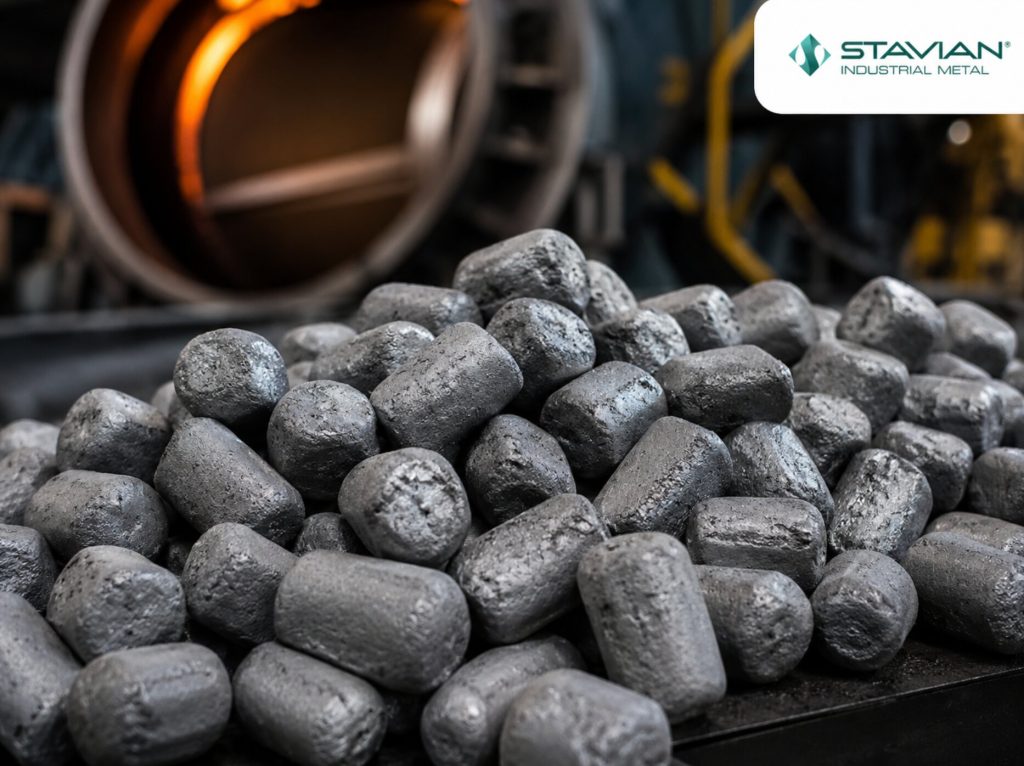
DRI is often called “sponge iron” because of its porous internal structure. This structure is created when oxygen is removed from iron oxide while the material remains in a solid state. Depending on the production route, DRI can be supplied as cold DRI, hot DRI, hot briquetted iron, or compacted forms suitable for transport and storage. Its iron content is typically high, while residual elements such as copper, tin, chromium, and nickel are usually lower than in many scrap sources. This makes DRI valuable for producing steel grades that require tighter chemical control.
The importance of direct reduced iron (DRI) is linked to the changing structure of global steel production. Electric arc furnace steelmaking continues to grow because it can use scrap and metallic iron units more flexibly than traditional blast furnace routes. However, scrap quality is not always consistent. In many markets, available scrap contains residual metals that may affect the final steel chemistry. DRI provides a cleaner source of iron units, helping steelmakers dilute residuals and produce higher-quality steel.
DRI also helps stabilize steelmaking operations when scrap supply becomes volatile. In periods of strong construction, automotive, and manufacturing demand, prime scrap can become expensive or difficult to secure. By using DRI, mills can reduce dependence on scrap and maintain production quality. For export steel producers, this is especially important because international customers often require stable mechanical properties, predictable chemical composition, and reliable shipment schedules.
Gas-based direct reduction is one of the most widely used DRI production routes. In this process, iron ore pellets or lump ore are charged into a shaft furnace and exposed to hot reducing gas. The gas is usually produced from natural gas reforming and contains hydrogen and carbon monoxide. These gases react with iron oxide and remove oxygen, converting the ore into metallic iron while keeping the material below its melting point.
Gas-based DRI plants are common in regions with competitive natural gas supply, such as the Middle East, North Africa, and parts of the Americas. These plants can produce high-quality DRI with strong metallization levels, often above 90%. The MIDREX process remains the dominant technology in shaft furnace DRI production, with MIDREX plants producing about 76.2 million tonnes of DRI in 2024 and accounting for roughly 54.1% of total global DRI output. This demonstrates the importance of shaft furnace technology in modern ironmaking.
Coal-based DRI is mainly produced in rotary kilns, where iron ore and non-coking coal are heated together. The coal acts as both fuel and reducing agent. This route is especially common in India, where large domestic coal-based DRI capacity has developed over the past two decades. India’s strong growth in sponge iron output has been a major driver of global DRI production records in recent years.
Coal-based DRI can be practical in markets where natural gas is limited or expensive. However, it generally has higher carbon intensity than gas-based DRI and may face greater pressure as environmental regulations become stricter. Even so, coal-based DRI remains important for steelmakers that operate induction furnaces, electric arc furnaces, and smaller steel plants requiring flexible metallic feedstock supply.
Hydrogen-based DRI is one of the most discussed technologies in the global steel decarbonization roadmap. Instead of relying mainly on carbon monoxide from natural gas or coal, hydrogen-based direct reduction uses hydrogen to remove oxygen from iron ore. The primary reaction produces water vapor instead of carbon dioxide, which gives hydrogen DRI significant potential for reducing emissions when the hydrogen is produced from low-carbon or renewable energy sources.
However, hydrogen DRI is still developing commercially. Early projects using 100% hydrogen are expected to have higher production costs than conventional blast furnace-basic oxygen furnace routes, partly because of the cost of clean hydrogen, renewable electricity, infrastructure, and suitable high-grade iron ore. Current industry analysis shows that near-zero-emission iron capacity planned by 2030 remains limited compared with total global steel demand. This means natural gas-based DRI, scrap, and transitional low-carbon steelmaking routes will remain important while hydrogen infrastructure scales up.
Cold DRI is discharged from the reduction furnace, cooled, and then stored or transported for steelmaking use. It is commonly used near the production site or in controlled supply chains. Because DRI is porous and reactive, cold DRI requires careful handling to prevent reoxidation, moisture absorption, and overheating during storage or transport. For long-distance international shipment, cold DRI is more challenging than denser and less reactive alternatives.
Steelmakers use cold DRI because it offers high metallic iron content and low residual elements. In electric arc furnace operations, it can be charged continuously or in batches depending on furnace design. Continuous feeding of DRI can improve furnace stability, reduce power fluctuation, and support better control of slag practice. This makes cold DRI particularly useful for plants located close to DRI production units.
Hot DRI is transported directly from the reduction furnace to the electric arc furnace while still hot, often at temperatures above 600°C. This route improves energy efficiency because the steelmaking furnace needs less electricity to melt the material. Hot charging can reduce energy consumption, shorten tap-to-tap time, and increase productivity. However, it requires close physical integration between the DRI plant and the steel melt shop.
Hot DRI is therefore most suitable for integrated DRI-EAF complexes. It is not normally used for long-distance export because the material must be transferred quickly and safely while retaining heat. For large steel producers, hot DRI can provide a competitive advantage by lowering operating costs and improving furnace performance.
Hot briquetted iron, often known as HBI, is made by compacting hot DRI into dense briquettes. This reduces the material’s surface area and makes it more stable for handling, storage, and ocean shipment. HBI is widely considered the preferred merchant form of DRI for international trade because it is less reactive than cold DRI and easier to transport in bulk.
HBI is important for steelmakers that want the benefits of DRI but do not operate their own direct reduction plants. It allows mills in scrap-short or quality-sensitive markets to import high-quality iron units. In electric arc furnace steelmaking, HBI can replace part of the scrap charge and help improve final steel chemistry. For global steel exporters and industrial metal suppliers, HBI is a key product to monitor because it connects upstream ironmaking regions with downstream steel producers worldwide.
The global direct reduced iron (DRI) industry has shown steady long-term growth. In 2024, worldwide DRI output reached about 140.8 million tonnes, up from approximately 135.7 million tonnes in 2023. This represented a new record and an increase of around 5.1 million tonnes year on year. Since 2019, global DRI production has grown by more than 30%, showing that steelmakers are increasingly relying on DRI as a strategic metallic feedstock.
This growth should be viewed in the wider context of global crude steel production. World crude steel production was approximately 1.885 billion tonnes in 2024, while the 70 reporting countries tracked by worldsteel produced about 1.804 billion tonnes in 2025, down around 2.0% year on year. Even though total crude steel production has been relatively stable or slightly weaker in some regions, DRI has continued to gain attention because it supports cleaner electric steelmaking and improves raw material flexibility.
The largest DRI-producing regions include India, the Middle East, North Africa, and countries with strong natural gas or coal-based ironmaking resources. India is particularly important because of its large sponge iron sector and strong domestic steel growth. The Middle East also plays a major role because gas-based DRI plants can operate competitively where natural gas supply is available and industrial infrastructure is well developed.
Iran, Saudi Arabia, Egypt, Qatar, the United Arab Emirates, and other regional producers have invested in DRI capacity to support domestic steelmaking and export-oriented metal industries. In these markets, DRI fits naturally with electric arc furnace production because it reduces dependence on imported scrap and supports production of billets, rebar, wire rod, flat products, and other steel materials.
The demand for direct reduced iron (DRI) is being driven by several structural factors. First, global scrap demand is rising as more steelmakers shift toward electric arc furnace routes. Second, high-quality scrap is not always available in sufficient quantity, especially in developing markets where end-of-life scrap collection systems are still maturing. Third, steel buyers increasingly require better traceability, lower residual content, and improved carbon performance.
For export steel markets, these factors are significant. A steel mill that uses DRI can produce more consistent steel, which improves its ability to meet technical specifications for international buyers. DRI also helps mills respond to raw material price cycles. When scrap prices rise sharply, DRI or HBI can become a competitive substitute. When iron ore, gas, or freight markets shift, mills can adjust their metallic mix to protect margins.
One of the biggest advantages of direct reduced iron (DRI) is its low residual element content. Scrap may contain copper, tin, chromium, molybdenum, nickel, or other alloying elements from previous applications. Some residuals are difficult to remove during steelmaking and can affect ductility, surface quality, formability, and product consistency. DRI, made directly from iron ore, provides cleaner iron units and helps dilute unwanted residuals in the furnace charge.
This is especially important for flat steel, automotive steel, special bar quality steel, and products requiring strict chemical control. Even in long product production, cleaner metallic input can improve process stability and reduce quality risk. For buyers of exported steel, the use of DRI can be a positive signal when evaluating mill capability and product reliability.
DRI gives steelmakers flexibility in electric arc furnace operations. It can be used as a small percentage of the charge to improve chemistry, or as a major input when scrap is scarce or expensive. In some DRI-EAF plants, DRI can represent a large share of the metallic charge. The exact proportion depends on furnace design, DRI quality, energy cost, slag practice, productivity targets, and final steel grade.
Continuous DRI feeding can help maintain a stable bath temperature and improve furnace control. It can also reduce the risk of residual-related quality issues and help steelmakers produce consistent heats. However, DRI requires proper carbon management because it may affect slag foaming, power consumption, and yield. Experienced furnace operators carefully balance DRI, scrap, carbon injection, oxygen practice, and slag chemistry.
DRI is central to the steel industry’s decarbonization strategy because it can be combined with electric arc furnaces and, in the future, low-carbon hydrogen. Traditional blast furnace-basic oxygen furnace production still accounts for a major share of global steel output, estimated at around 70%. This route is highly efficient at large scale but depends heavily on coal and coke, making emissions reduction difficult without major technology changes.
The DRI-EAF route can reduce carbon intensity, particularly when natural gas is used instead of coal and when electricity comes from lower-carbon sources. Hydrogen-based DRI offers an even deeper reduction pathway, although commercial deployment still faces cost and infrastructure barriers. For steel buyers preparing for carbon border mechanisms, green procurement policies, and ESG reporting, understanding DRI-based steelmaking is increasingly important.
Direct reduced iron (DRI) is one of the main pathways for reducing emissions in primary steelmaking. Steel made only from scrap can have a lower carbon footprint, but scrap supply is limited by the amount of steel reaching end-of-life. As global steel demand continues, the industry still needs primary iron units from ore. DRI provides a way to produce those iron units with lower potential emissions than traditional coal-based blast furnace production.
Natural gas-based DRI is not zero-carbon, but it can be a transitional solution. It can reduce reliance on metallurgical coal and prepare steel plants for future hydrogen use. Many new DRI projects are designed to be hydrogen-ready, meaning they can start with natural gas and gradually increase the hydrogen share when supply becomes commercially available.
Hydrogen DRI is technically promising, but several challenges must be solved before it becomes widely competitive. Clean hydrogen must be produced at large scale, transported safely, and supplied consistently to steel plants. Renewable electricity capacity must expand significantly. In addition, hydrogen DRI usually requires high-grade iron ore pellets with low gangue, which may create competition for suitable ore supply.
Cost is another major challenge. Early hydrogen DRI-EAF projects are estimated to cost significantly more than conventional BF-BOF production, depending on region, energy price, technology maturity, and policy support. This does not mean hydrogen DRI will fail. It means the transition will likely happen in stages, supported by carbon pricing, green procurement, public funding, renewable power development, and customer willingness to pay for lower-carbon steel.
For steel buyers, the rise of DRI and green steel changes how procurement decisions are made. Price, delivery, and mechanical specification remain essential, but buyers increasingly evaluate carbon footprint, production route, raw material origin, and documentation. Companies supplying infrastructure, automotive, machinery, renewable energy, and construction projects may face stricter carbon reporting requirements in the coming years.
Understanding DRI helps buyers ask better questions. Was the steel produced through EAF or BF-BOF? Was DRI or HBI used in the metallic charge? What is the mill’s raw material strategy? Does the supplier have access to lower-residual metallics? These questions can help buyers reduce technical risk and prepare for future sustainability standards.
Steelmakers rarely depend on only one metallic input. Instead, they choose a mix of scrap, DRI, HBI, pig iron, and sometimes hot metal depending on cost, availability, furnace technology, and product quality. Each material has advantages and limitations. Scrap is widely used and supports circular steelmaking, but its residual content can vary. Pig iron offers high iron units and carbon content, but it is produced through more carbon-intensive routes. DRI and HBI provide cleaner iron units and can support lower-emission EAF steelmaking.
The best choice depends on the mill’s operating goals. A producer making commodity rebar may prioritize cost efficiency. A producer making high-grade flat steel may prioritize residual control. A producer targeting low-carbon steel may increase DRI and renewable electricity use. Export buyers should understand these differences because metallic feedstock strategy influences both product quality and price stability.
| Feedstock | Main Advantage | Main Limitation | Typical Use |
| Scrap | Cost-effective and circular | Variable residual elements | EAF steelmaking |
| DRI | Low residuals and high iron content | Requires careful handling | EAF and integrated DRI-EAF plants |
| HBI | Safer for international transport | Additional briquetting cost | Merchant metallic feedstock trade |
| Pig Iron | High metallic yield and carbon | Higher carbon footprint | EAF charge mix and foundry use |
DRI is preferred when a steelmaker needs cleaner iron units, stable chemistry, and flexibility against scrap market volatility. It is also attractive when a plant is designed around EAF production but wants to produce grades that cannot rely entirely on lower-quality scrap. In markets with limited domestic scrap supply, DRI can be essential for maintaining steel output.
For international customers, DRI-based steel can be especially relevant when purchasing products that require consistent quality, such as hot rolled coil, plate, wire rod, special bar quality steel, and semi-finished steel for further rolling. Although buyers may not purchase DRI directly, the presence of DRI in the steel production route can influence product performance and reliability.
Stavian Industrial Metal provides industrial metal and steel products suitable for international customers across construction, manufacturing, infrastructure, energy, and trading sectors. In the context of direct reduced iron (DRI), the most relevant products are those connected to EAF-based and integrated steel supply chains, including semi-finished and finished steel materials that benefit from stable metallic input quality.
Depending on customer requirements and market availability, Stavian Industrial Metal can support sourcing and supply discussions for steel products such as hot rolled coil, steel billets, steel slabs, wire rod, rebar, structural steel, and other industrial metal materials. These products are important for buyers who need reliable export documentation, consistent specifications, and professional coordination across international markets.
DRI affects more than raw material procurement. It influences steelmaking cost, energy intensity, production route, product quality, and long-term sustainability positioning. By monitoring DRI market trends, Stavian Industrial Metal can better understand how changes in iron ore, scrap, natural gas, hydrogen, and electric arc furnace capacity may affect steel product availability and pricing.
This market understanding is valuable for customers because steel export decisions are often affected by upstream factors. A sudden increase in scrap prices, a shortage of high-grade pellets, a shift in natural gas cost, or new carbon regulations can influence steel quotations and shipment planning. Stavian Industrial Metal approaches these developments with an industry-focused perspective, helping customers evaluate products not only by price but also by suitability, consistency, and supply chain resilience.
Steel products connected to DRI-supported production routes can serve many applications, including construction structures, mechanical fabrication, pipe and tube production, automotive components, shipbuilding, renewable energy infrastructure, and general manufacturing. The key is matching the right steel grade, dimension, tolerance, surface condition, and certification package to the buyer’s application.
Stavian Industrial Metal emphasizes product suitability because international steel procurement involves more than selecting a commodity. Buyers must consider standards such as ASTM, EN, JIS, GB, or other project-specific requirements. They must also evaluate packing, loading method, inspection, mill test certificates, shipment schedule, and destination market regulations. A professional supplier helps reduce these risks by aligning technical and commercial requirements from the beginning.
When sourcing steel products influenced by DRI-based production, buyers should review technical specifications carefully. Important details include chemical composition, mechanical properties, dimensional tolerance, surface condition, delivery standard, heat number traceability, and mill test certificate requirements. For higher-grade applications, buyers may also need impact testing, ultrasonic testing, flattening tests, bending tests, or additional third-party inspection.
The production route should also be considered when relevant. While not every buyer needs to specify whether steel is made with DRI, it can matter for quality-sensitive or sustainability-focused projects. Buyers should ask whether the mill can provide information on metallic input, steelmaking process, and carbon-related documentation if required by the end user or importing market.
Steel export procurement involves multiple risks: raw material volatility, vessel availability, port congestion, policy changes, payment terms, inspection delays, and documentation errors. A capable supplier must coordinate these details professionally. DRI-related steel products may be affected by upstream changes in iron ore pellet supply, natural gas prices, and EAF operating rates, so buyers should work with partners who understand market movement.
Stavian Industrial Metal’s role as an industrial metal supplier is to help customers navigate these practical requirements. Reliable supply is not only about having material available. It is about matching the right product to the right market, ensuring documentation accuracy, and maintaining communication throughout quotation, production, inspection, loading, and shipment.
Carbon performance is becoming a stronger factor in steel procurement. Buyers serving Europe, North America, Japan, South Korea, and multinational manufacturing supply chains may increasingly face requests for environmental data. DRI-based EAF steelmaking can support lower-emission strategies, especially when combined with cleaner electricity or hydrogen-ready production routes.
However, buyers should avoid assuming that all DRI-based steel is automatically low-carbon. The actual footprint depends on the reduction fuel, electricity source, pellet quality, plant efficiency, logistics, and downstream processing. Proper documentation and supplier transparency are essential. Companies preparing for future carbon reporting should start building internal knowledge now rather than waiting until regulations become mandatory.
The outlook for direct reduced iron (DRI) remains positive because several long-term trends support demand. Electric arc furnace steelmaking is expanding, scrap quality concerns are increasing, and steel decarbonization policies are pushing producers toward lower-carbon ironmaking routes. DRI and HBI are well positioned to serve these needs because they provide high-quality metallic iron units that can be used in EAF steel production.
Global DRI capacity is expected to grow, especially in regions with access to natural gas, renewable energy, high-grade iron ore, or policy support for green steel. The Middle East may strengthen its role as a hub for gas-based and potentially hydrogen-ready DRI. India is likely to remain a major sponge iron producer due to its steel demand growth. Europe may develop more hydrogen-ready DRI projects as part of industrial decarbonization plans, although cost competitiveness remains a challenge.
Despite strong potential, the DRI market faces several constraints. High-grade DR pellet supply is limited compared with total iron ore production. Natural gas price volatility can affect production economics. Hydrogen infrastructure remains expensive and underdeveloped in many regions. Shipping and handling rules for DRI require strict safety management. In addition, carbon policy uncertainty may delay investment decisions.
Another challenge is competition between different decarbonization routes. Some steelmakers may prioritize scrap-based EAF production, while others may invest in carbon capture, hydrogen DRI, biomass, or smelting reduction. The future steel industry will likely use multiple pathways rather than one universal solution. For buyers, this means flexibility and supplier knowledge will be essential.
Direct reduced iron (DRI) is becoming a strategic material in global steelmaking because it provides clean iron units, supports electric arc furnace production, reduces dependence on variable scrap, and plays a central role in future low-emission steel technologies. With global DRI production reaching about 140.8 million tonnes in 2024 and continuing to attract investment, its influence on steel export markets will keep growing.
For steel buyers, DRI matters even when it is not purchased directly. It affects steel chemistry, furnace stability, product quality, carbon performance, and long-term sourcing security. Understanding the differences between DRI, HBI, scrap, and pig iron helps buyers make better procurement decisions and evaluate suppliers more effectively.
Stavian Industrial Metal recognizes the importance of DRI-related trends in the global industrial metal supply chain. By offering suitable steel and industrial metal products such as hot rolled coil, billets, slabs, wire rod, rebar, structural steel, and other export-oriented materials, Stavian Industrial Metal helps customers approach steel procurement with stronger technical understanding and better market awareness. As the steel industry moves toward cleaner, more flexible, and more quality-focused production, DRI will remain a key topic for producers, traders, and buyers worldwide.
Read more
Address
Website: https://stavianmetal.com
Email: info@stavianmetal.com