On November 19–20, 2026, in Ho Chi Minh City, Stavian Industrial Metal Joint Stock Company (Stavian Industrial Metal) attended the Asia Aluminum Conference 2026 – Vietnam Edition. This is an industry-focused forum bringing together representatives of regulatory agencies, associations, manufacturing and processing enterprises, and consulting organizations from various countries and territories, with discussions focusing on regional markets, policies, supply chains, and development pathways toward low-emission growth across the region.
At the conference, Ms. Vu Thi Xoan, Development Strategy Director of Stavian Industrial Metal, and Mr. Pham Cong Dung, Vice President and Secretary-General of the Vietnam Foundry and Metallurgy Science and Technology Association (VFMSTA), presented a paper entitled “Vietnam aluminum value chain in green transition, opportunities And challenges.” The paper examined the current state of Vietnam’s aluminum value chain, identified drivers and barriers to the green transition, and proposed solutions from the perspectives of government agencies, associations, and businesses.
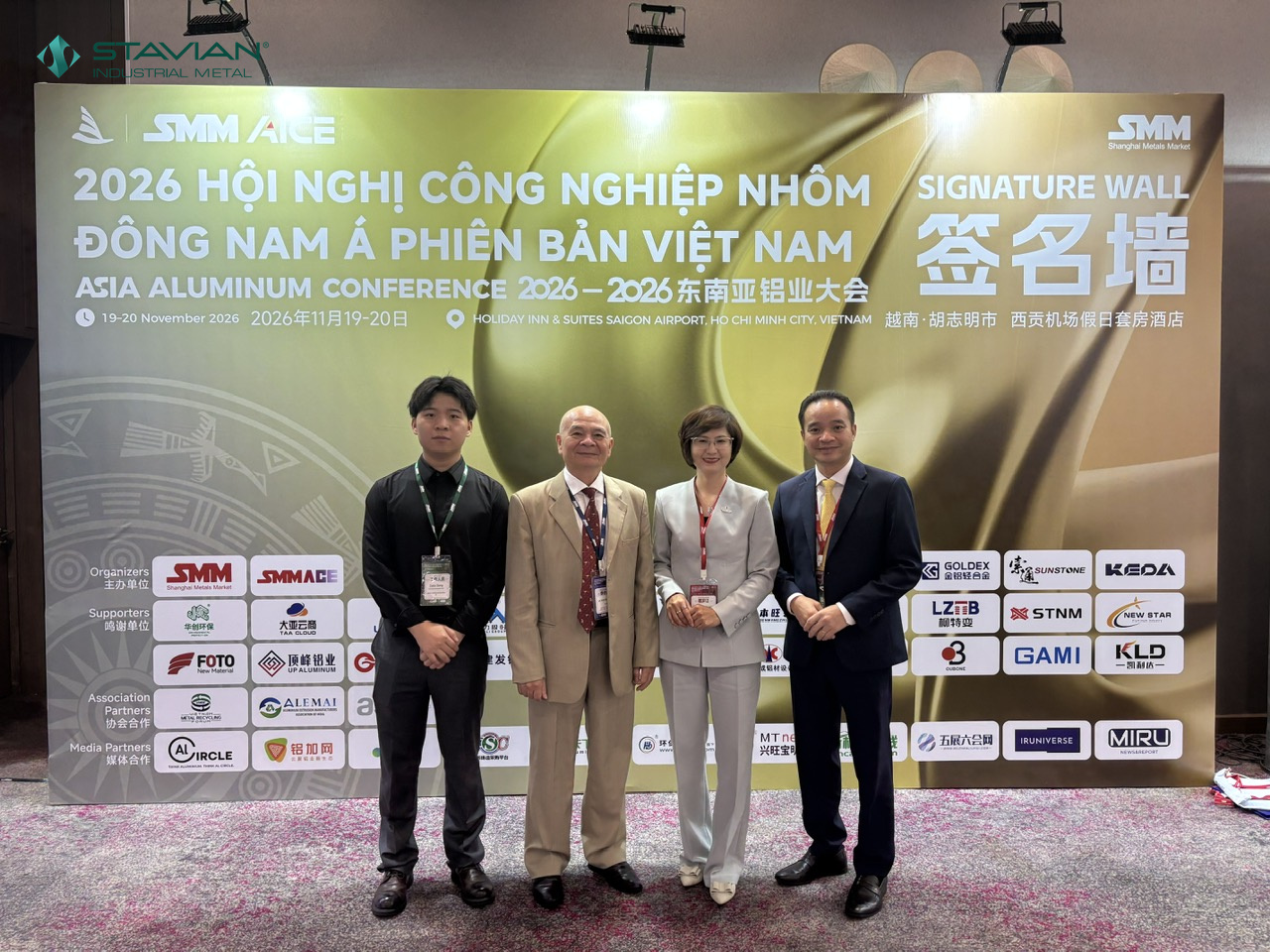
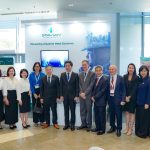
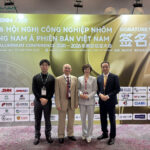
Ms. Vu Thi Xoan, Development Strategy Director of Stavian Industrial Metal (second from the right), with other delegates at the conference.
Vietnam’s Aluminum Value Chain in the Face of Green Transition Requirements
The presentation outlined Vietnam’s aluminum value chain, from bauxite mining and alumina production to electrolytic aluminum smelting, forming, and downstream manufacturing. With estimated bauxite reserves of approximately 3.1 billion tonnes, equivalent to nearly 11% of global reserves, Vietnam has a significant advantage in terms of raw material resources. However, its deep-processing capacity and alumina and primary aluminum production scale remain limited relative to its resource potential.
Within this value chain, electrolytic aluminum smelting plays a strategic role in converting resource advantages into higher-value products and enhancing supply autonomy for downstream manufacturing industries. At the same time, this stage directly affects a product’s carbon footprint due to its high electricity consumption.
Alongside market demand and advantages arising from free trade agreements, the aluminum industry is increasingly affected by the European Union’s Carbon Border Adjustment Mechanism (CBAM) and Vietnam’s carbon market development roadmap. CBAM’s requirements for emissions measurement, reporting, and data transparency pose significant challenges for aluminum exporters. Meanwhile, low-emission aluminum has greater opportunities to become more deeply integrated into green supply chains, particularly in the automotive, energy, and mechanical engineering sectors.
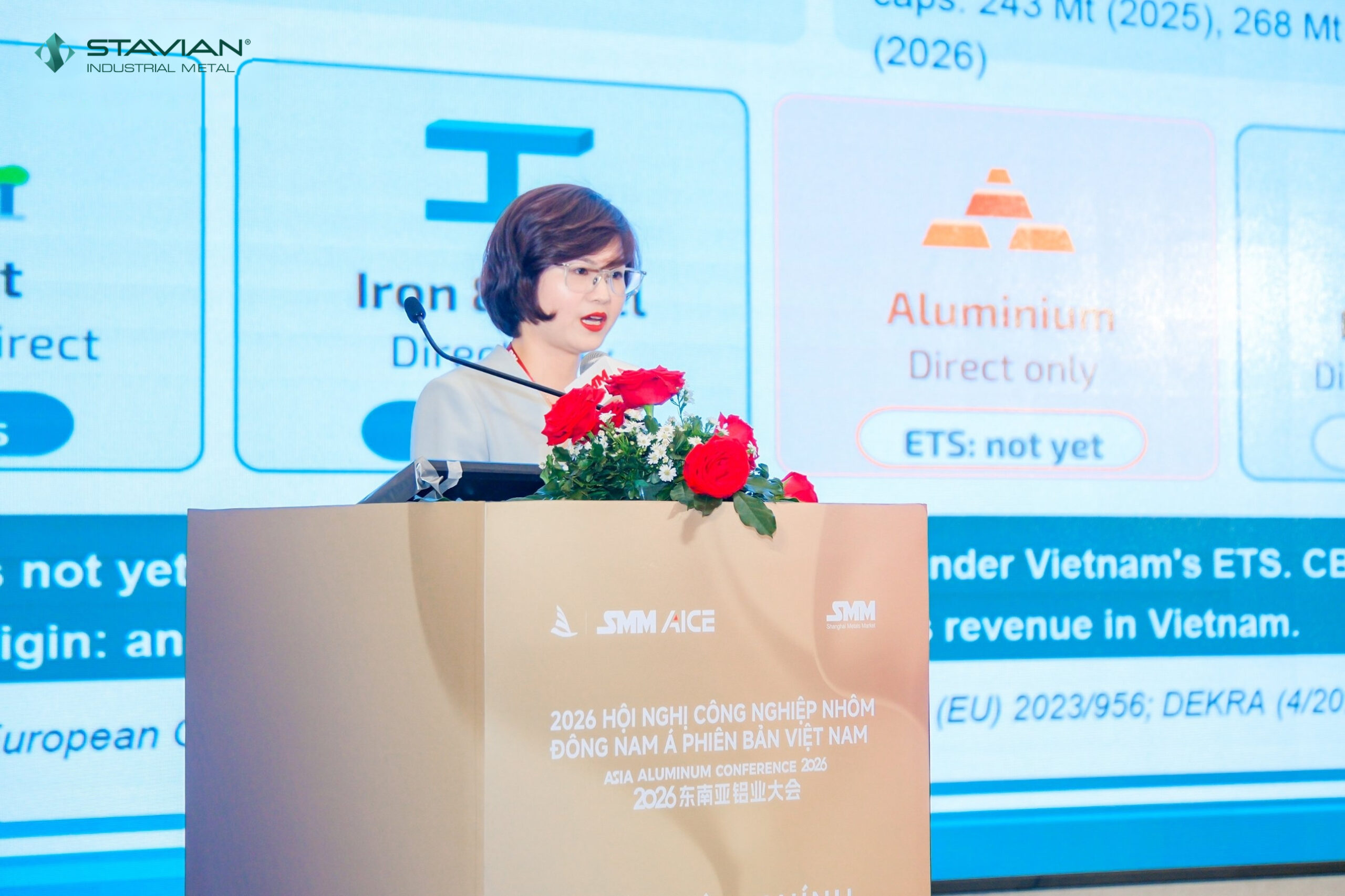
Ms. Vu Thi Xoan, Development Strategy Director of Stavian Industrial Metal, presenting at the conference.
The green transition also faces a range of challenges, including the emissions intensity of the electricity grid, the risk of being locked into high-emission technologies, dependence on input materials, inadequate clean-energy and logistics infrastructure, and limitations in emissions data and businesses’ implementation capacity. In particular, the lack of verified product carbon footprint (PCF) data may force companies to use default emissions values, increasing costs and weakening their competitiveness in markets with stringent requirements.
Accordingly, the paper recommended prioritizing the improvement of emissions measurement, reporting, and verification (MRV) systems and developing product carbon footprint (PCF) data as a foundation for the green transition. Other coordinated solutions include promoting clean energy through direct power purchase agreements (DPPA) and rooftop solar; strengthening recycling and scrap sorting by alloy grade; adopting sustainability standards and certifications such as ASI; developing low-carbon aluminum contracts; and mobilizing green finance.
Stavian Industrial Metal Develops Comprehensive Solutions Across the Industrial Metals Value Chain
At the conference, Stavian Industrial Metal introduced its comprehensive solutions model for industrial metals, covering steel, aluminum, copper, and zinc. The model integrates trading, distribution, processing, and investment activities, providing raw material supplies, offtake solutions, and financing support across the value chain—from mining and smelting to processing and manufacturing. The company also develops emissions-reduction solutions and carbon credits, contributing to more sustainable supply chains.
In the aluminum sector, Stavian Industrial Metal was the distributor of Vietnam’s first batch of aluminum ingots produced by the Dak Nong Aluminum Electrolysis Plant (Tran Hong Quan Metallurgy Co., Ltd.) in July 2026. The company also aims to develop a portfolio of green aluminum products with an emissions intensity of below 4 tCO2e per tonne.
Under its development strategy through 2030, Stavian Industrial Metal aims to become Southeast Asia’s No. 1 company in green metals trading and carbon credit services, while ranking among the world’s Top 10 in industrial metals processing and trading.
Through its participation in the conference, Stavian Industrial Metal continued to contribute business perspectives on the green transition of Vietnam’s aluminum value chain while promoting connections and developing industrial metal materials and service solutions that meet requirements for quality, data transparency, and sustainable development.
Address
Website: https://stavianmetal.com
Email: info@stavianmetal.com